


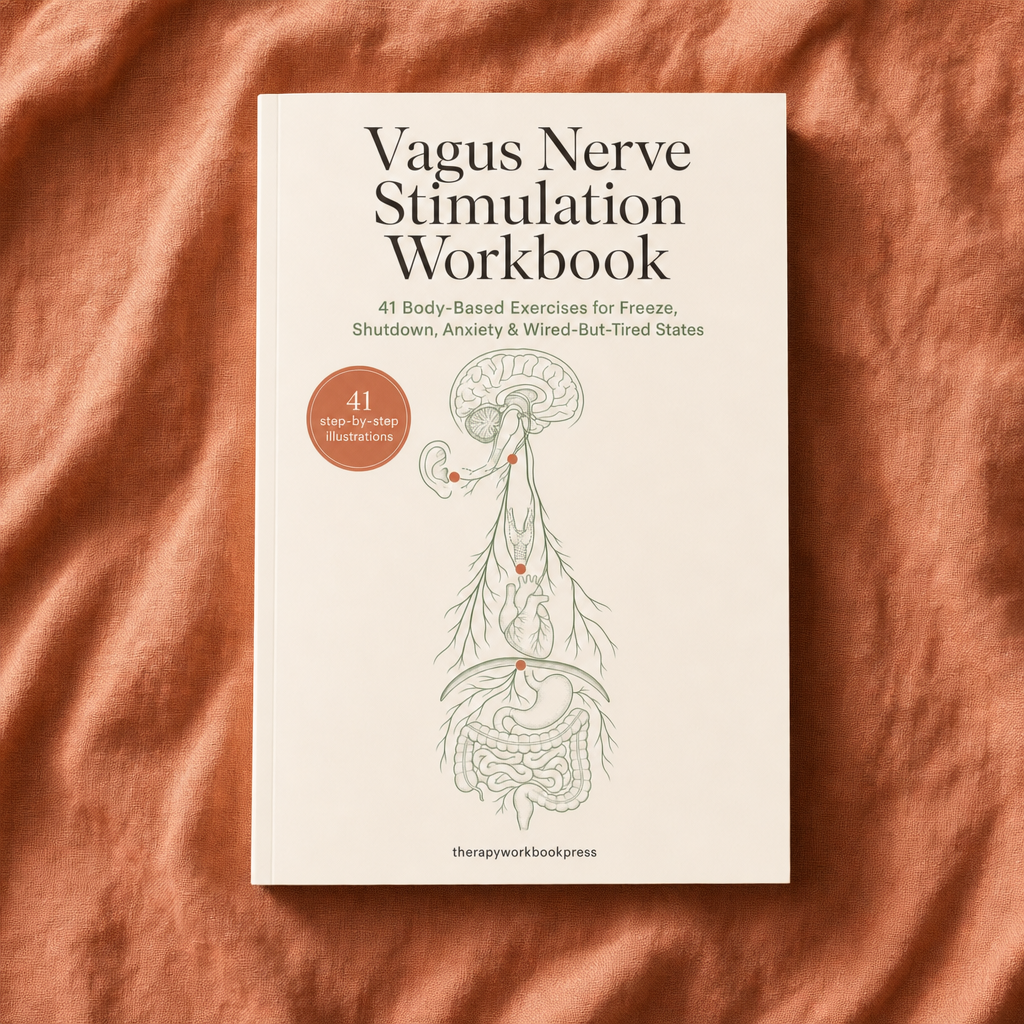














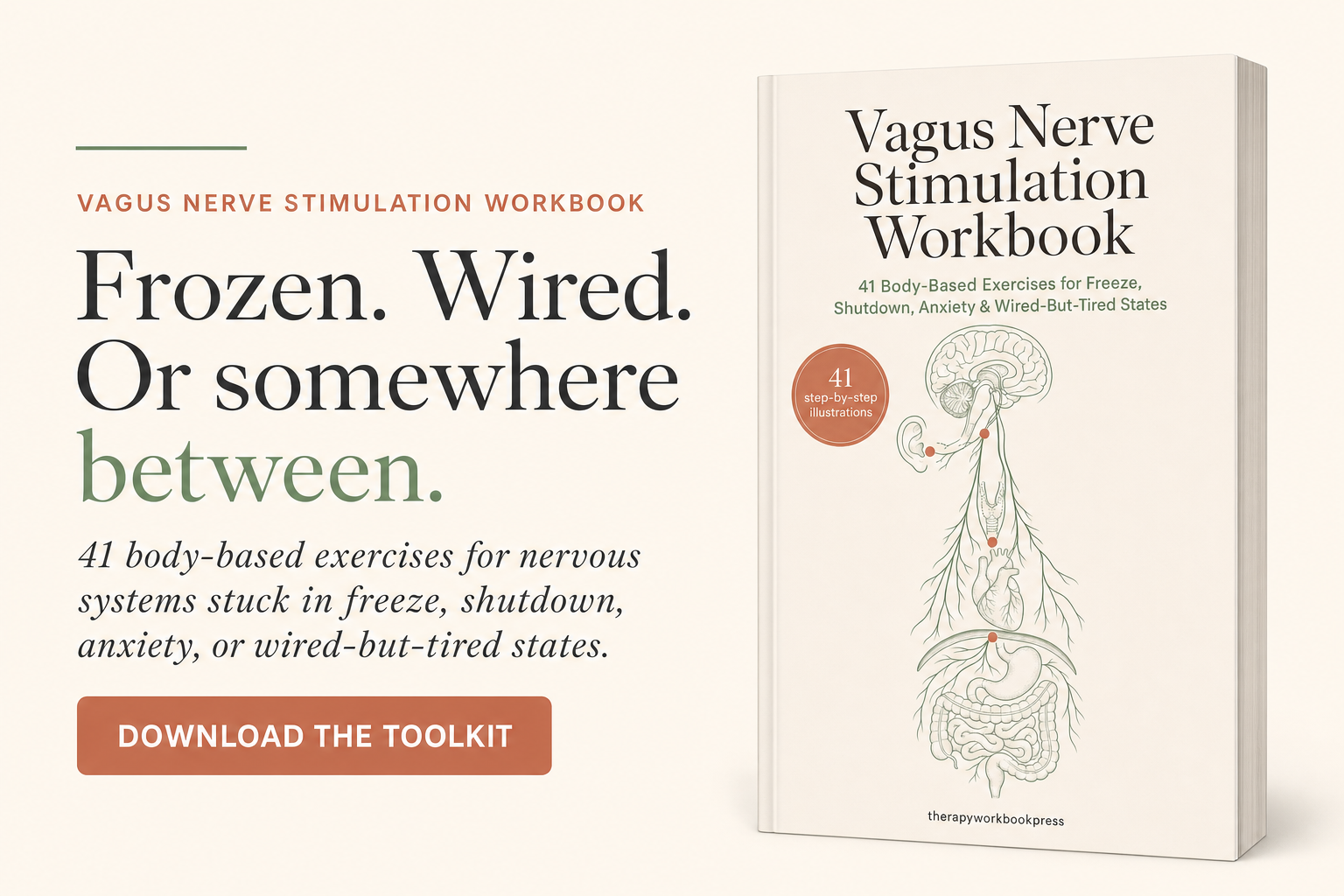

Vagus Nerve Stimulation Workbook: 41 Body-Based Exercises for Freeze, Shutdown, Anxiety & Wired-But-Tired States
$29.49$59.00
✨ INSTANT DIGITAL DOWNLOAD: A link will be sent to your email immediately. Safe to open on your phone now or save to your computer for later.
🚀 Lifetime Access + Free Future Updates: Buy once, own it forever. You’ll receive all future versions, new content, and updated resources for free, delivered straight to your inbox.
If your nervous system has been stuck somewhere it shouldn't be — frozen, wired-but-exhausted, anxious, hollow, dissociated, hypervigilant, or just not where you left it — this workbook hands you 41 ways back, anchored to the one nerve that controls all of them.
The mechanism most self-help skips
Your vagus nerve is the master switch between "fight or flight" and "rest and digest." It runs from your brainstem down through your face, throat, heart, lungs, and gut — and it processes danger and safety signals roughly 0.3 seconds before your thinking brain knows what's happening.
This is why insight alone rarely shifts a stuck nervous system. The brainstem decides first. The cortex catches up. By the time you're trying to "calm down" with thoughts, the body has already chosen a state.
The 41 practices in this workbook bypass that lag. Each one is a direct, body-based input to the vagal pathway — breath, sound, movement, temperature, pressure, eye position — that the nervous system reads as a safety cue and responds to in seconds.
Start with the map, not the technique
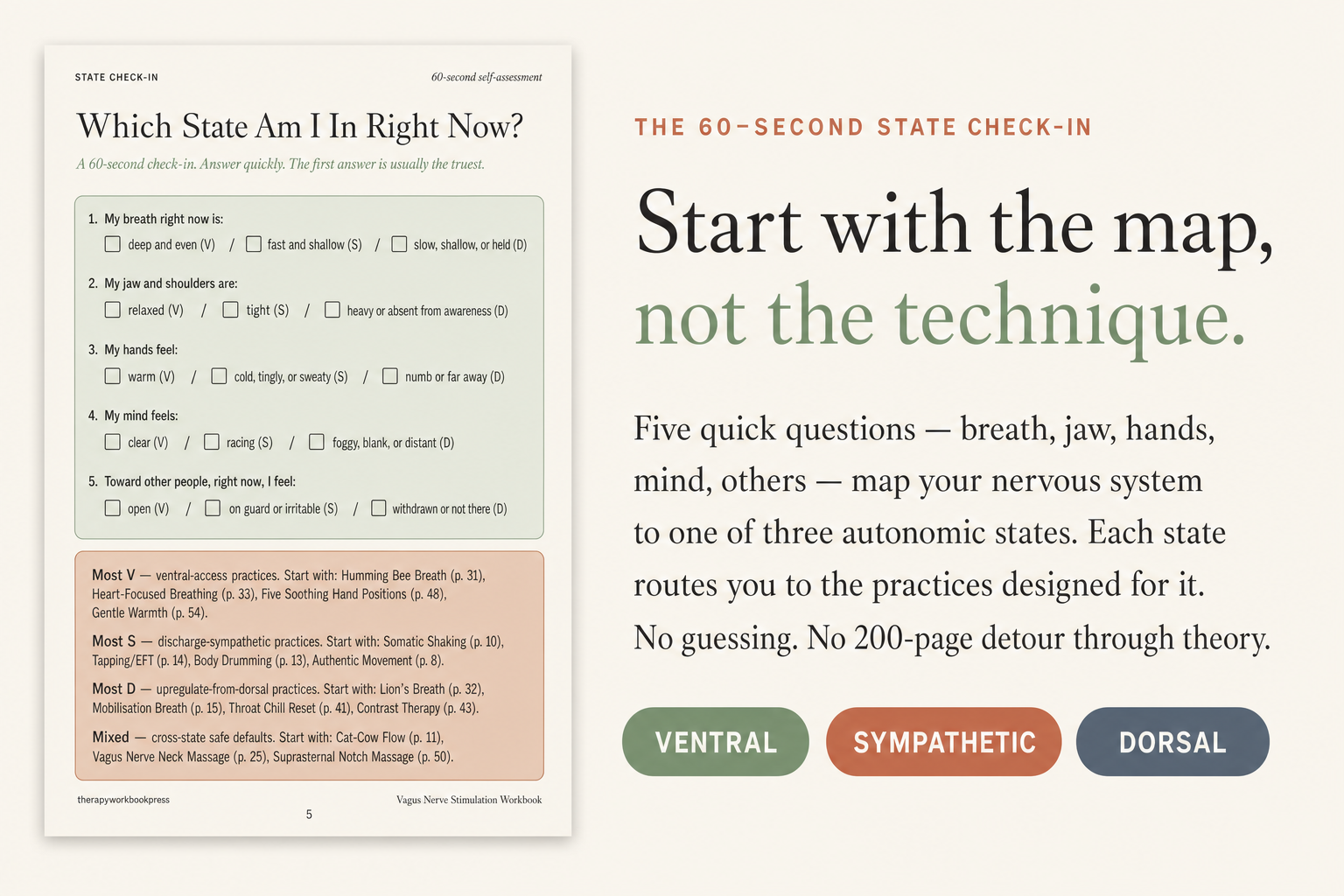
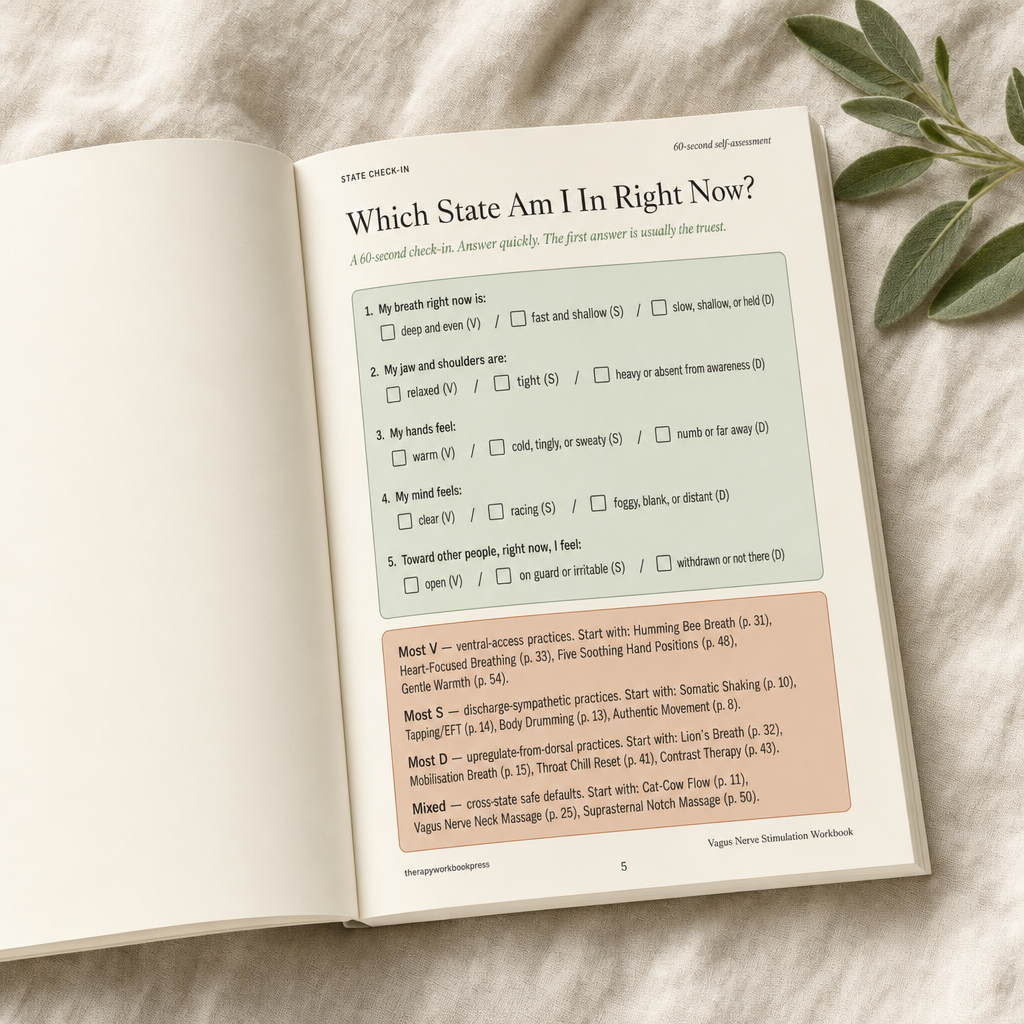
Most somatic resources hand you 50 exercises and let you guess. This workbook opens with a 60-second state check-in — five quick questions about your breath, jaw, hands, mind, and orientation to people — that maps your current state to one of three autonomic positions:
- Ventral — connected, calm, capable. Practices here deepen and stabilise the state.
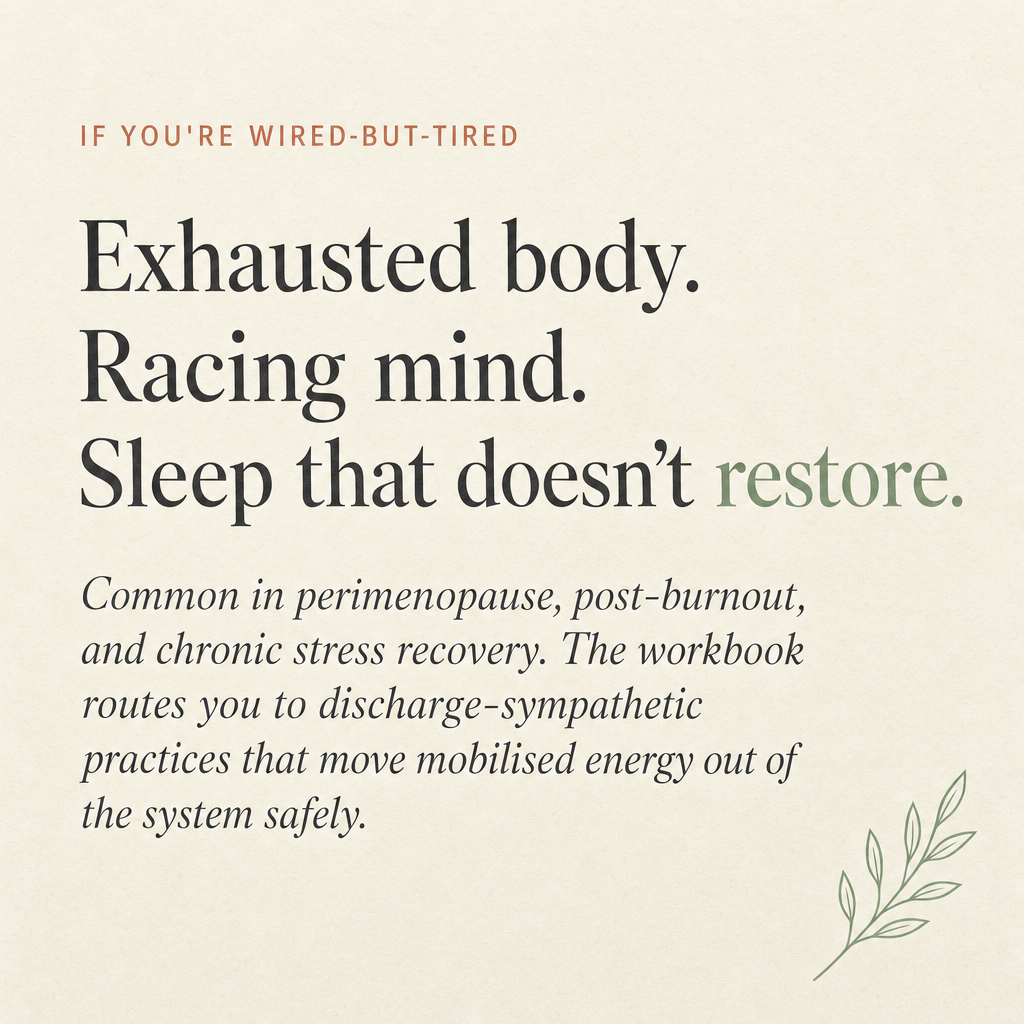
- Sympathetic — wired, anxious, irritable, racing. Practices here discharge mobilised energy safely.
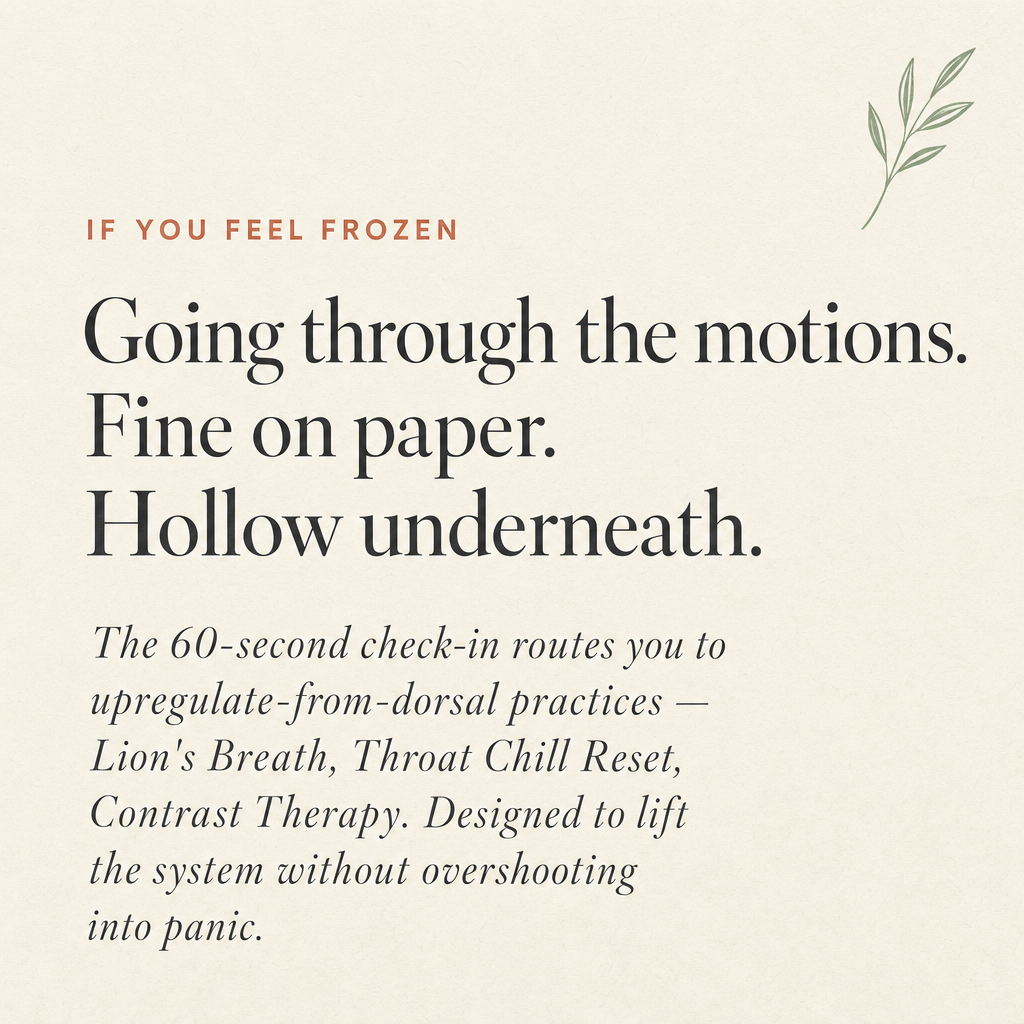
- Dorsal — shut down, foggy, withdrawn, numb. Practices here gently upregulate without overshooting.
The check-in routes you straight to the four or five practices that fit your nervous system in this moment. No trial-and-error. No 200-page detour through theory. The map is on page 5.
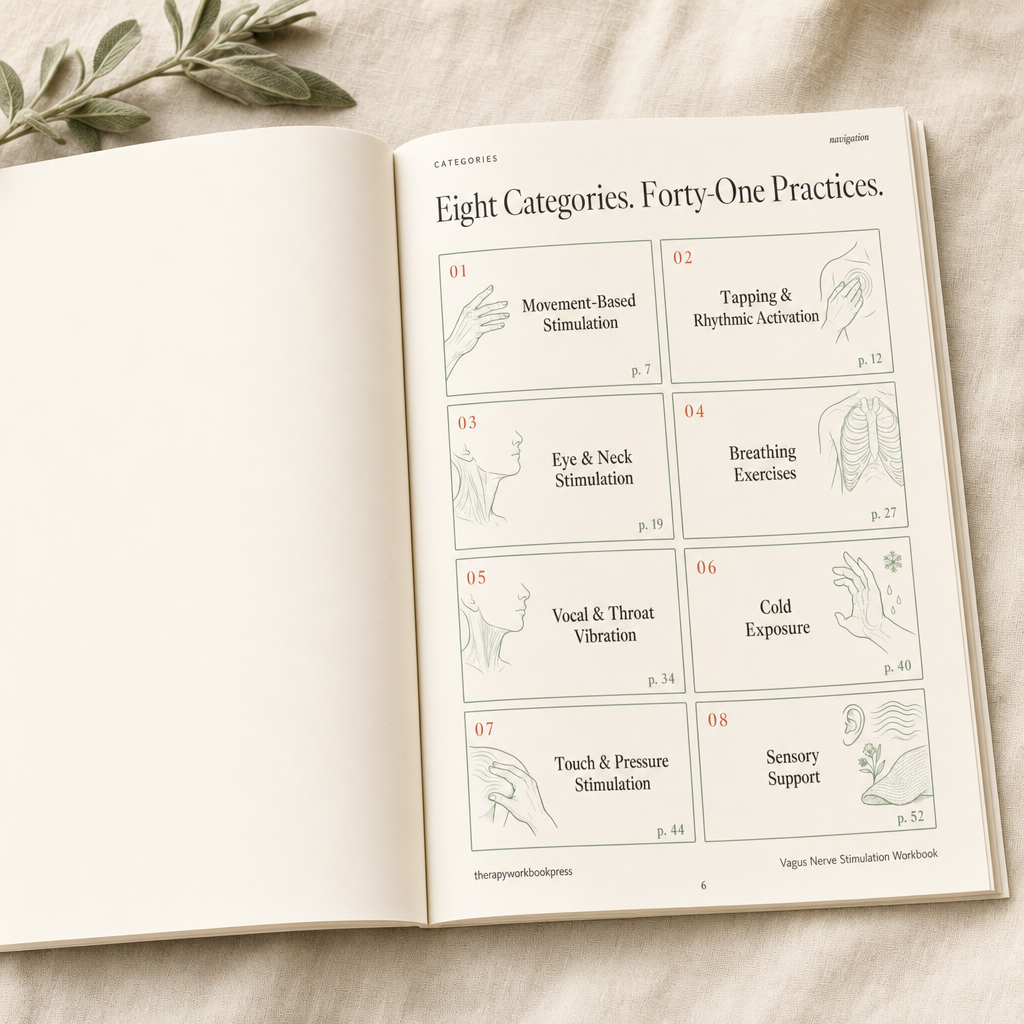
Eight categories. Forty-one practices. One page each.
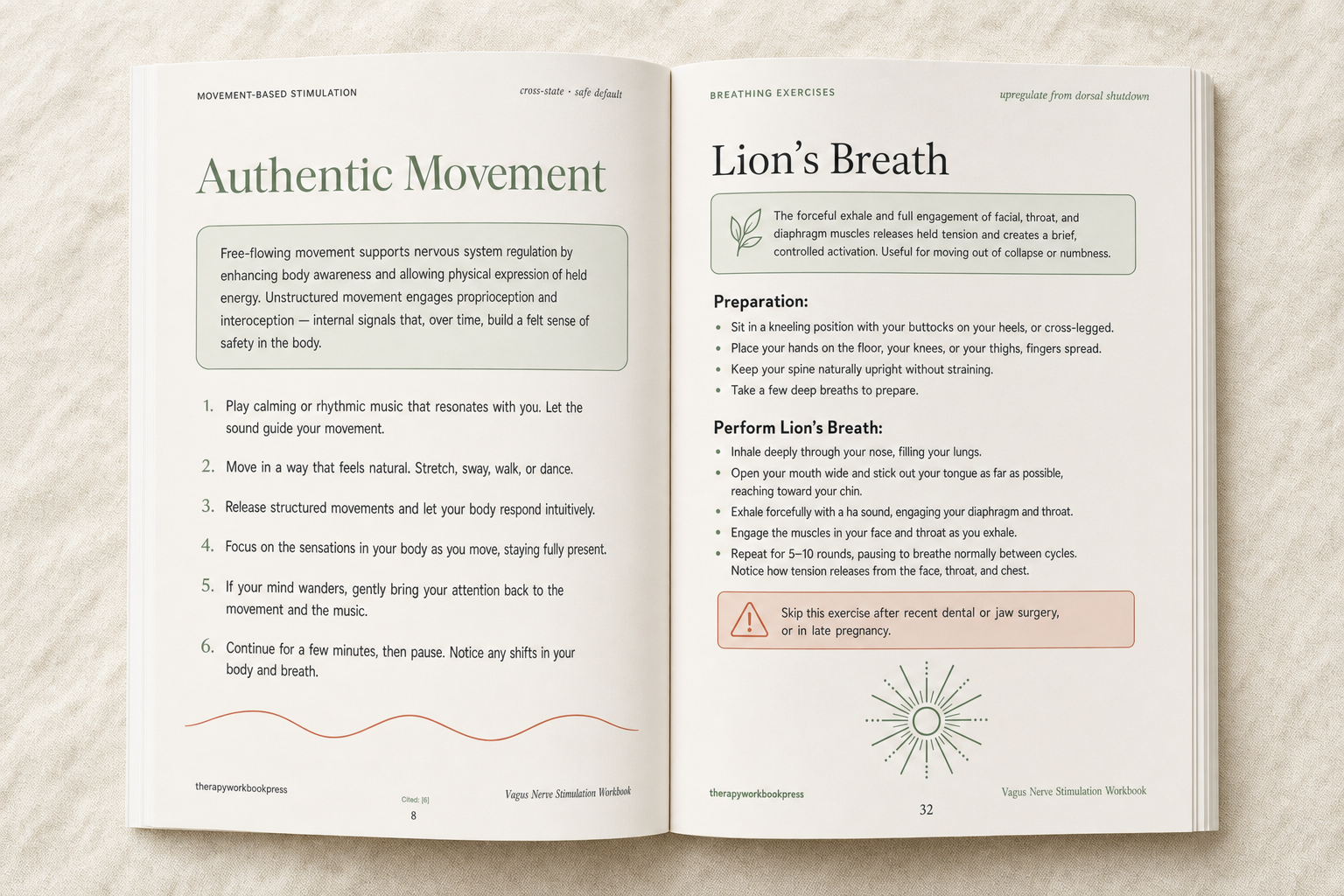
Every practice is on a single page, with the mechanism, the instructions, and the safety considerations together. Flip to whichever fits the moment. No required order.
- 01 — Movement-Based Stimulation: Authentic Movement, Somatic Shaking, Cat-Cow Flow, Body Drumming, and others. For energy that's stuck or stored and needs to move.
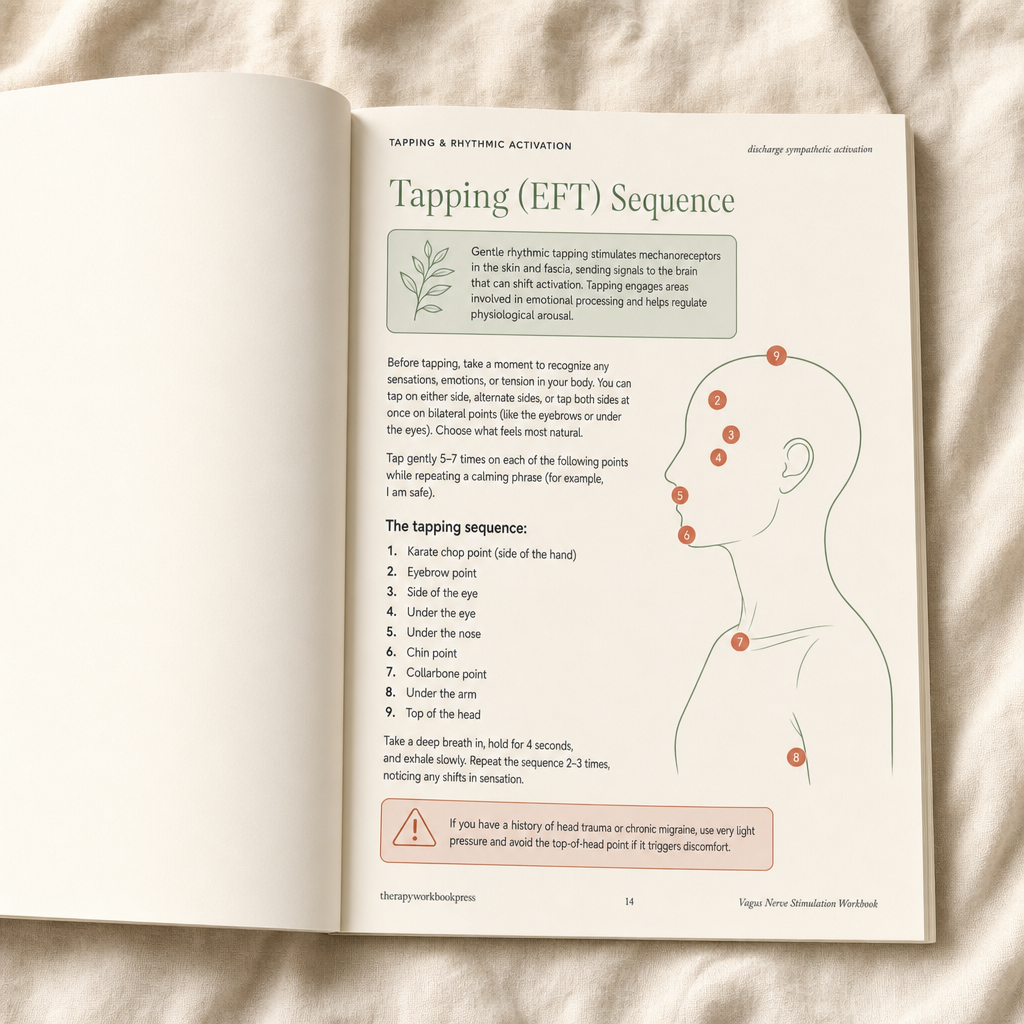
- 02 — Tapping & Rhythmic Activation: EFT-Style Tapping, Bilateral Hand Tapping, Pendulum Self-Hug. Right-left rhythmic input for systems caught in alarm.
- 03 — Eye & Neck Stimulation: Basic Exercise (Stanley Rosenberg), Vagus Nerve Neck Massage, Suprasternal Notch Release. Direct input to the cervical branches of the vagus.
- 04 — Breathing Exercises: 4-4-6-2 Breath, Buteyko, Alternate Nostril, Lion's Breath, Mobilisation Breath, Humming Bee Breath. Different breaths for different states — not "just breathe."
- 05 — Vocal & Throat Vibration: "Vooo" Toning, Humming, Throat Chill Reset. Internal vibration that engages the recurrent laryngeal branch and softens the amygdala.
- 06 — Cold Exposure: Cold Water Reset, Contrast Therapy, structured protocols for using temperature as a controlled nervous-system stimulus — not a shock.
- 07 — Touch & Pressure Stimulation: Five Soothing Hand Positions, Heart-Focused Holding, weighted and pressure-based interoceptive cues.
- 08 — Sensory Support: Texture Exploration, Sound Mapping, Aroma Anchors. Practices to interrupt dissociation loops and rebuild felt safety.
Built on the canon — not the algorithm
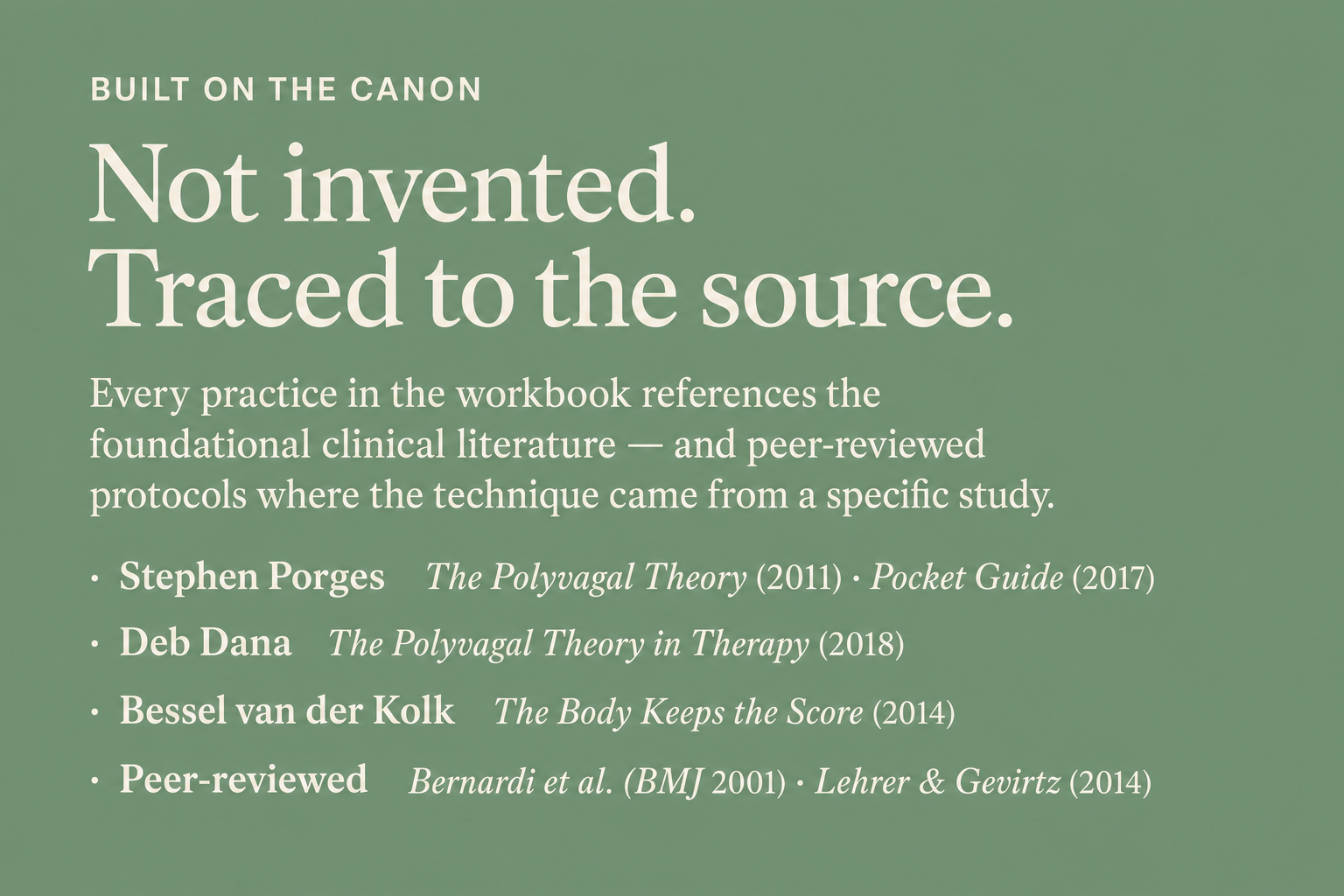
The framework draws on the foundational clinical literature: Stephen Porges (The Polyvagal Theory, 2011; The Pocket Guide to Polyvagal Theory, 2017), Deb Dana (The Polyvagal Theory in Therapy, 2018), and Bessel van der Kolk (The Body Keeps the Score, 2014). Specific protocols cite peer-reviewed sources including Bernardi et al. (BMJ, 2001) on respiratory rhythms, Lehrer & Gevirtz (Frontiers in Psychology, 2014) on heart rate variability, and Schauer & Elbert (2010) on dissociation. Every practice has a traceable mechanism. Nothing here is invented.
Who this workbook is for
This is a map-before-technique resource. It's not a symptom-specific protocol — it's a state-specific one. That makes it useful for anyone whose nervous system runs hotter, colder, or more erratically than they'd like:
- People in functional freeze — going through the motions, fine on paper, hollow underneath.
- People in wired-but-tired states — exhausted body, racing mind, sleep that doesn't restore. Common in perimenopause, post-burnout, and chronic stress recovery.
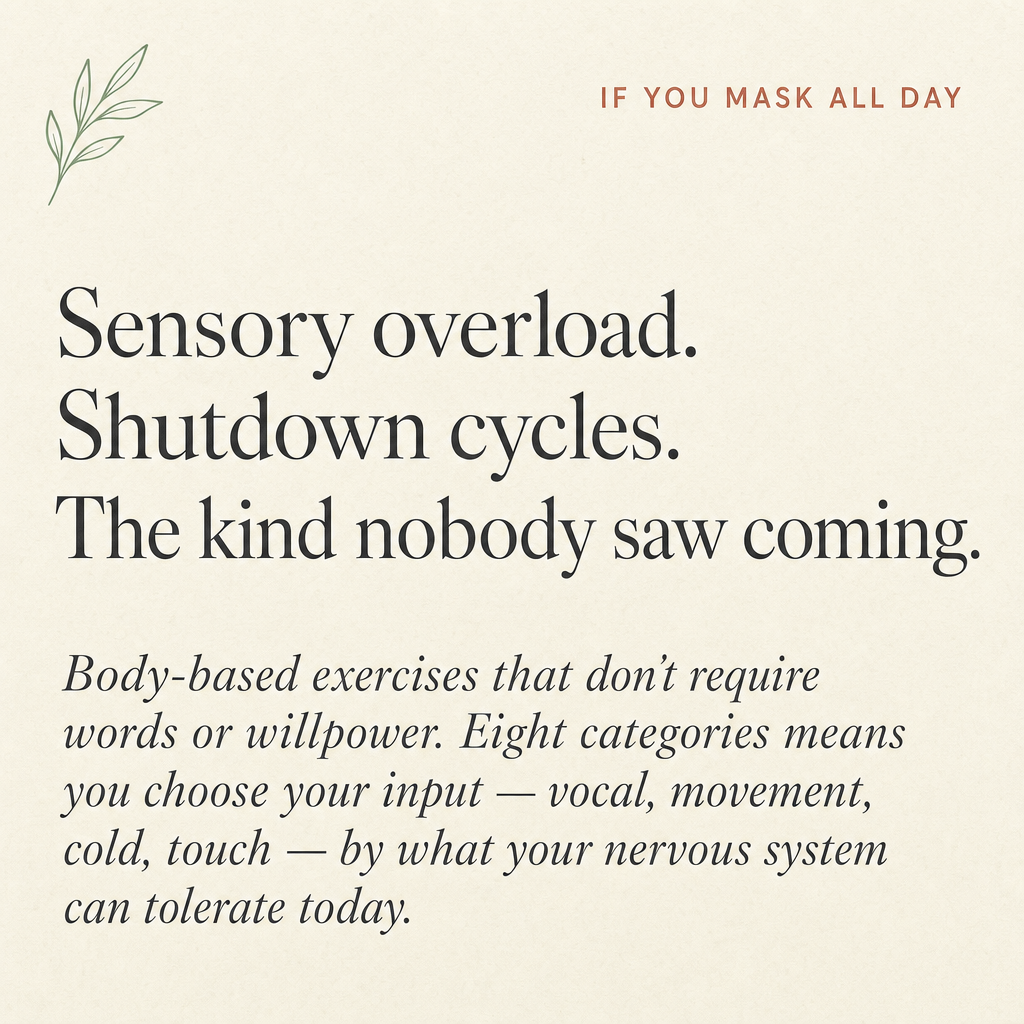
- Late-diagnosed neurodivergent adults processing sensory overload, masking exhaustion, and shutdown cycles.
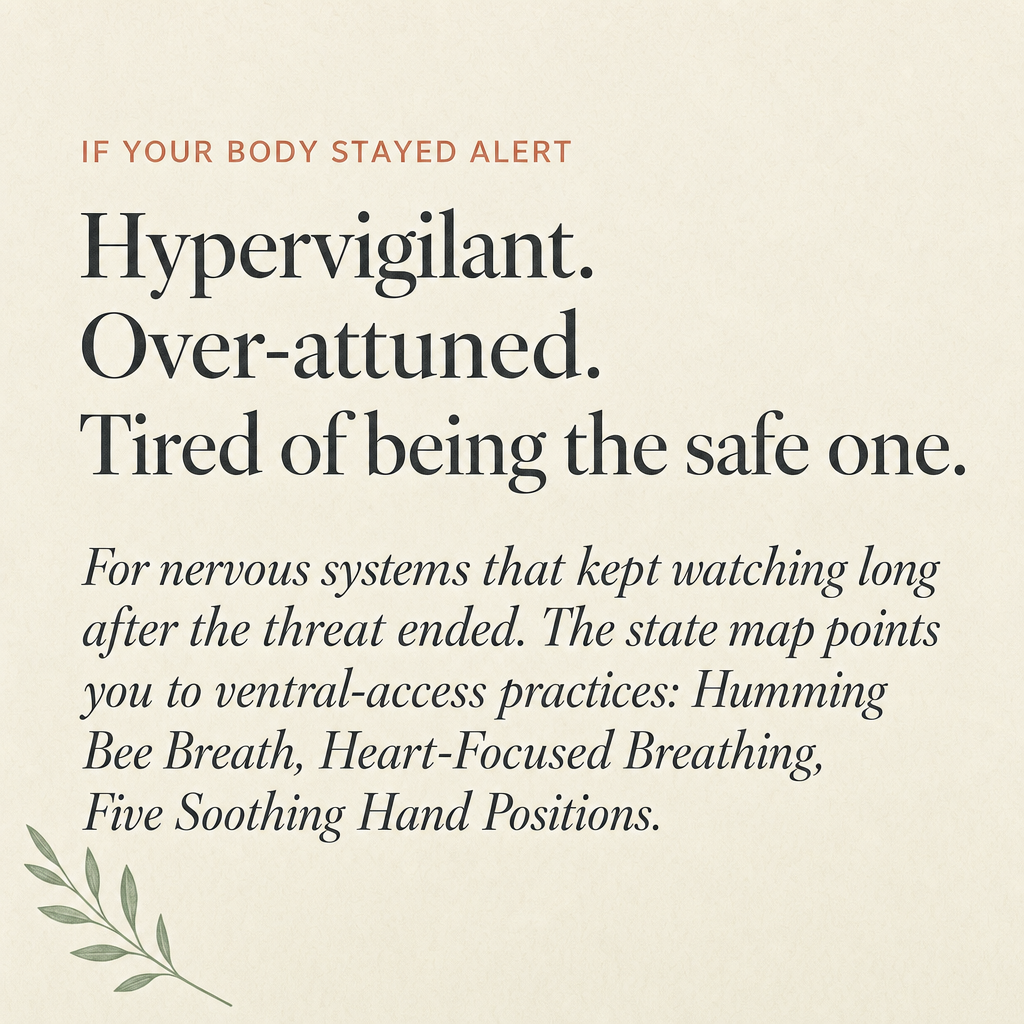
- People recovering from complex or developmental trauma, including fawn-response and people-pleasing patterns where the body stayed alert long after the threat ended.
- Parents learning co-regulation — practices you can use alongside a child, not at them.
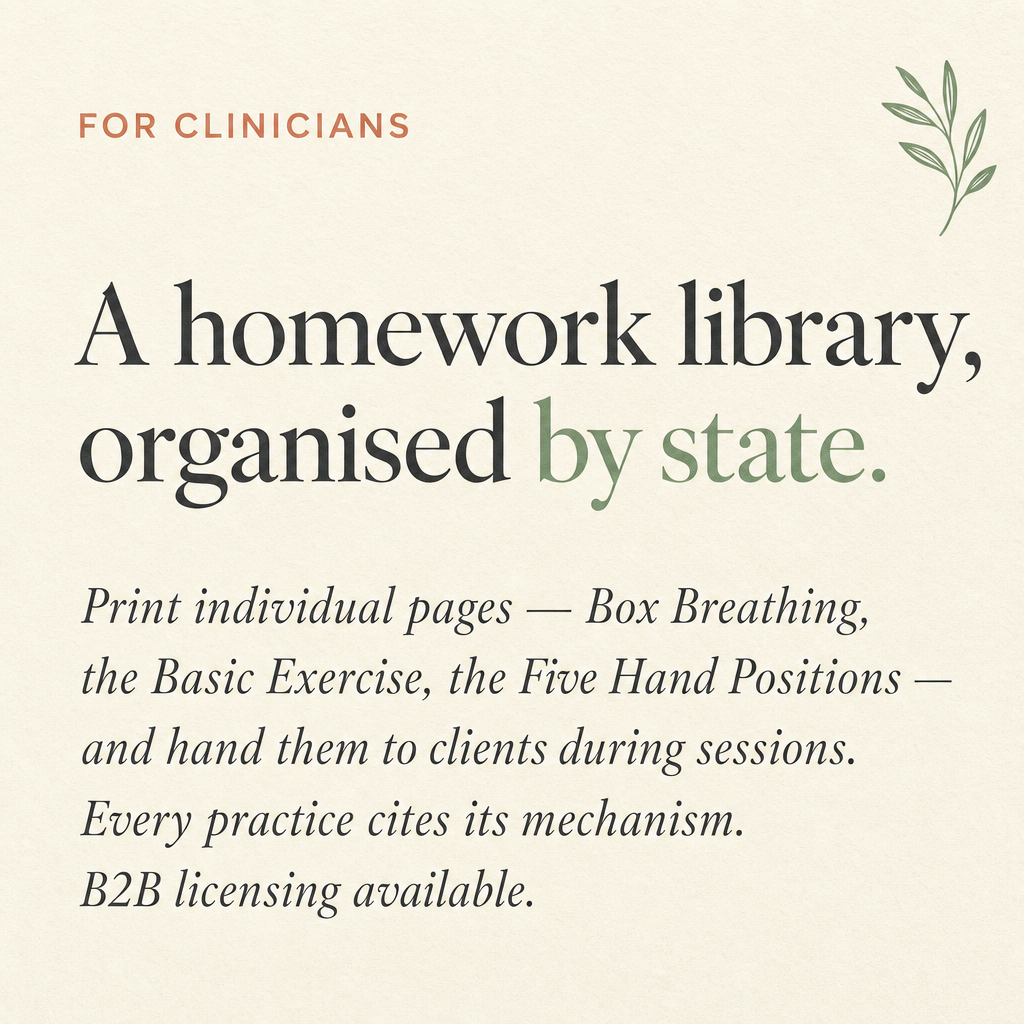
- Clinicians — a library of homework assignments organised by state. Print individual pages (Box Breathing, the Basic Exercise, Five Soothing Hand Positions) and hand them to clients during sessions. B2B licensing available on request.
What you receive
- 60-page digital PDF workbook — A4 and US Letter format. Printable, tablet-friendly, returnable to often.
- 41 step-by-step illustrated practices, each on a single page with mechanism and safety notes.
- The 60-second State Check-In — your routing tool, used as often as needed.
- Lifetime access and free future updates — buy once, own forever. Every revised edition and new release in this series is delivered straight to your inbox at no additional cost.
- Instant download — delivery link arrives on your confirmation page and by email within seconds of checkout.
Format: Digital PDF Workbook (A4 & US Letter). 60 pages. Printable and tablet-friendly. No physical item shipped.