





















Chronic Pain & Nervous System Tracker — 10-Page Polyvagal Workbook (PDF)
$21.00$32.00
✨ INSTANT DIGITAL DOWNLOAD: A link will be sent to your email immediately. Safe to open on your phone now or save to your computer for later.
🚀 Lifetime Access + Free Future Updates: Buy once, own it forever. You’ll receive all future versions, new content, and updated resources for free, delivered straight to your inbox.
✨ Instant digital download. A link will be emailed to you within 60 seconds. Open it on your phone now, or save it to your computer for later.
💕 Lifetime access + free future updates. Buy once, own it forever. New pages and revised versions arrive in your inbox automatically — no second purchase required.
Track your pain. Map your nervous system. Walk in with both.
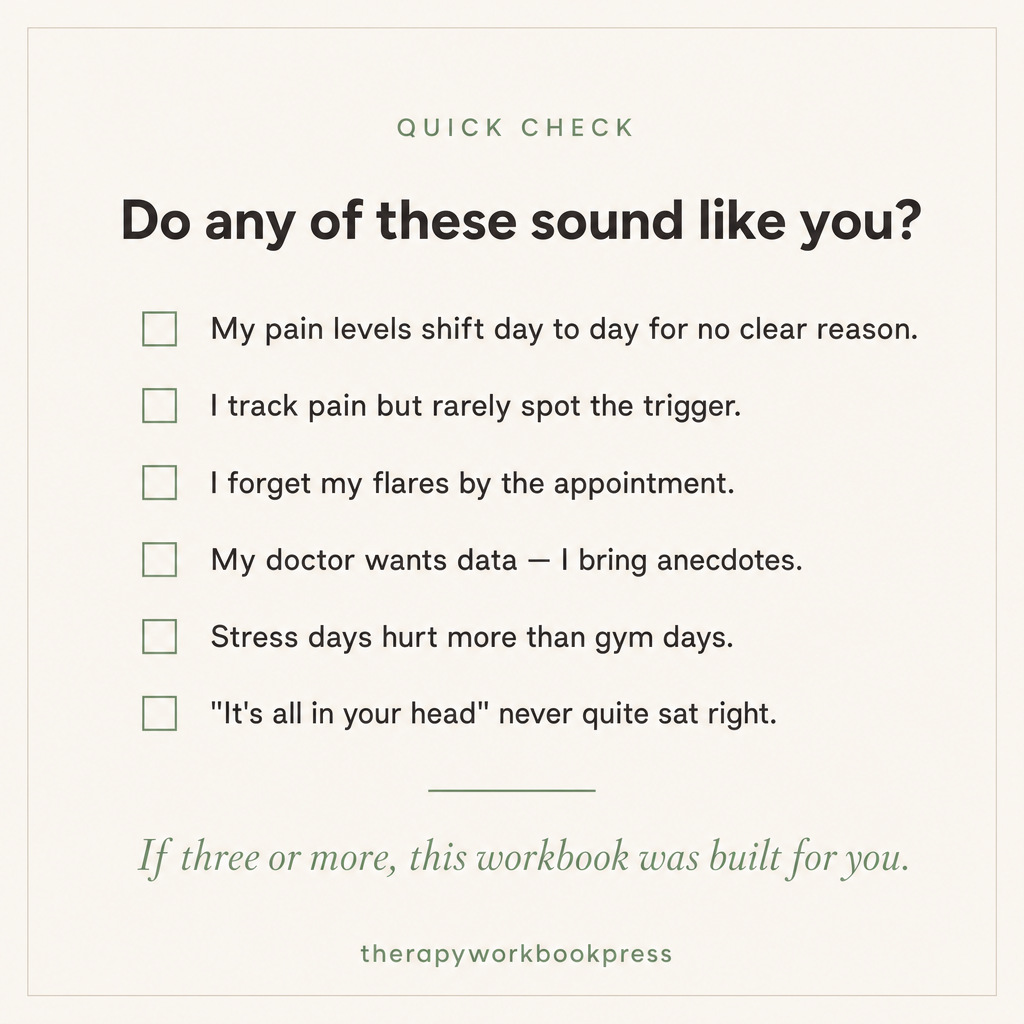
Most chronic pain trackers ask you to rate pain 1–10 and call it done. That's not enough — and your body has been trying to tell you why.
Pain isn't purely mechanical. It rises and falls with sleep, stress, hormones, and the state your autonomic nervous system was in when the flare started. Which is why your worst pain days often follow your most overwhelming weeks, not your most physically demanding ones — and why the "same" injury hurts a 6 one Tuesday and a 9 the next.
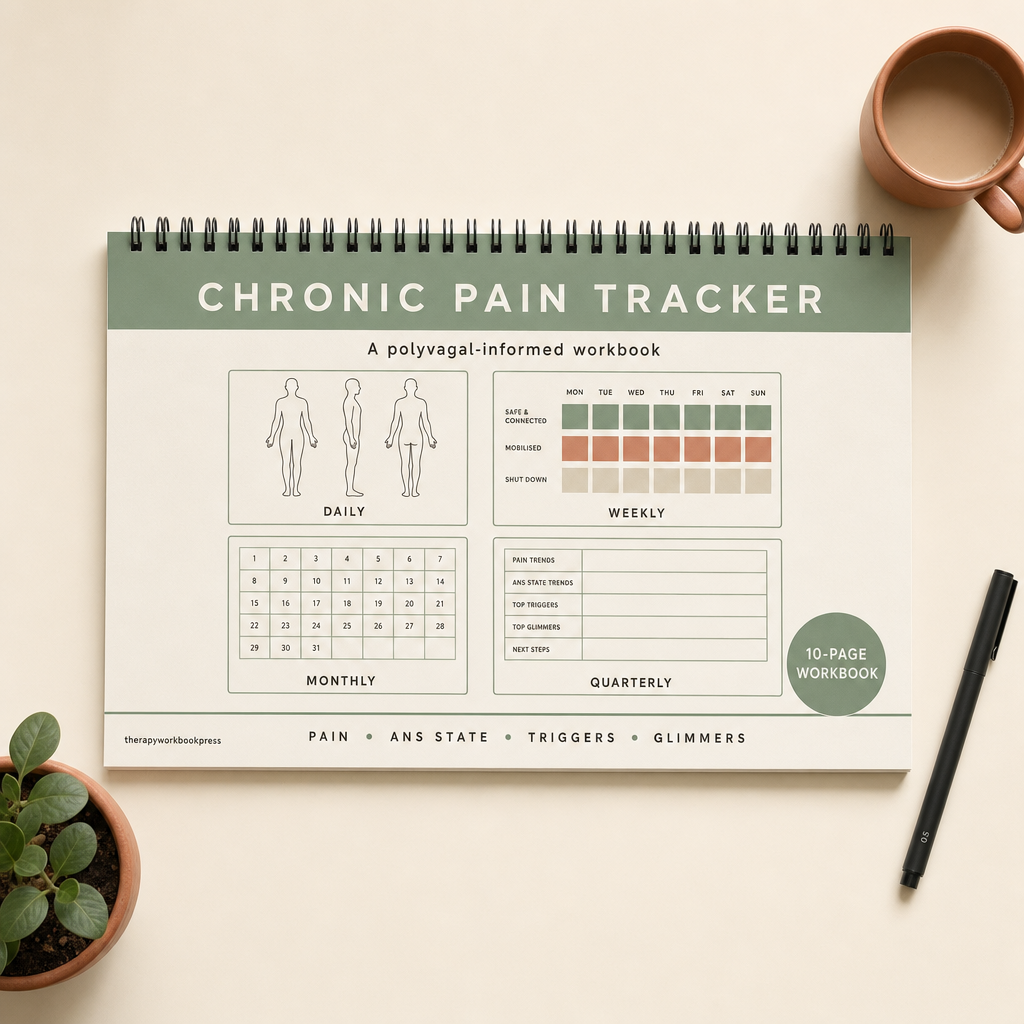
This 10-page polyvagal-informed workbook tracks both layers at once: the physical pain, and the nervous-system state running underneath it. So when you walk into a 15-minute appointment, you don't walk in with approximations. You walk in with patterns.
What's inside — a 4-layer system
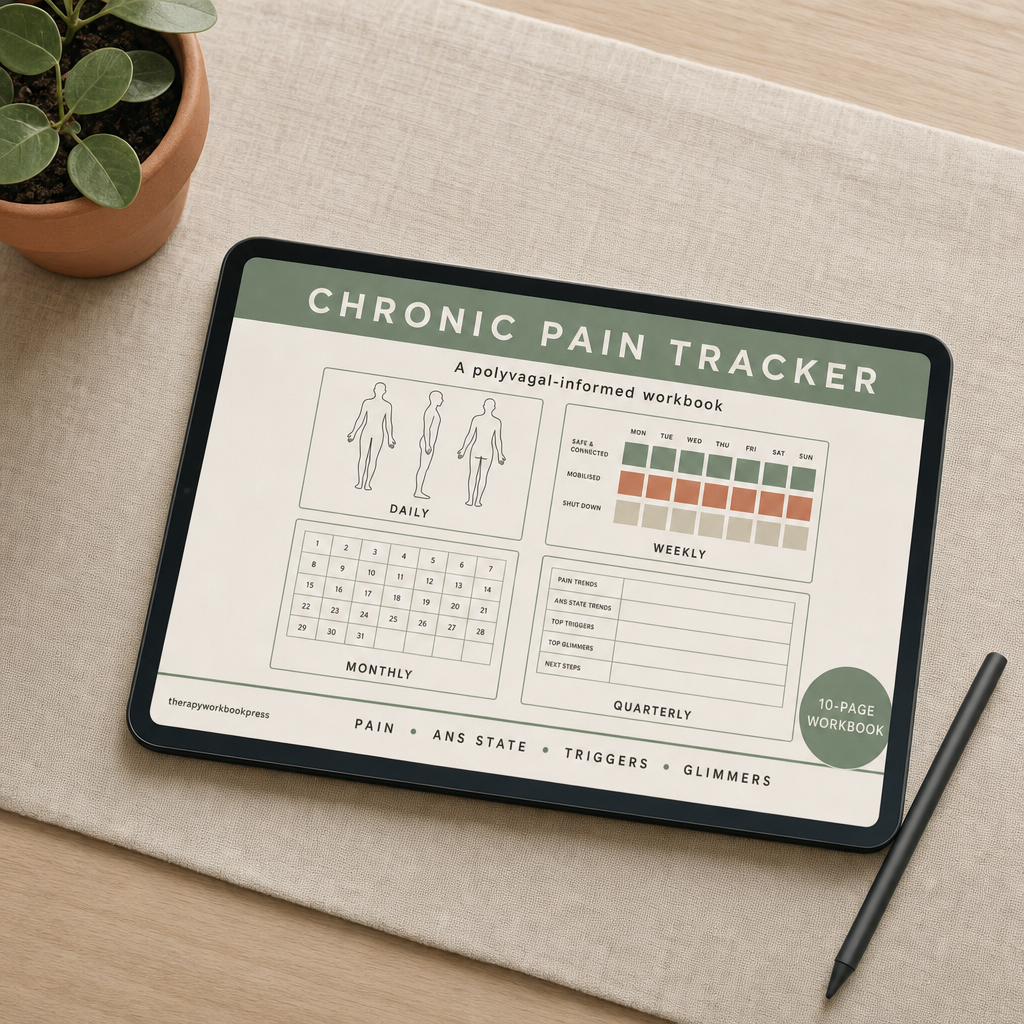
The 10 pages are structured around how chronic illness actually unfolds: minute-to-minute, week to week, month to month, and across the 90 days a specialist needs to see.
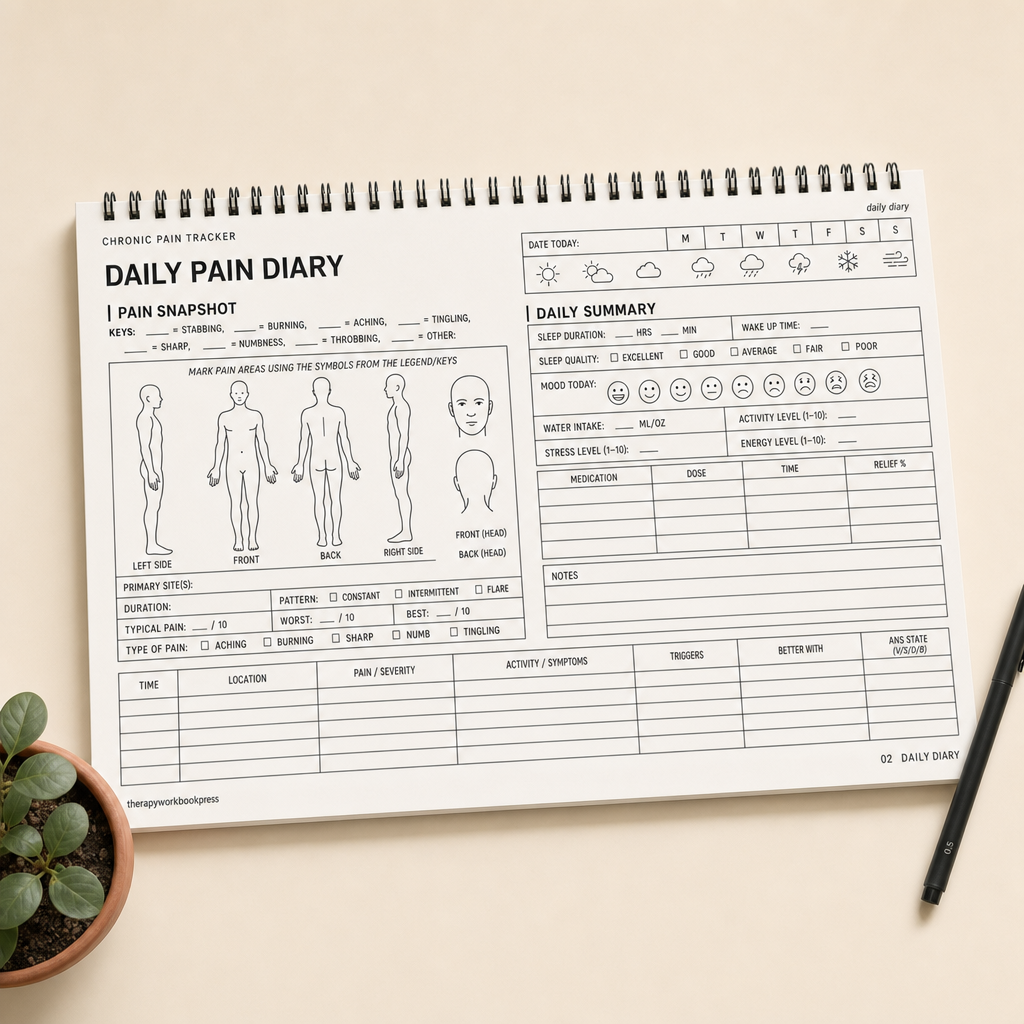
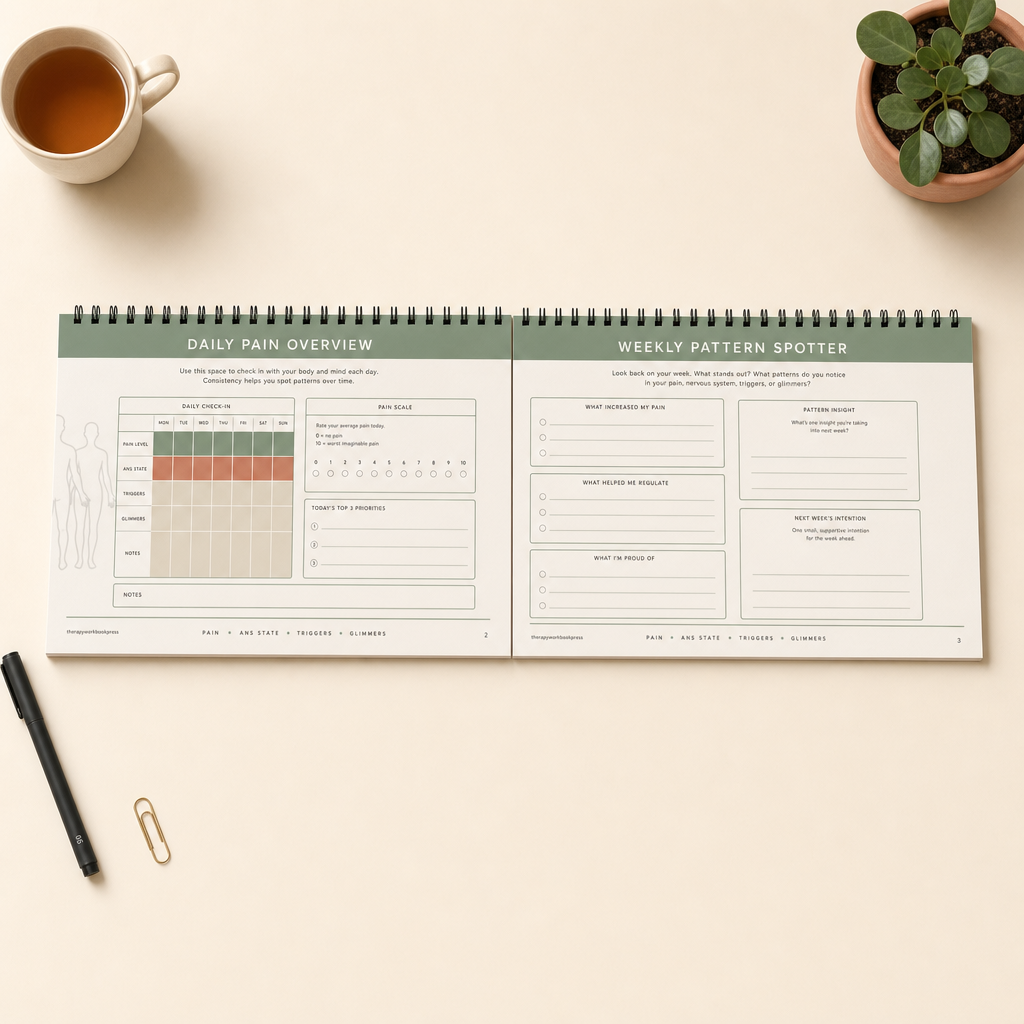
- Daily (pages 2–4) — Pain snapshot with a full-body map (front, back, side, head views), daily summary, regulation practice log, and a trigger + glimmer tracker.
- Weekly (pages 5–6) — Pain summary across the week, plus the Window of Tolerance map — which days were ventral, which were sympathetic, which dropped into dorsal shutdown.
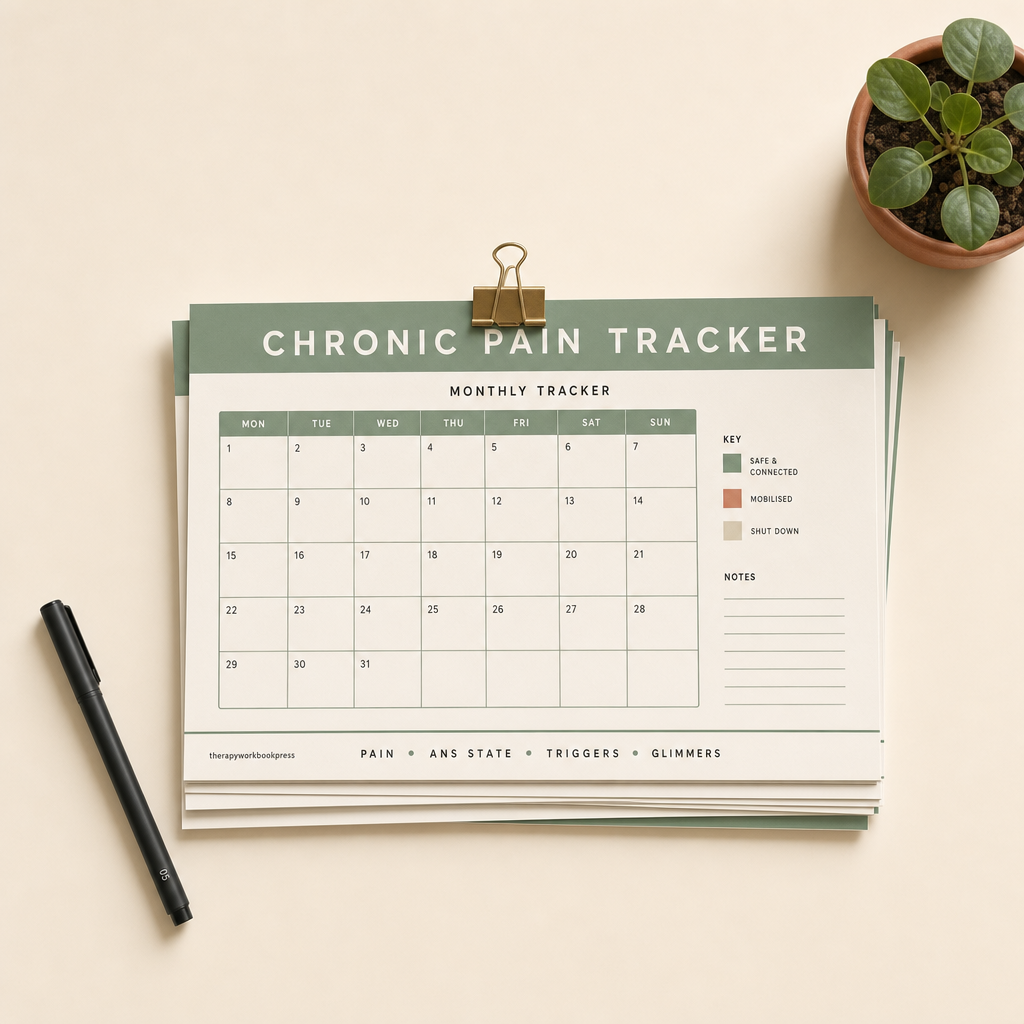
- Monthly (pages 7–9) — A 31-day grid for pain, fatigue, and ANS state, a pattern-insight worksheet, and a hormonal / cycle overlay for perimenopausal and menstrual flares.
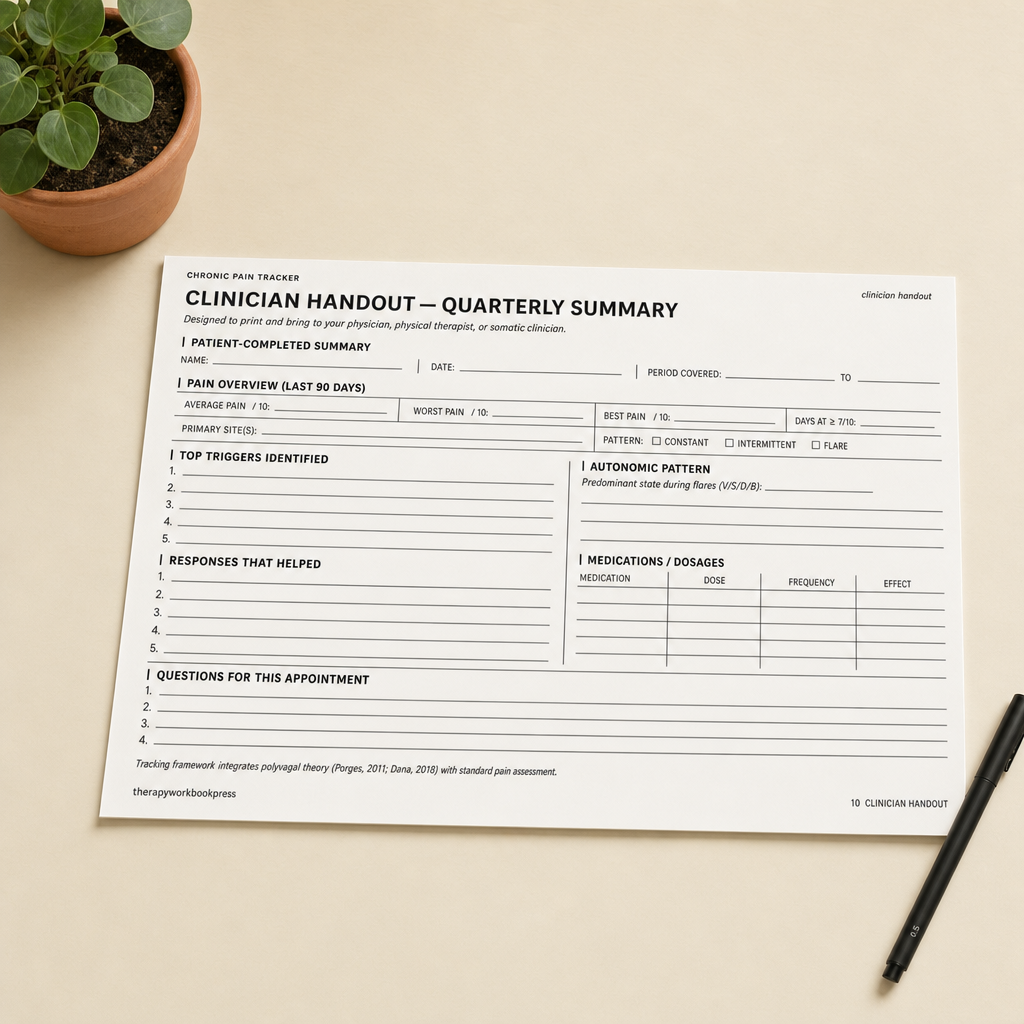
- Quarterly (page 10) — The clinician handout. A one-page printable summary built to hand directly to your doctor, physiotherapist, or somatic clinician at your next appointment.
The page-by-page breakdown
- 01 · How to Use — The four layers explained, plus the ANS state key (V / S / D / B) that runs through every page.
- 02 · Daily Pain Diary — Pain snapshot with seven symbol keys (stabbing, burning, aching, tingling, sharp, numbness, throbbing), a full body map across five views, daily summary fields (sleep, mood, water, activity, stress, energy), medication log, and a time-stamped activity / symptom / trigger table with an ANS-state column.
- 03 · Trigger + Glimmer Log — A 6-category trigger taxonomy (Physical, Postural, Relational, Emotional, Sensory, Hormonal) with state-before / state-after tracking. Plus a dedicated glimmers section for the micro-shifts toward safety that most people miss.
- 04 · Regulation Practices Log — An 8-practice menu (orienting, physiological sigh, vagal humming, weighted pressure, cold water, social engagement, slow exhale breathing, gentle movement) with a daily log to track which ones actually shifted your state and which didn't.
- 05 · Weekly Pain Summary — Day-by-day pain (worst, least, average), ANS state, medications, activities, triggers. Plus a 7-day pain plot and a weekly reflection page.
- 06 · Weekly Window of Tolerance — A 7-day state band that shows which days you spent in ventral, sympathetic, or dorsal. Trigger frequency tally by category. Glimmer count.
- 07 · Monthly Pain Tracker — A 31-day grid covering body area, pain level, fatigue level, and ANS state in parallel rows. The patterns become visible the first month you fill it in.
- 08 · Monthly Pattern Insights — A structured pattern-recognition page: the three patterns you're noticing, a hormonal / cycle overlay, and a sleep × pain × state correlation grid.
- 09 · Symptom Severity — Two 31-day severity grids for tracking specific symptoms (e.g., migraine intensity, joint pain, brain fog) across the month.
- 10 · Clinician Handout — Quarterly Summary — Patient-completed one-pager covering 90 days of pain data, top triggers, autonomic pattern, what helped, medication review, and questions for the appointment. Designed to print and hand across the desk.
The ANS state framework — the key that unlocks pattern recognition
Every page uses a single shorthand for tracking nervous-system state alongside symptoms:
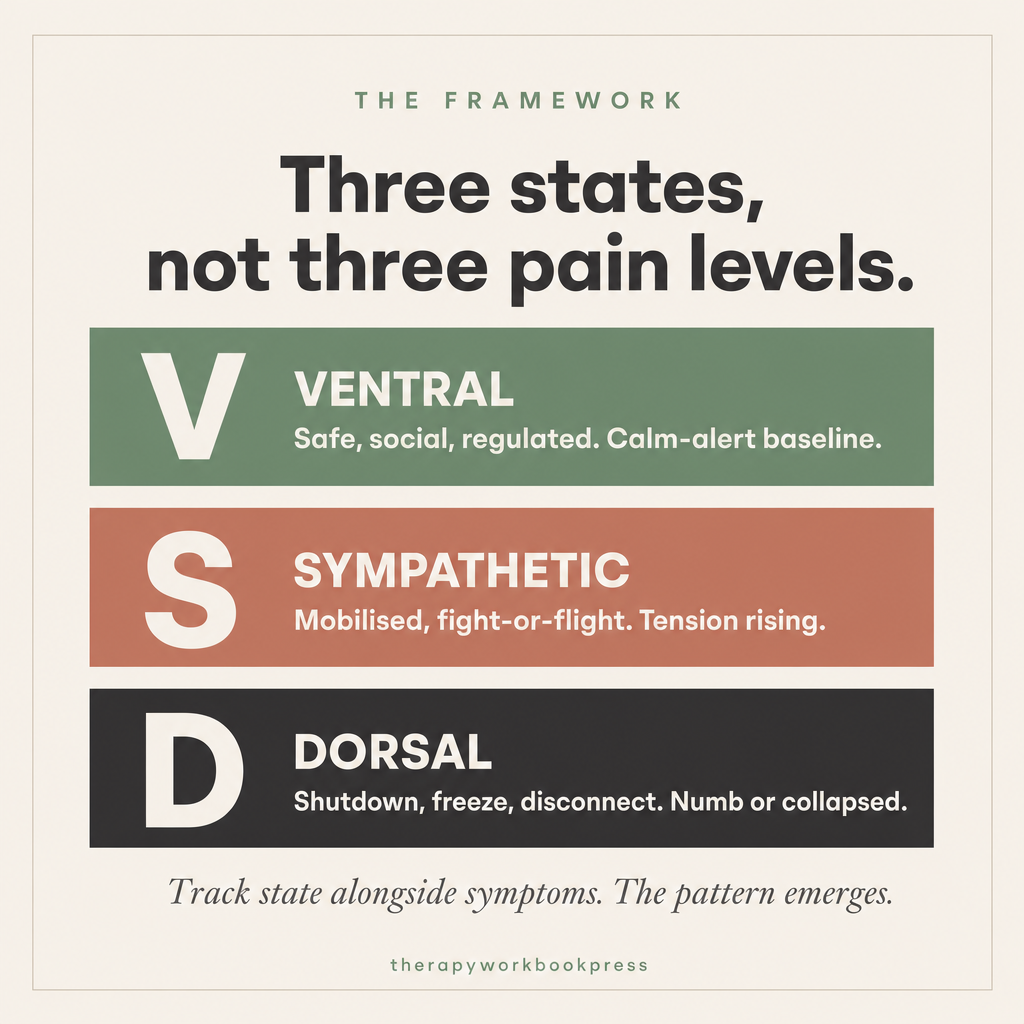
- V · Ventral — Safe, social, regulated. Your calm-alert baseline.
- S · Sympathetic — Mobilised, activated, fight-or-flight. Tension rising.
- D · Dorsal — Shutdown, freeze, disconnect. Numb or collapsed.
- B · Blended — A mixed state (e.g., V/S = safe activation; V/D = safely still).
Once you start tracking pain and state together, the relationship becomes visible in your own handwriting — usually within two to three weeks. That's the moment most people describe as "oh, that's what's happening."
Anchored in the canon
The framework integrates polyvagal theory with standard pain assessment. The work references and adapts material from Stephen Porges (The Polyvagal Theory, 2011), Deb Dana (The Polyvagal Theory in Therapy, 2018), Bessel van der Kolk (The Body Keeps the Score, 2014), Arielle Schwartz (The Polyvagal Theory Workbook for Trauma, 2018), and Pete Walker (Complex PTSD: From Surviving to Thriving, 2013). The window-of-tolerance and glimmer concepts are adapted from Dana, 2018.
Who this is built for
- The chronically ill and "Spoonie" community — Fibromyalgia, ME/CFS, POTS, EDS, endometriosis, chronic migraines, long COVID, autoimmune flares. Conditions where pain and nervous-system state are entangled, and where most trackers fail because they only track one.
- The still-undiagnosed — If you're building the evidence file for a specialist visit, the Clinician Handout (page 10) is the document doctors actually ask for and rarely receive. Structured 90-day data moves the conversation from "we're not sure" to "we think it's this."
- The perimenopausal / hormonally-driven — The hormonal cycle overlay (page 8) makes cycle-linked flares visible across a month — including the perimenopausal pattern that often gets missed in general pain tracking.
- The polyvagal-curious — If you've read Dana, Porges, or Schwartz and you want a daily instrument that brings the framework into your body — not just your head — this is it.
- Caregivers, partners, and parents — For someone you love who can't articulate what they're feeling on a bad day, or who underreports to avoid being a burden. You can track on their behalf.
- Therapists, somatic practitioners, and clinicians — Use as printable homework between sessions. Clients arrive with concrete data — including ANS state — instead of "it was a hard week." Unlimited personal printing rights for one practitioner.
How most people actually use it
You don't need to print all 10 pages at once. Most people print pages 2–4 daily, pages 5–6 weekly, pages 7–9 monthly, and page 10 quarterly — then keep the rest digital. Pages are undated, so you can start any day.
If you prefer to go paperless, the PDF works directly on iPad with GoodNotes, Notability, or any annotation app. Fill it in on the couch on flare days, export page 10 as an image, hand the image to your doctor at the appointment.
Format & access
- Format: Instant digital download (PDF). A4 and US Letter versions included — both sizes in one purchase.
- Pages: 10-page system, undated, fillable on tablet or printable on standard home paper.
- Print rights: Unlimited personal printing. Clinicians: one practitioner may print unlimited copies for use with their own clients.
- Updates: Free lifetime updates. New pages and revisions land in your inbox automatically.
- Delivery: Email link arrives within 60 seconds of checkout.
30-day no-questions refund
If this workbook doesn't help you walk into your next appointment with cleaner data than you've ever brought before, email contact@therapyworkbookpress.com within 30 days and we'll refund every cent. No forms. No friction.
Frequently asked
Do I need to know polyvagal theory to use this? No. Page 1 is a one-page primer with everything you need — the four states (V/S/D/B) and how to spot them in yourself. Most people are comfortable tracking by the end of the first week. Reading Dana or Porges later deepens the practice, but you can start without them.
Will it work for headaches / migraines specifically? Yes. The body map includes front and back head views, and the symptom severity grid (page 9) is designed for tracking a specific symptom over 31 days — pain intensity, frequency, or duration.
I have fibromyalgia / ME/CFS / long COVID. Does this fit? Yes — these conditions are exactly what the multi-layer design was built for. Fatigue is tracked alongside pain on every monthly page, and the post-exertional pattern shows up clearly across a week.
I'm perimenopausal and my pain shifts with my cycle. Is that covered? Yes. Page 8 includes a 31-day hormonal / cycle overlay specifically for cycle-linked and perimenopausal flares. Hormonal is one of the six trigger categories on the daily and weekly logs.
I'm a therapist. Can I use this with clients? Yes. One practitioner may print unlimited copies for use with their own clients. Not for resale or redistribution as a digital file.
Is this medical advice? No. It's a structured tracking tool. It does not diagnose, treat, or replace medical care. What it does is hand your doctor or specialist time-stamped, organised data they can actually use during your visit. Many clinicians ask for exactly this kind of log; few patients ever bring one.