


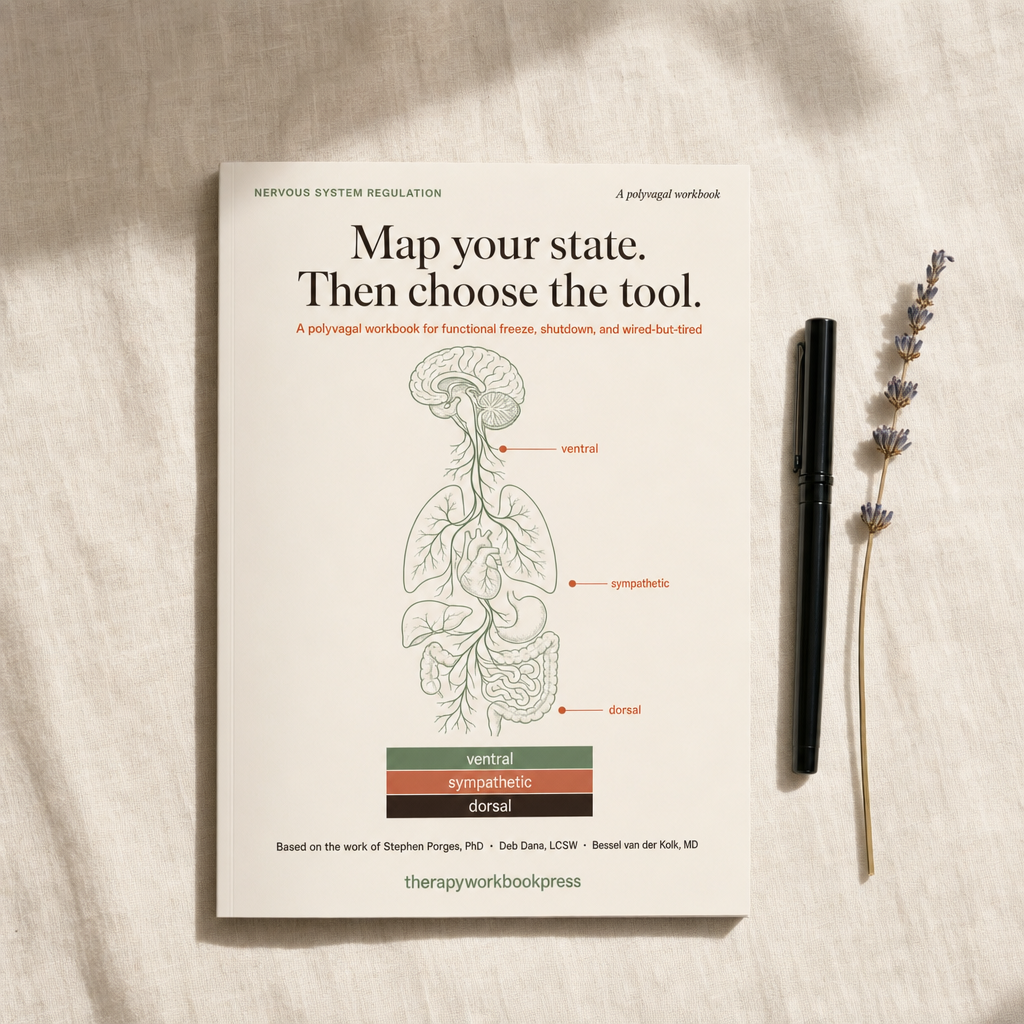














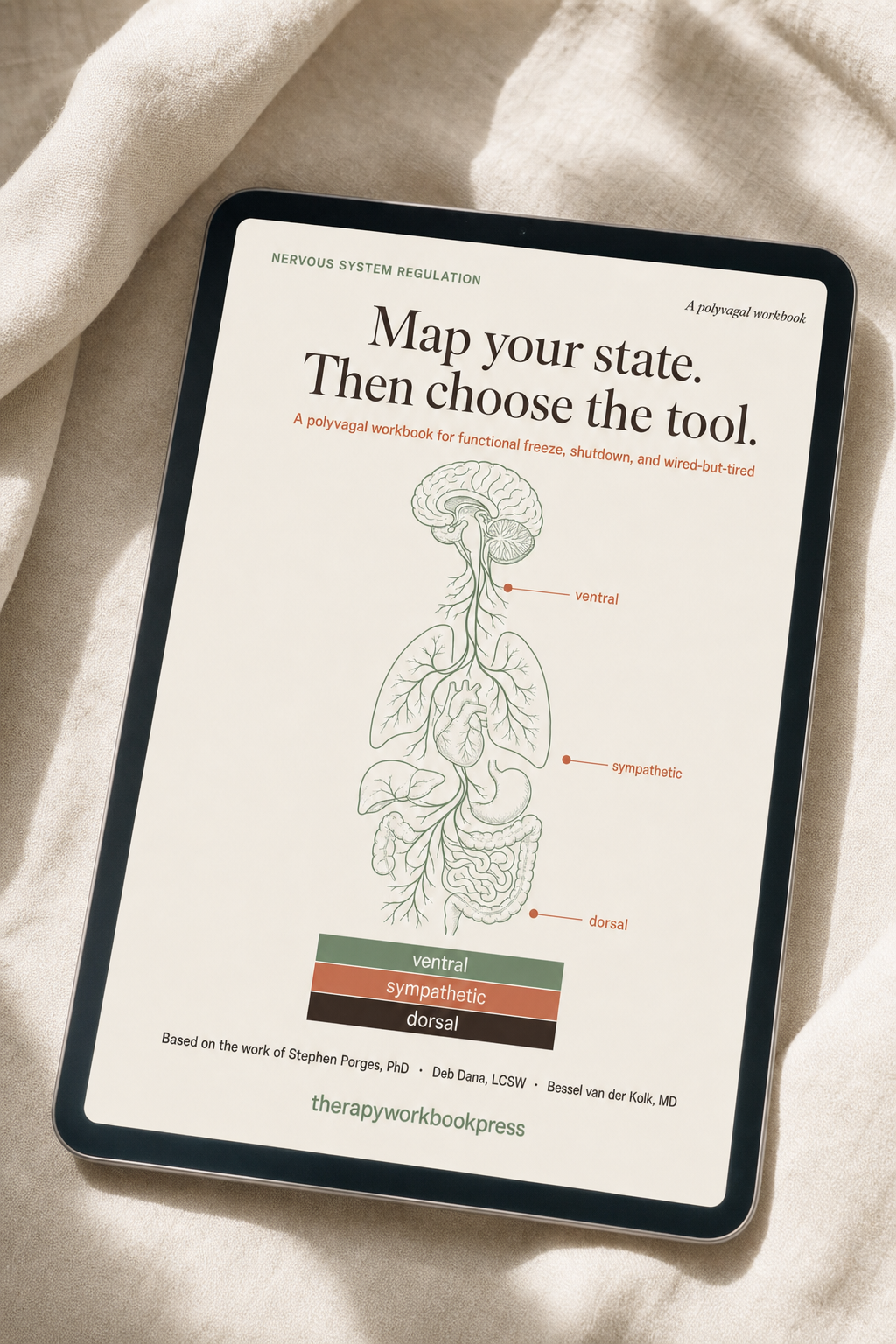





Nervous System Regulation Workbook: Map Your State, Then Choose the Tool
$29.49$55.00
✨ INSTANT DIGITAL DOWNLOAD: A link will be sent to your email immediately. Safe to open on your phone now or save to your computer for later.
🚀 Lifetime Access + Free Future Updates: Buy once, own it forever. You’ll receive all future versions, new content, and updated resources for free, delivered straight to your inbox.
You've been told to breathe through it. To ground. To "just feel your feelings."
And on some days, it works. On the days that matter most, the same techniques do nothing — or make it worse. This is not a discipline problem. It is a structural one.
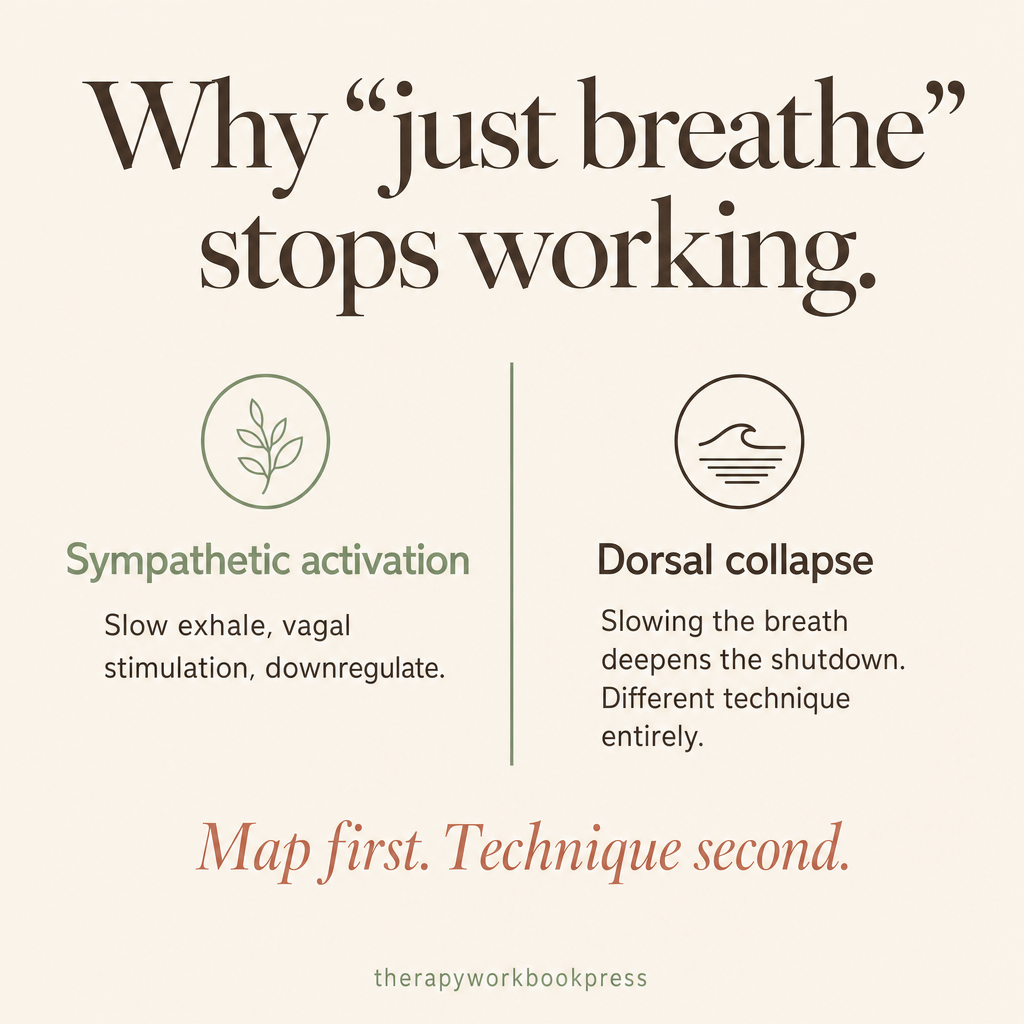
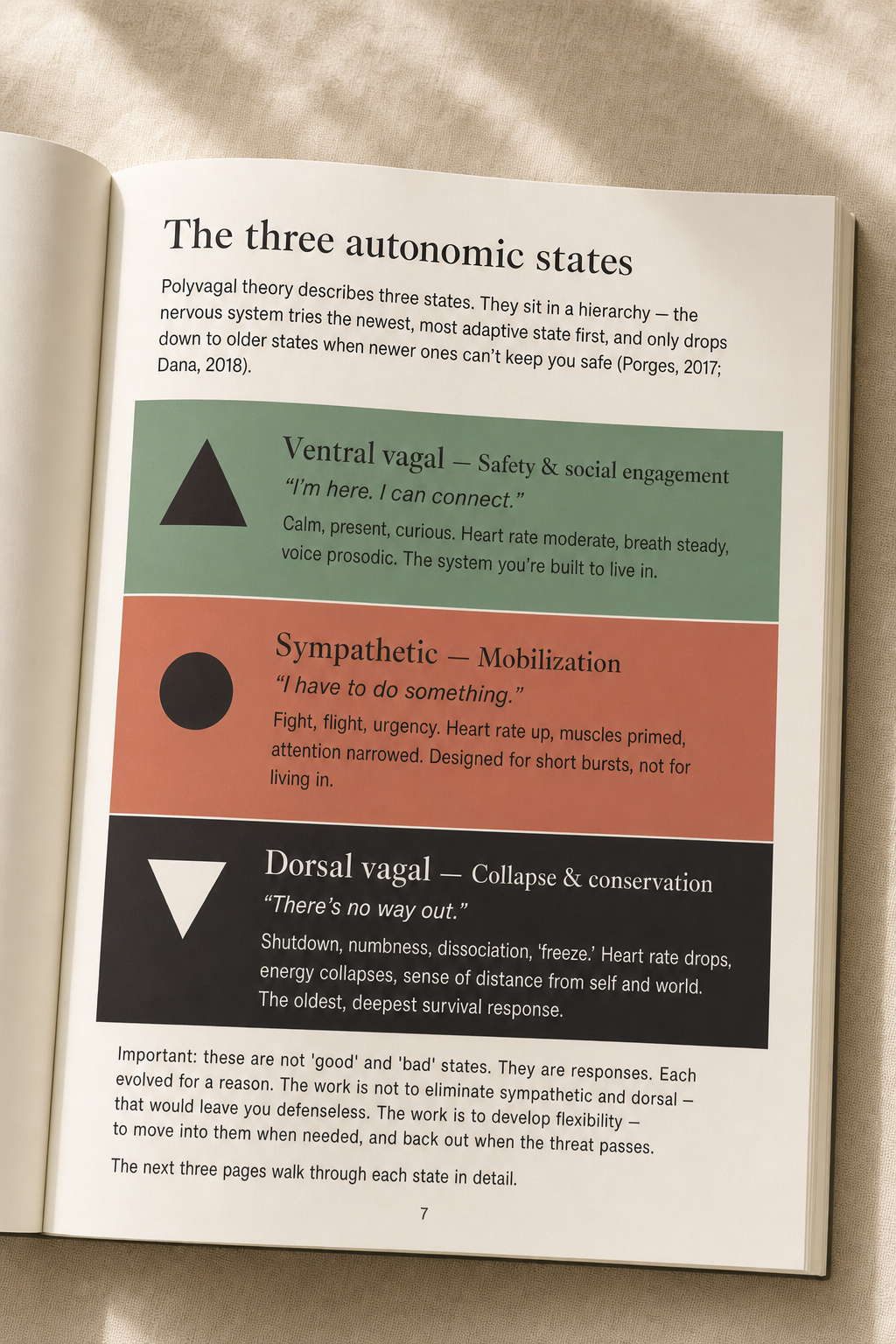
Your autonomic nervous system has three states, not two (Porges, 1994). Each one has a distinct physiology, a distinct felt sense, and a distinct set of techniques that actually move it. A breathing pattern that calms sympathetic activation can deepen a dorsal shutdown. A cold splash that resets a wired-but-tired system can spike a panic-prone one. Most wellness content hands you the techniques. None of it hands you the map.
This workbook is the map.
Why "map before technique" matters
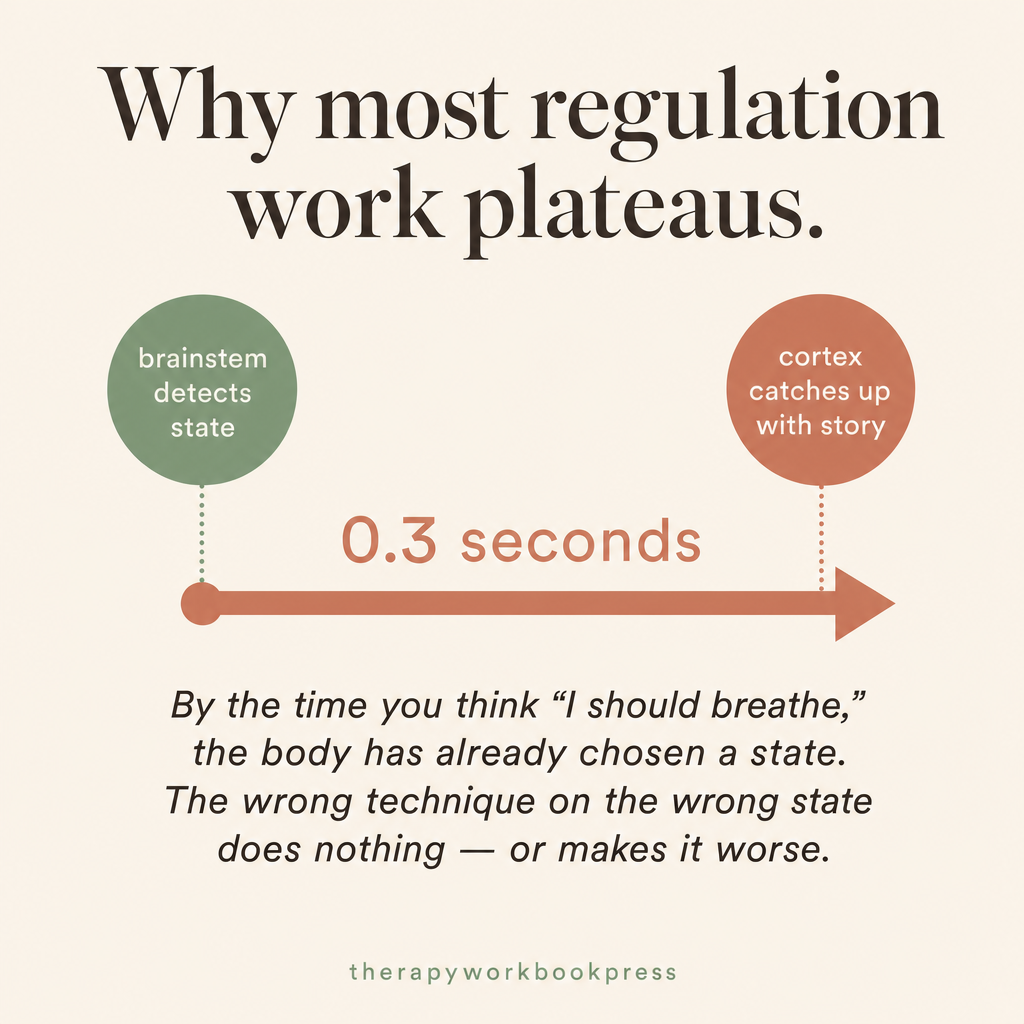
There is a 0.3-second gap between when your brainstem registers a state shift (neuroception) and when your cortex catches up with a story about it. By the time you're thinking "I should breathe," your body has already chosen a state. If the technique you reach for is built for the wrong state, the system doesn't take it well.
This is the part Deb Dana (2018), Stephen Porges (2011, 2017), and Bessel van der Kolk (2014) emphasize and most popular resources skip: you cannot regulate a state you haven't identified. The skill is not technique-collection. It is state-recognition first, then matched intervention.
This workbook teaches that skill in 50 pages.
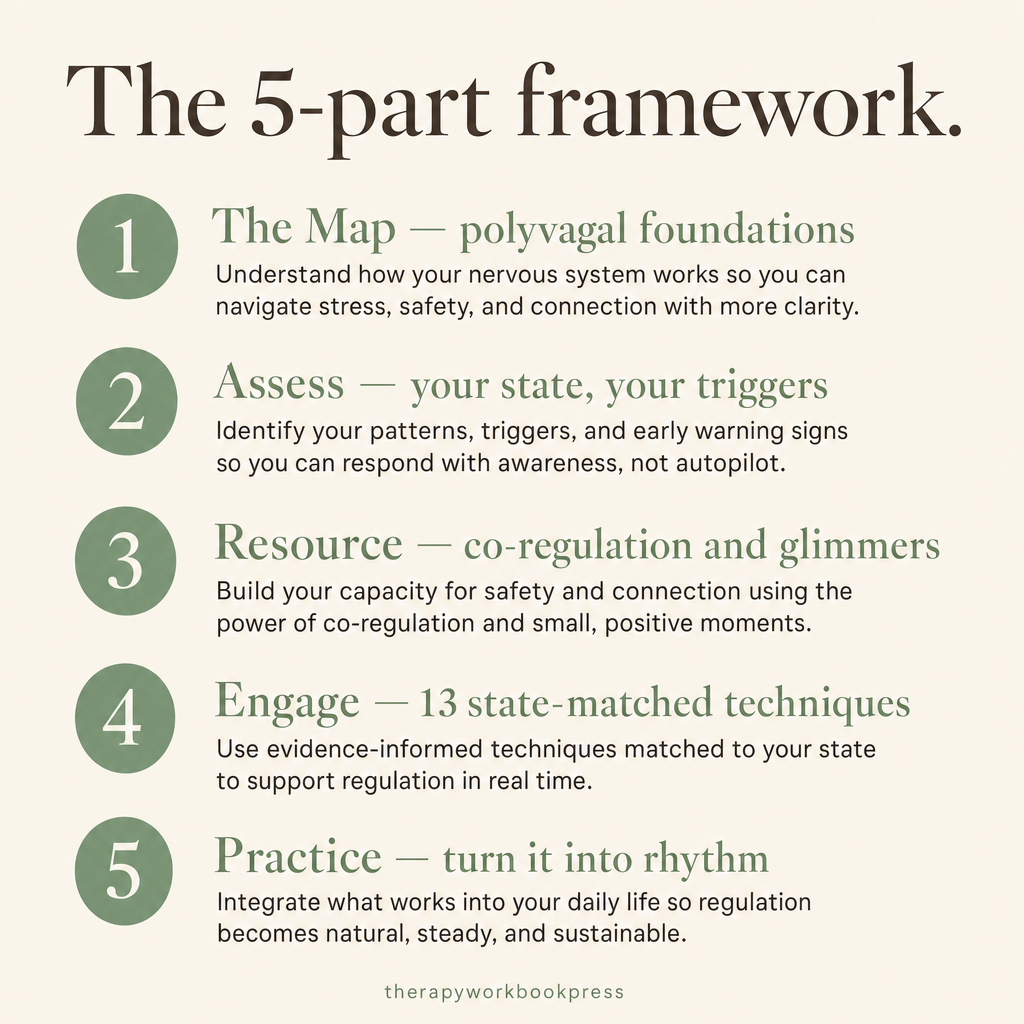
What's inside — the 5-part framework
Part 1 — The Map (Polyvagal Foundations). The three autonomic states (ventral vagal, sympathetic, dorsal vagal), the autonomic ladder, and neuroception — the unconscious threat-detection that runs below conscious awareness. Clear diagrams of the CNS, PNS, and vagus nerve. By the end, you can name what's happening in your body in language a clinician would recognize.
Part 2 — Assess Your State (Diagnostics). A 60-second state check. A symptom decoder that correlates physical symptoms (chest tightness, gut shutdown, brain fog, jaw clench) with autonomic state. Your personal autonomic profile — where you live by default and where you drop under stress. Your triggers and your glimmers (the moments ventral comes back online).
Part 3 — Resource & Resilience. Co-regulation, the 3 Cs of safety, and the glimmer practice — building the felt sense of ventral so the techniques in Part 4 have somewhere to return to. This is the part most workbooks skip and the reason most regulation work plateaus.
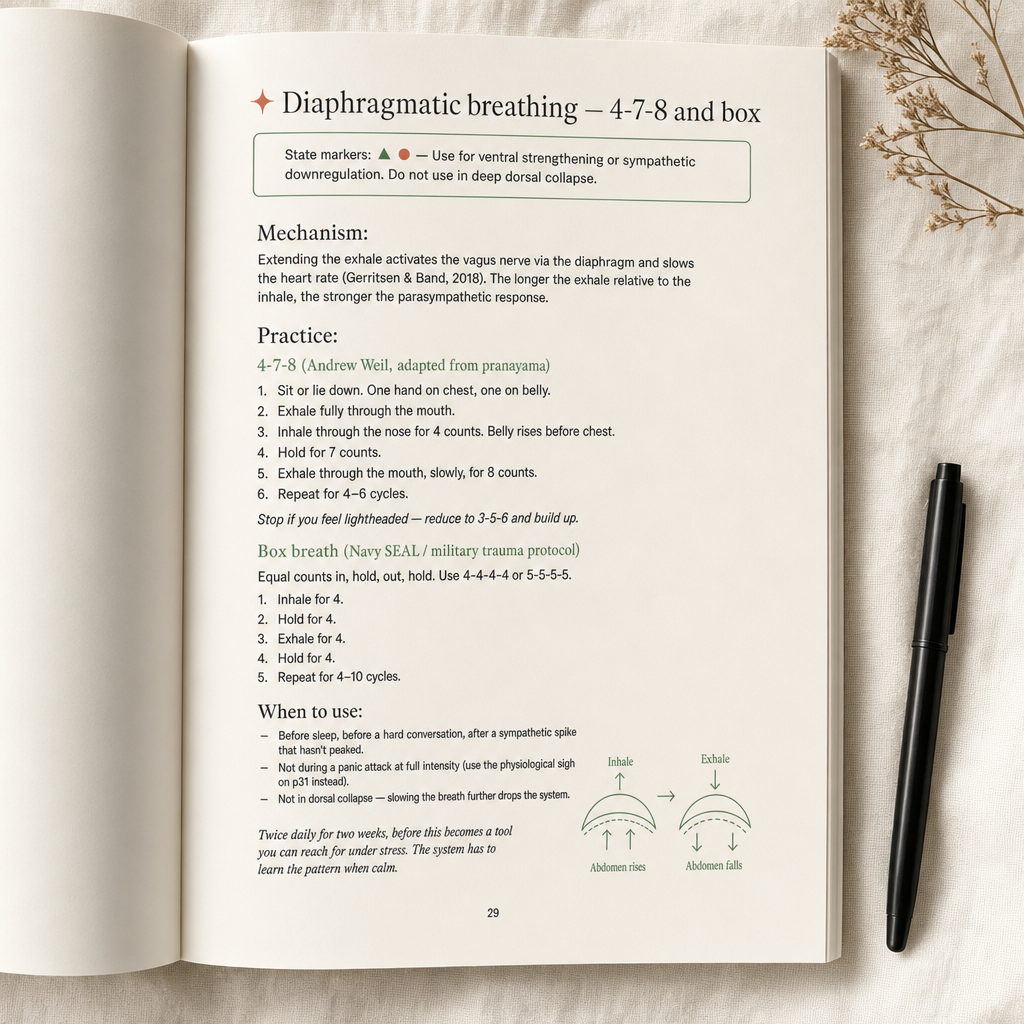
Part 4 — Active Engagement (13 techniques, state-matched). Each technique mapped to the state(s) it serves with the underlying mechanism named: diaphragmatic breathing (vagal activation via extended exhale), Voo breathing (vagal stimulation via vocal cord vibration), the physiological sigh (Balban et al., 2023, Stanford — the fastest documented sympathetic downregulator), humming and toning, cold exposure (mammalian dive reflex), bilateral stimulation, orienting, tongue release and soft palate, soothing touch with five hand positions, movement to discharge, co-regulation cues, concentration meditation, and the oculocardiac eye reset.
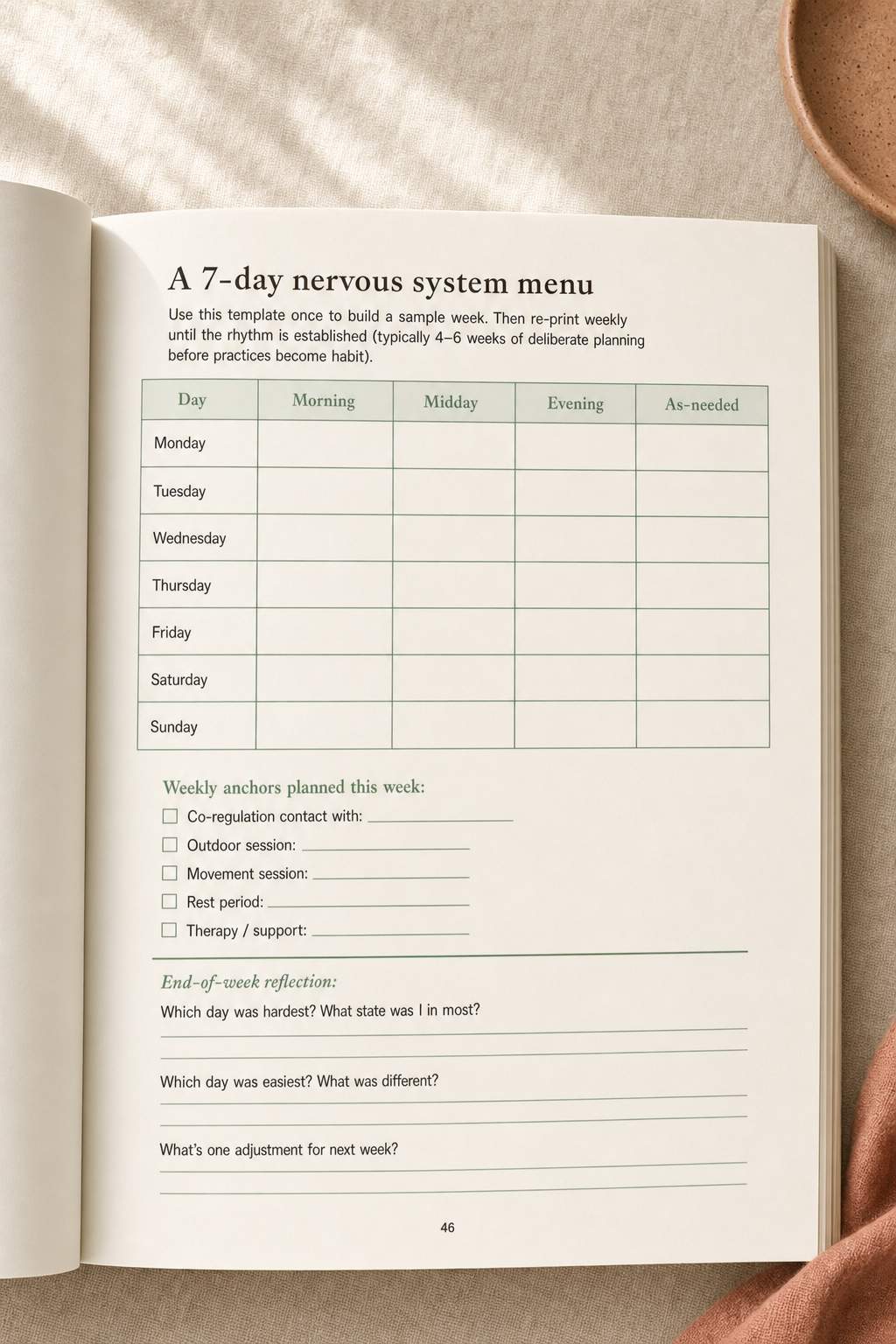
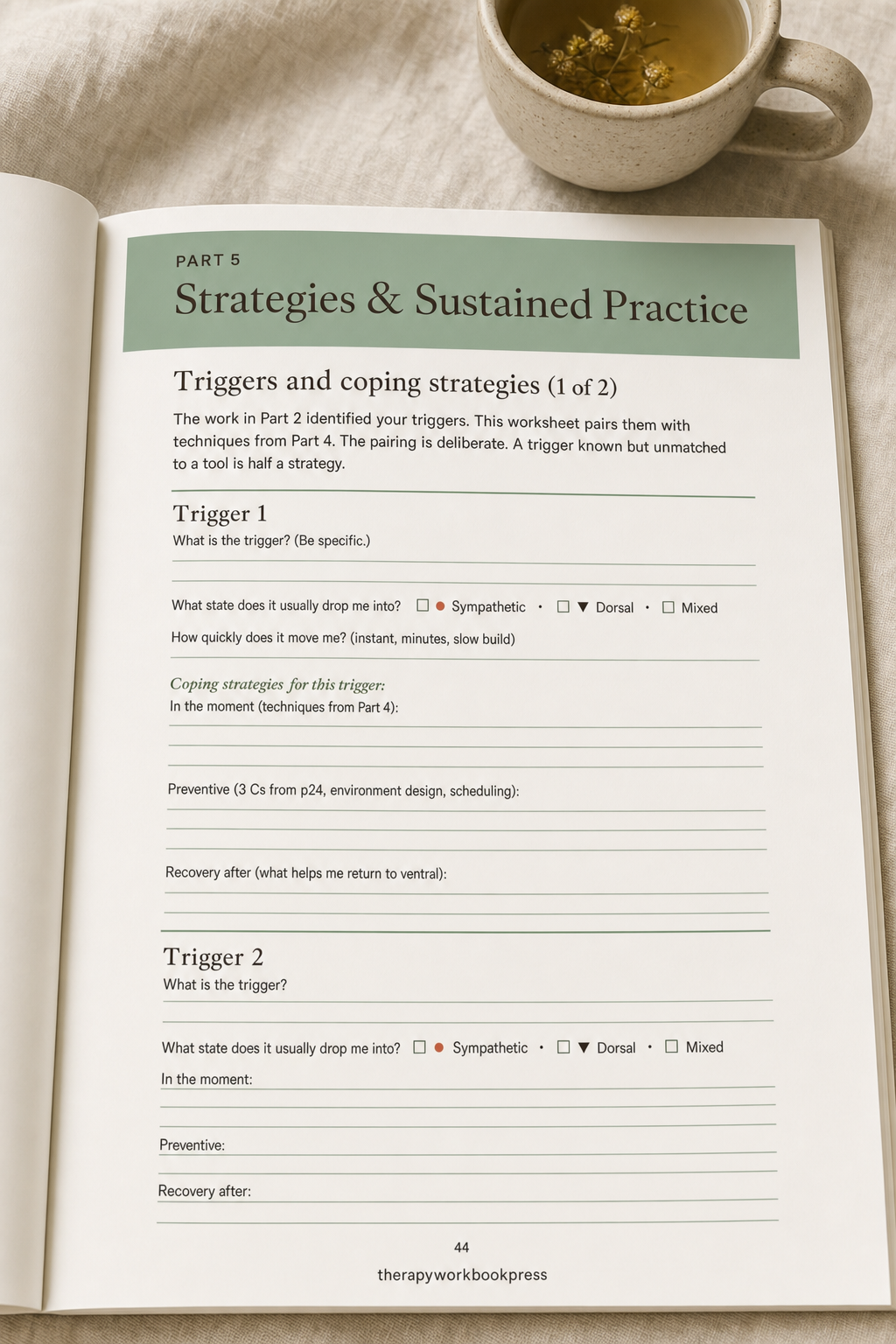
Part 5 — Sustained Practice. Trigger-to-technique pairing worksheets. A 7-day nervous system menu template. Weekly reflection. The slow, repeatable work of turning recognition into rhythm.
If you recognize yourself in any of these
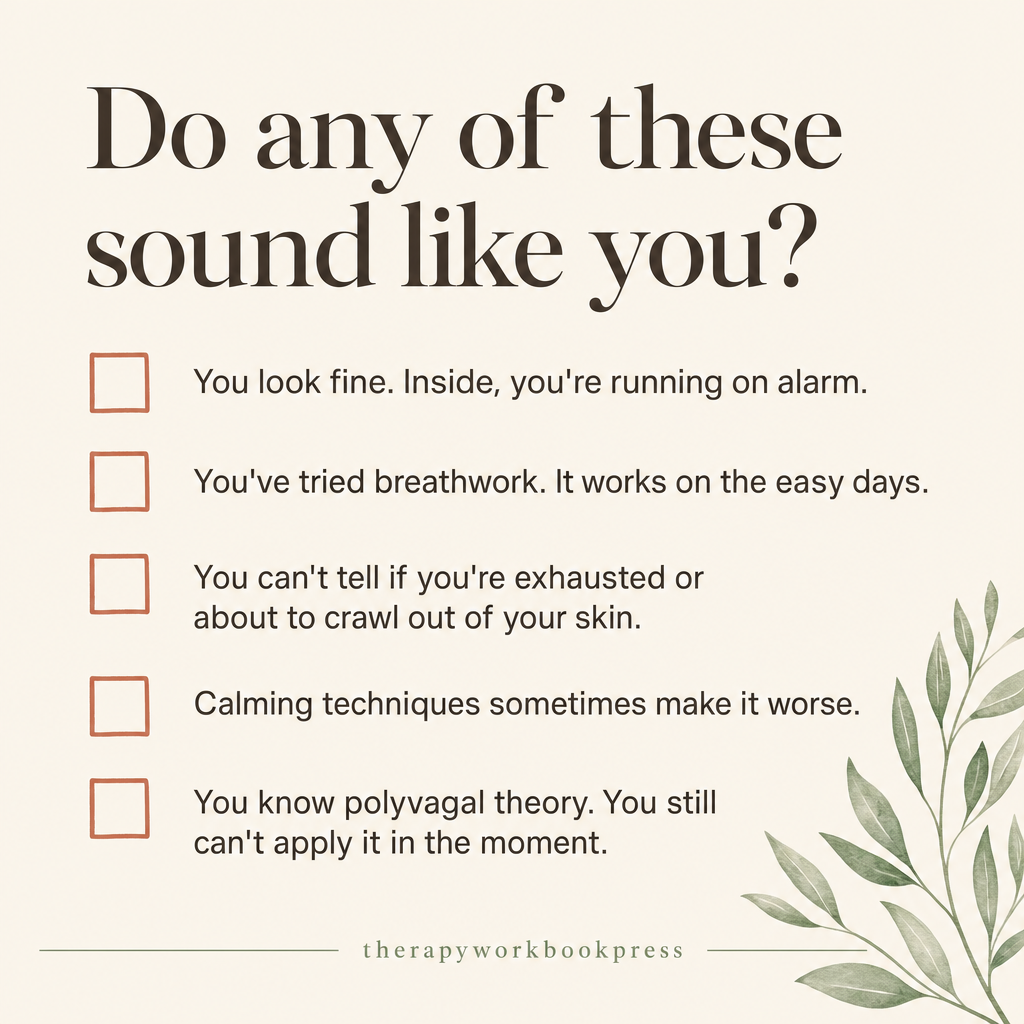
Functional freeze / "wired but tired." You look fine from the outside. Inside, you've been running on a low-grade alarm for years and can't tell whether you're exhausted or about to crawl out of your skin. This workbook explains why both can be true at once — and why most "calming" techniques aimed at sympathetic activation deepen a freeze state.
Perimenopause and nervous system dysregulation. Estrogen and progesterone are not only reproductive hormones — they modulate vagal tone and HPA-axis reactivity. As they shift, the nervous system that held together for decades can stop holding. This is not "you again" — it is a different physiological substrate, and it needs a polyvagal-informed approach, not a generic anxiety toolkit.
Late-diagnosed neurodivergent women. If your "burnout" looks like total shutdown after years of masking, you've likely been living in chronic sympathetic with intermittent dorsal collapse. The state map gives you language for what was happening before you had a name for it.
Recovery from people-pleasing / fawn response. Fawn is a learned override of your own neuroception — overriding what your body reads about safety in order to manage someone else's nervous system. The work in Part 2 is to put your own state-detection back online before any technique is useful.
Trauma-aware parents. You cannot teach a regulated nervous system to a child from a dysregulated one. Co-regulation runs both ways. The framework in Part 3 is the language to start.
Clinicians. This is a complete psychoeducation curriculum in workbook form. Use Part 1 for theory delivery, the assessments in Part 2 as session handouts, and Part 4 as state-matched between-session homework. The reference list is intentionally compatible with the polyvagal canon you already teach from.
Why this is different
This is not a coping-skills list and not a 50-page restatement of The Body Keeps the Score. It is the bridge most people are missing: between intellectual understanding ("I know I'm dysregulated") and somatic literacy ("I can feel what state I'm in and what moves it"). It is built to be re-opened — Part 2 when you need to figure out what's happening; Part 4 when you need a technique; Part 5 when you're ready to make the practice a rhythm.
References (foundational reading the workbook draws from)
Porges, S. W. (1994; 2011; 2017; 2023). Polyvagal Theory.
Dana, D. (2018). The Polyvagal Theory in Therapy. W. W. Norton.
van der Kolk, B. (2014). The Body Keeps the Score. Viking.
Schwartz, A. (2024). The Polyvagal Theory Workbook for Trauma. New Harbinger.
Balban, M. Y., et al. (2023). Brief structured respiration practices. Cell Reports Medicine.
Gerritsen, R. J. S., & Band, G. P. H. (2018). Breath of life. Frontiers in Human Neuroscience.
Format & delivery
50-page digital workbook. A4 and US Letter print-ready PDF. Worksheets are designed to be printed and re-printed; many of the Part 4 practices are formatted to be re-read in the moment rather than memorized.
Instant download. A download link is sent to your email immediately after purchase. Open it on your phone now or save it to your computer.
Lifetime access and free future updates. Buy once, own it. You'll receive all future versions, new content, and updated practice worksheets free, delivered to your inbox.
This workbook is educational and complements professional support — it is not a substitute for it. If a practice creates distress that doesn't pass within a few minutes, stop. Trauma work is best done with a trained clinician.