



















The ADHD Executive Dysfunction Workbook: Map Where You Get Stuck, Then Use the Tool That Fits (78 Pages, PDF)
$34.49$69.00
✨ INSTANT DIGITAL DOWNLOAD: A link will be sent to your email immediately. Safe to open on your phone now or save to your computer for later.
🚀 Lifetime Access + Free Future Updates: Buy once, own it forever. You’ll receive all future versions, new content, and updated resources for free, delivered straight to your inbox.
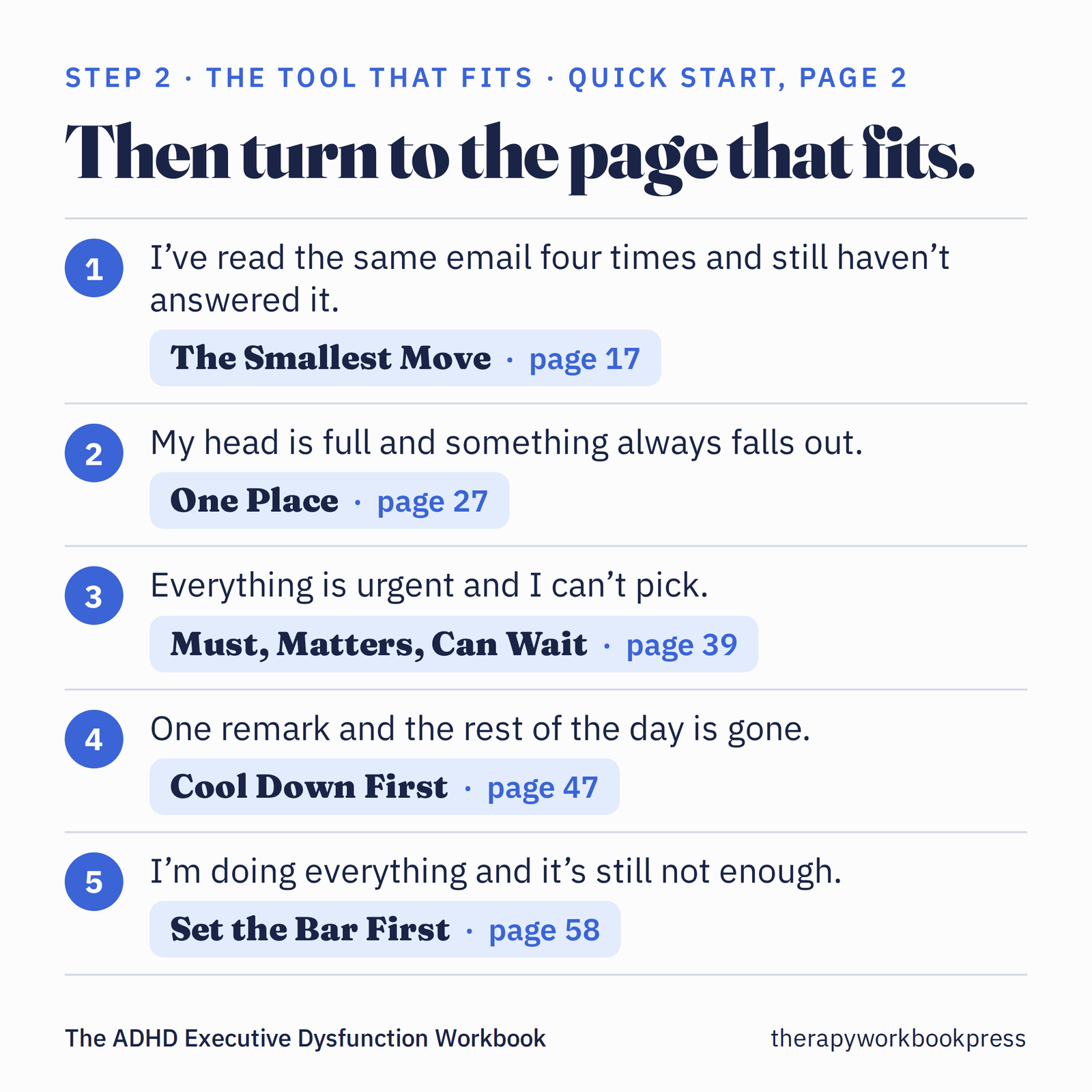
“I’ve read the same email four times and still haven’t answered it.”
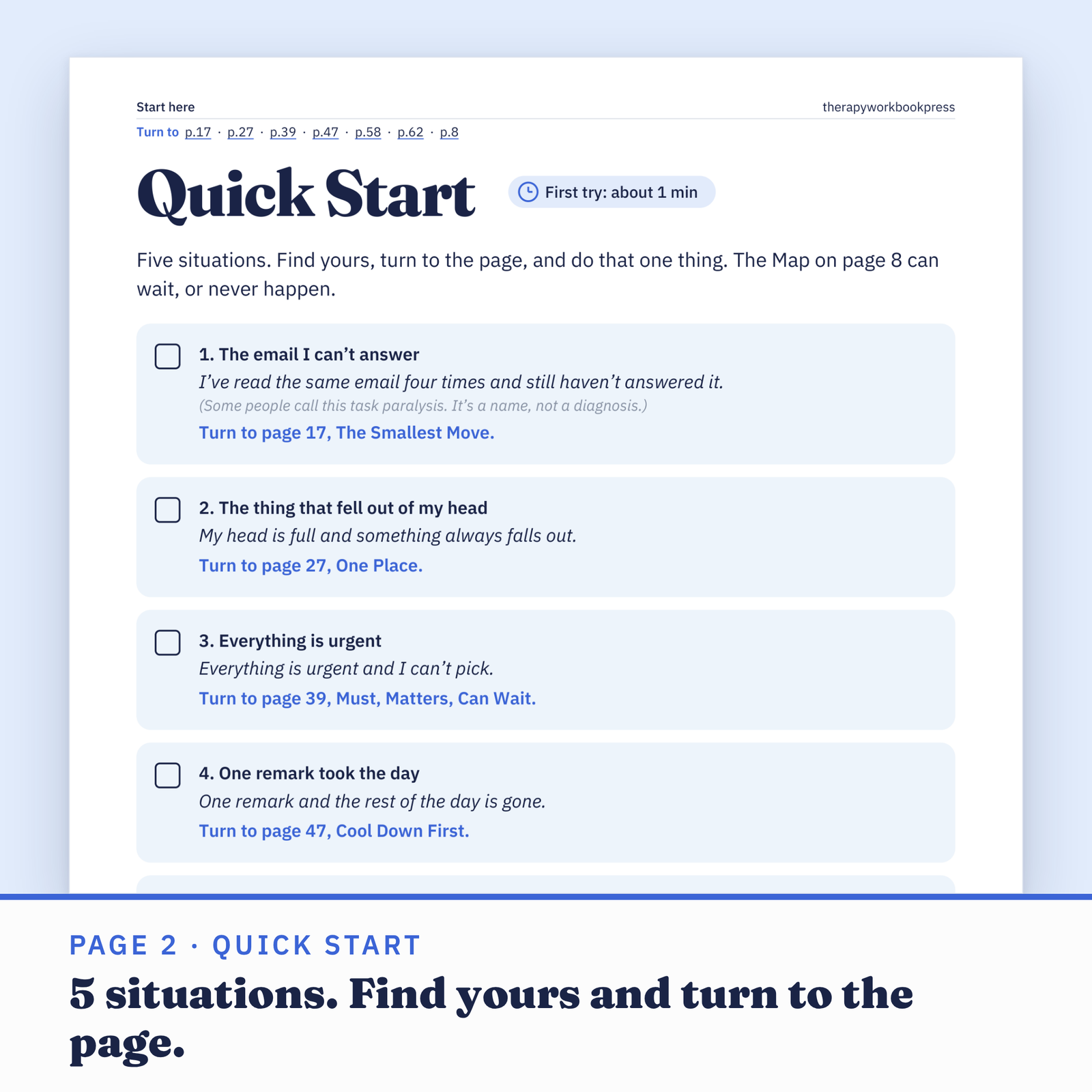
That sentence is printed on page 2 of this workbook, with a page number next to it. 4 more sit under it. The thing that fell out of my head. The day when everything is urgent. The one remark that took the day. The week I did everything and it was still not enough.
The ADHD Executive Dysfunction Workbook is a 78-page printable PDF for adults. It maps where you get stuck first. Then it gives you the tool that fits that place. There are 22 tools, each on a single page, and the first one takes about 3 minutes to try.
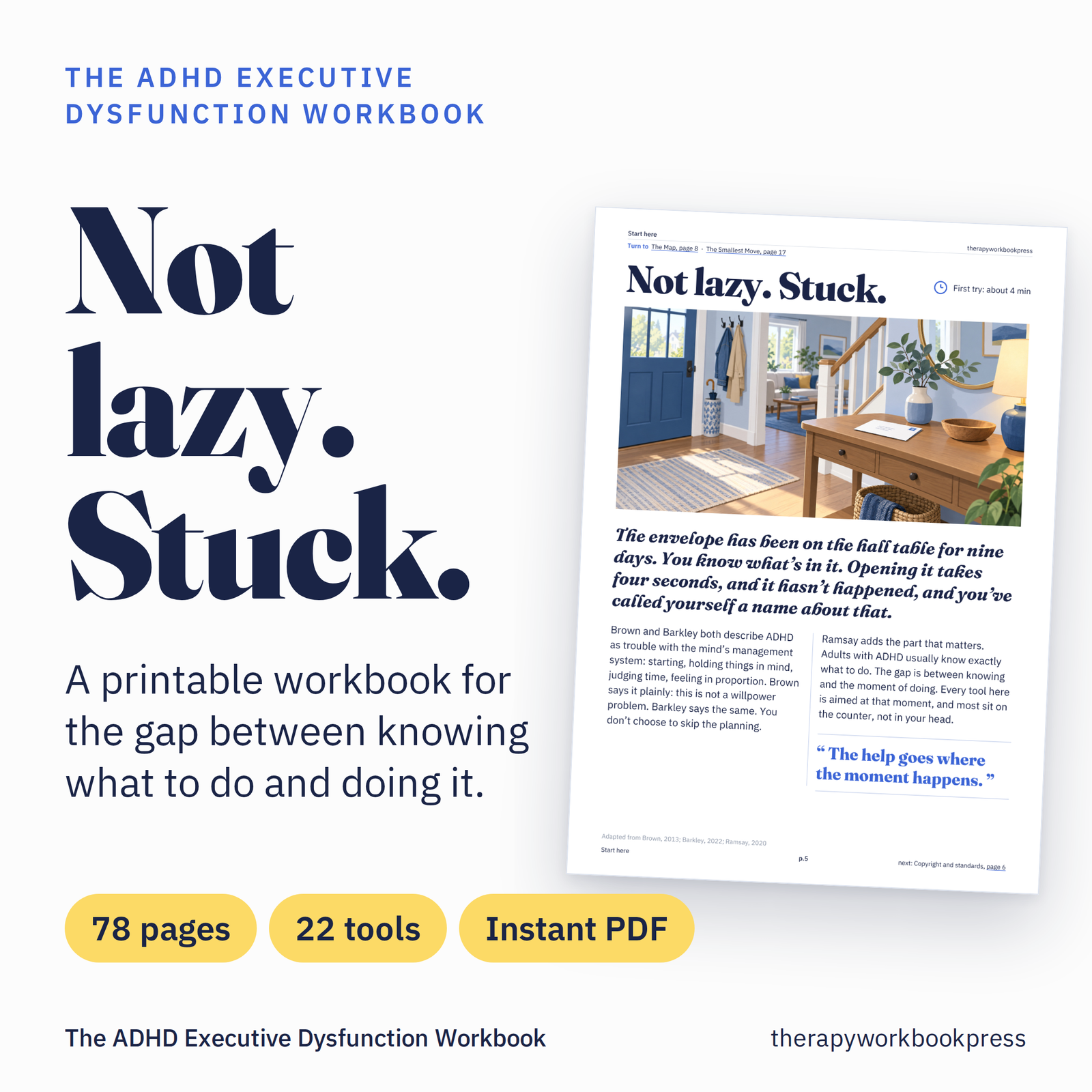
Not lazy. Stuck.
That is the title of page 5, and the page credits its sources. Psychologists Thomas Brown and Russell Barkley both describe ADHD as trouble with the mind’s management system: starting, holding things in mind, judging time, feeling in proportion. Clinicians call that system executive function. When it stalls, people say executive dysfunction.
Brown says it plainly: this is not a willpower problem. J. Russell Ramsay adds that adults with ADHD usually know exactly what to do. The gap is between knowing and the moment of doing.
That is why another planner was never the whole answer. A planner is a tool for planning. If the stuck point is the first seconds of a task, a name that slips, or a feeling that takes the wheel, it needs a different tool. So this workbook sorts first.
How It Works: Map First, Then the Tool That Fits
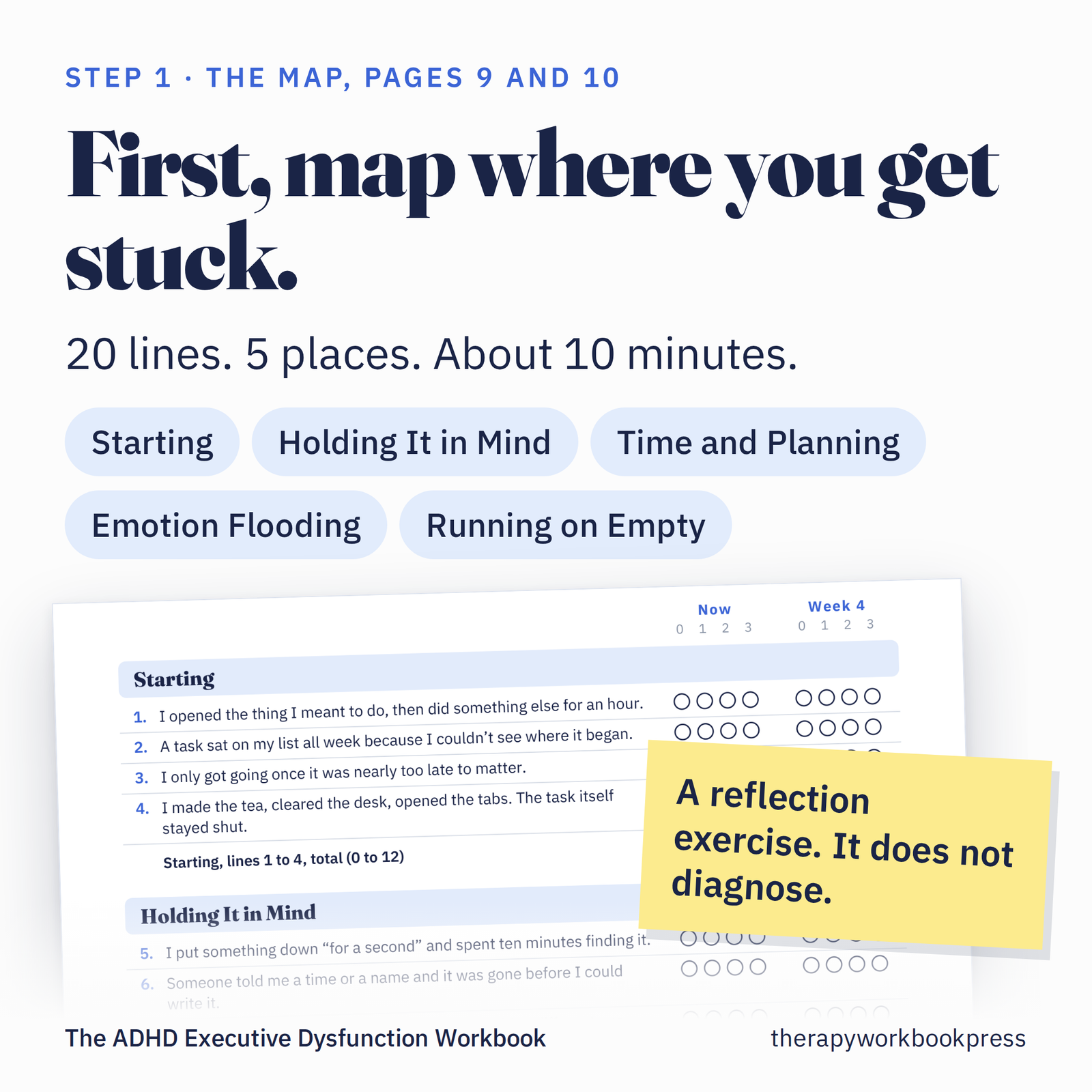
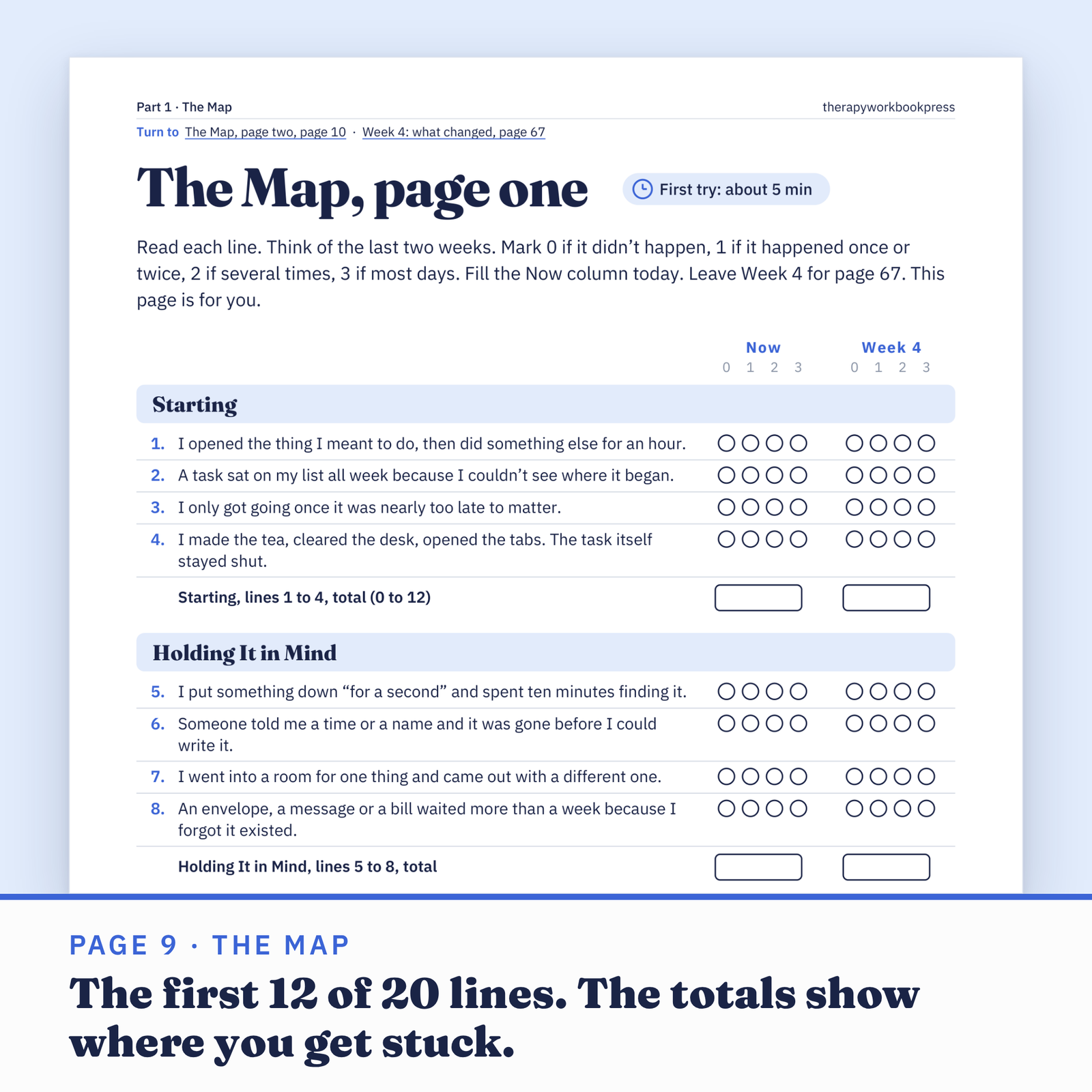
- Map where you get stuck (pages 9 to 11). 20 short lines, each marked 0 to 3 for the last 2 weeks. Line 4 reads: “I made the tea, cleared the desk, opened the tabs. The task itself stayed shut.” The marks add up to 5 totals: Starting, Holding It in Mind, Time and Planning, Emotion Flooding and Running on Empty. That takes about 10 minutes. Page 11 then helps you choose where to begin. The highest total is a suggestion, and the page also asks which place cost you most lately. If the two disagree, the book says to start where it cost you.
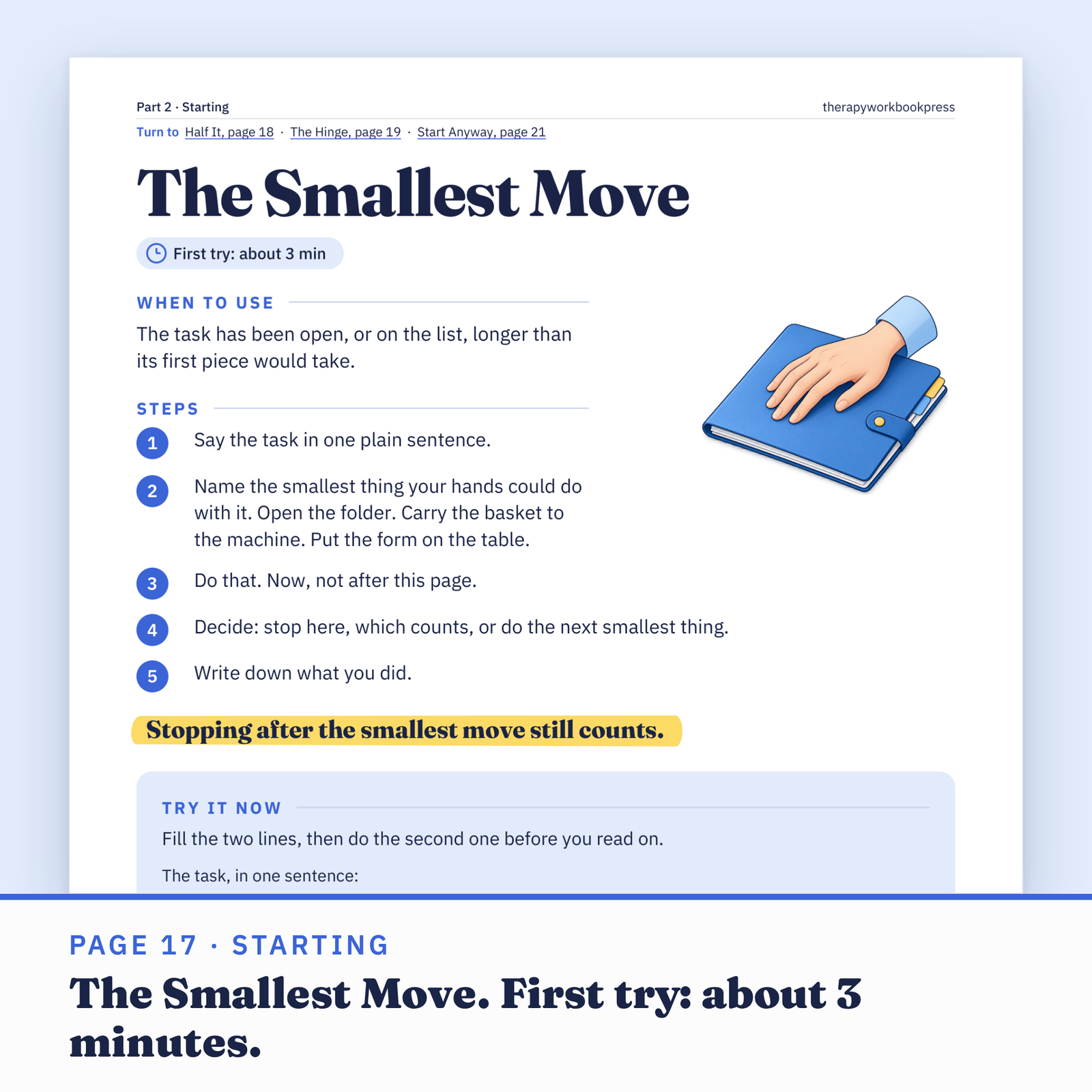
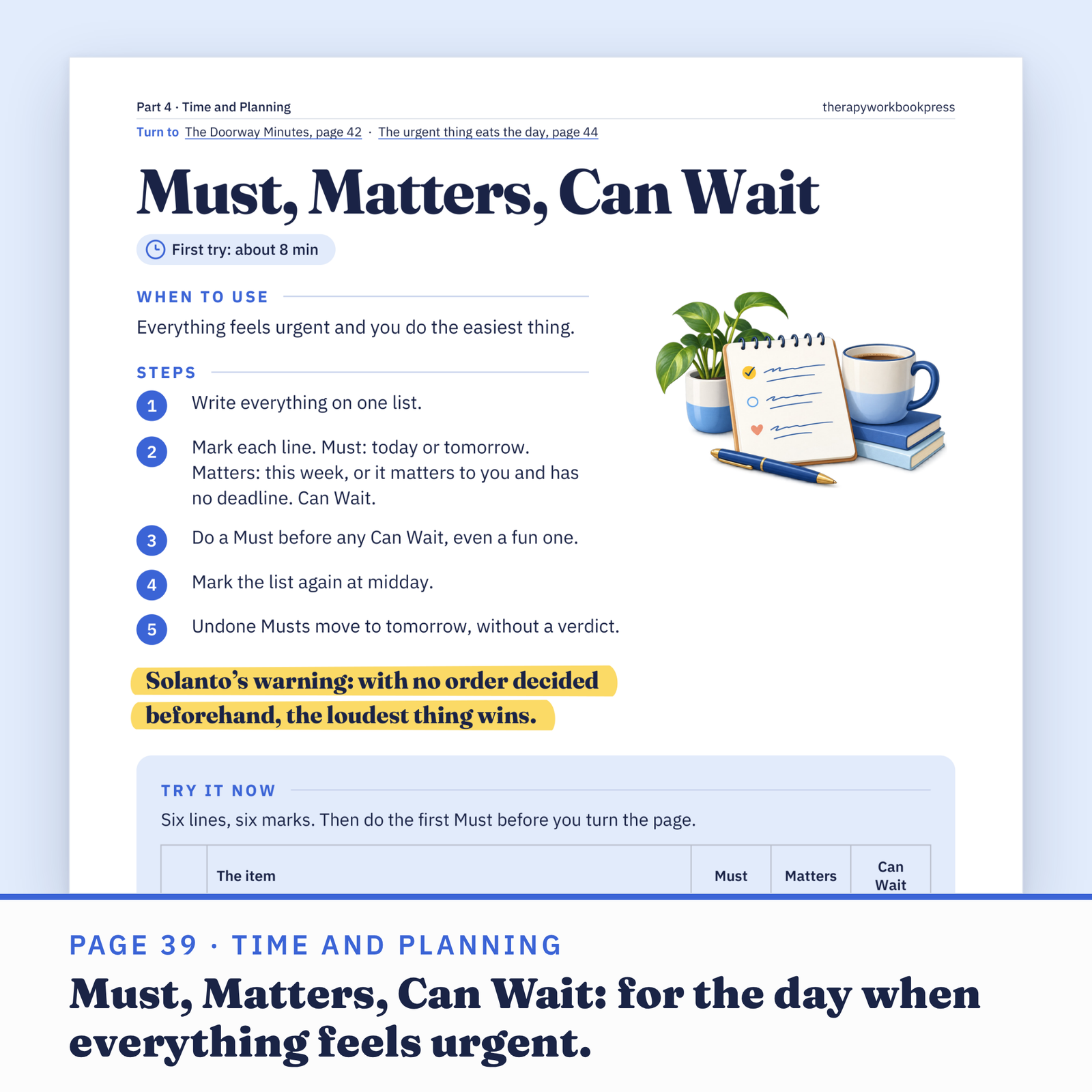
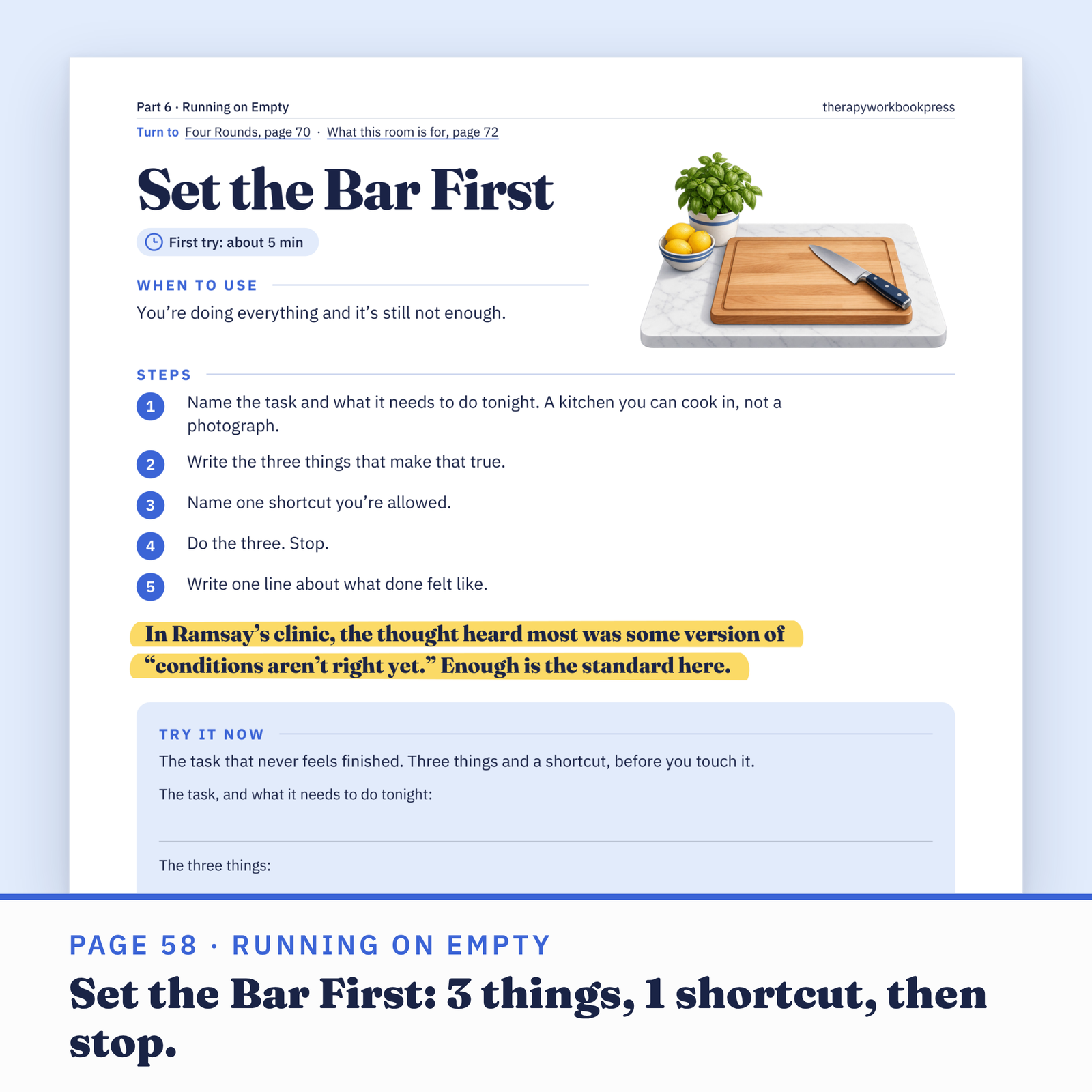
- Use the tool that fits. Each of the 5 places has its own part of the book and its own tools. Each tool is one page with the same layout: when to use it, 5 numbered steps, a “Try it now” box to write in, and a first-try time printed at the top. The Smallest Move on page 17 says about 3 minutes.
The Map is a reflection exercise. It does not screen for or diagnose anything. No time for it today? Quick Start on page 2 skips it: 5 situations, each with one page to turn to.
What’s Inside: 22 Tools Across 5 Stuck Points
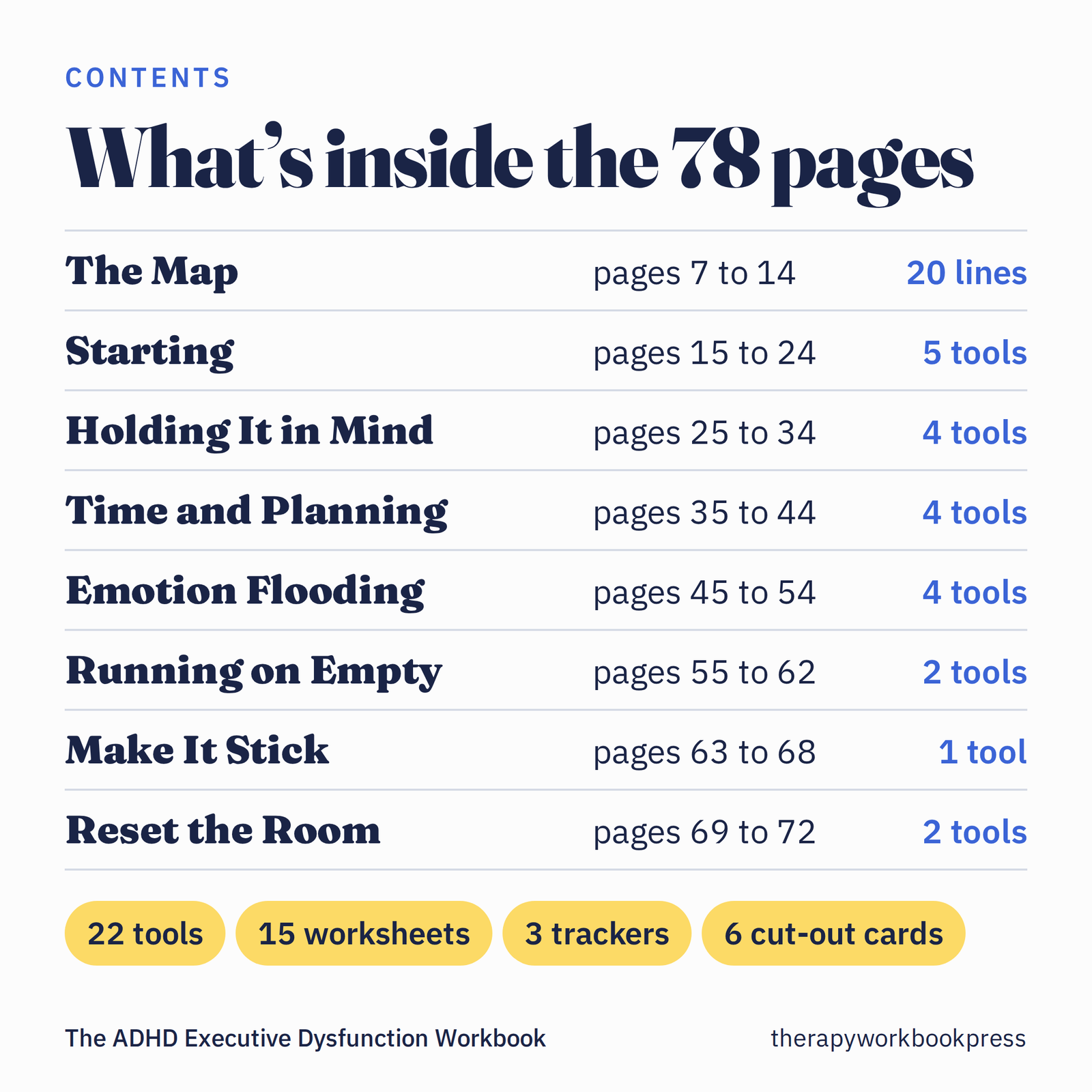
- Part 1, The Map (pages 7 to 14). The 20 lines, the page that helps you choose where to begin, and a look at where things already work.
- Part 2, Starting (pages 15 to 24). 5 tools for the seconds before a task: The Smallest Move, Half It, The Hinge, Start Anyway, Do It Second. This is the stretch people call task paralysis.
- Part 3, Holding It in Mind (pages 25 to 34). 4 tools that move dates, tasks and reminders out of your head and onto the counter: One Place, Park It, The Note at the Spot, Clear the Deck.
- Part 4, Time and Planning (pages 35 to 44). 4 tools for the day that turns out shorter than it looked: Guess, Time, Compare; Fit It in a Day; Must, Matters, Can Wait; The Doorway Minutes.
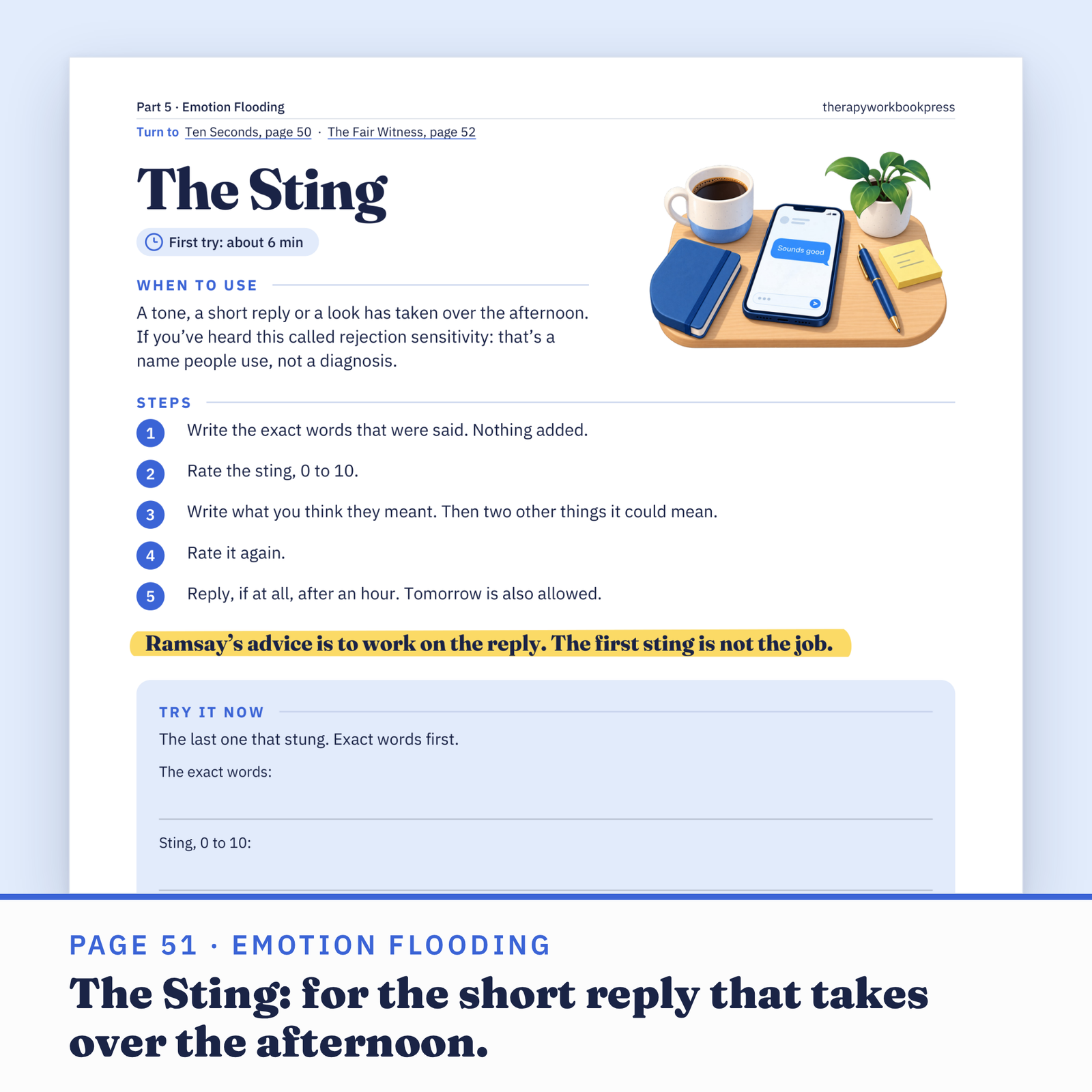
- Part 5, Emotion Flooding (pages 45 to 54). 4 DBT-informed tools for the moment a feeling takes the wheel: Cool Down First; Check, Then Turn; Ten Seconds; The Sting. The Sting is for the short reply that takes over the afternoon, which some people call rejection sensitivity.
- Part 6, Running on Empty (pages 55 to 62). 2 tools, Set the Bar First and One Plain Ask, for the week you kept up and paid for afterwards. Some people call this ADHD burnout.
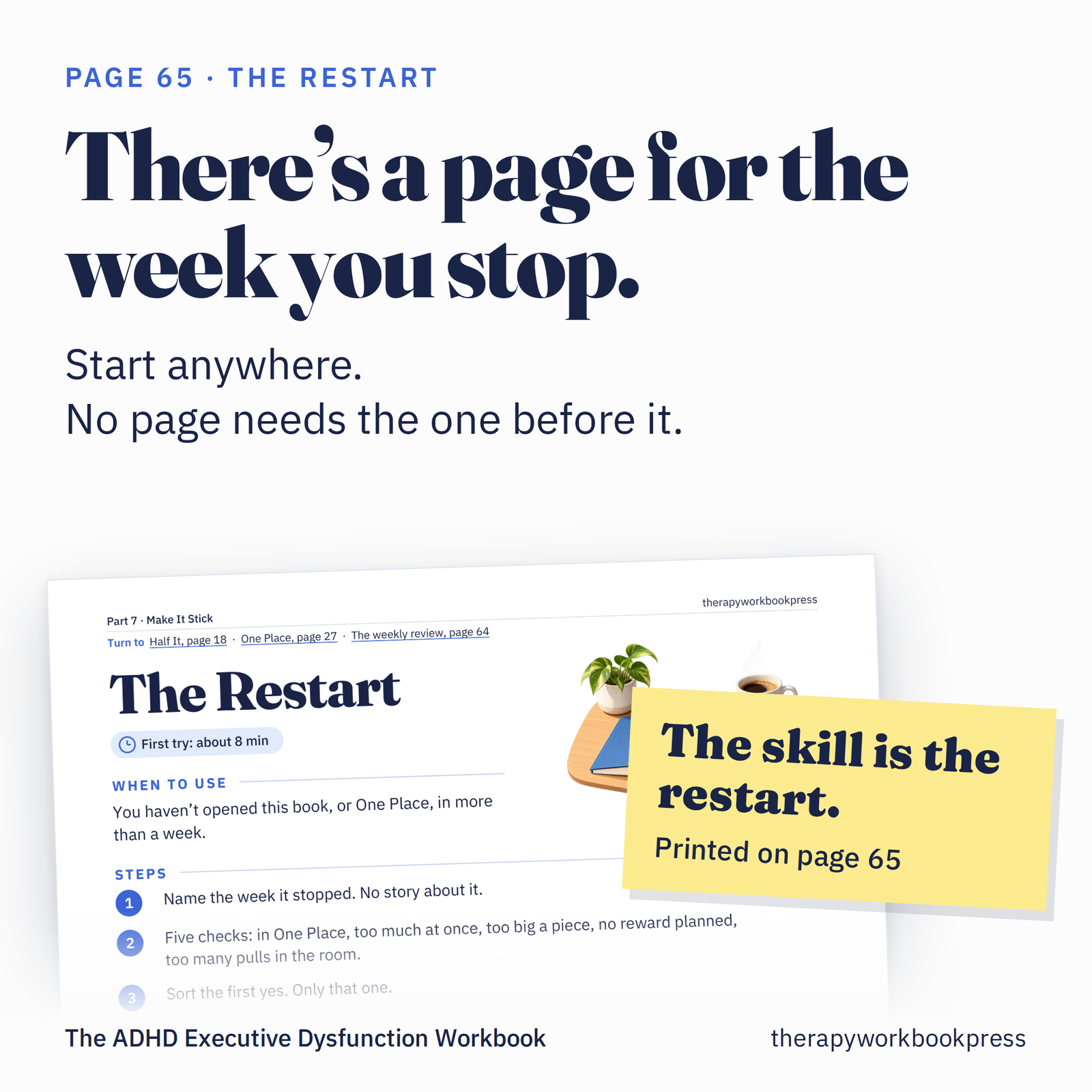
- Part 7, Make It Stick (pages 63 to 68). A weekly review, The Restart for the week the system falls over, a 4-week grid, and the Map again at week 4.
- Reset the Room (pages 69 to 72). A 4-page insert, Four Rounds and Three for Tomorrow, for the room that has stopped working.
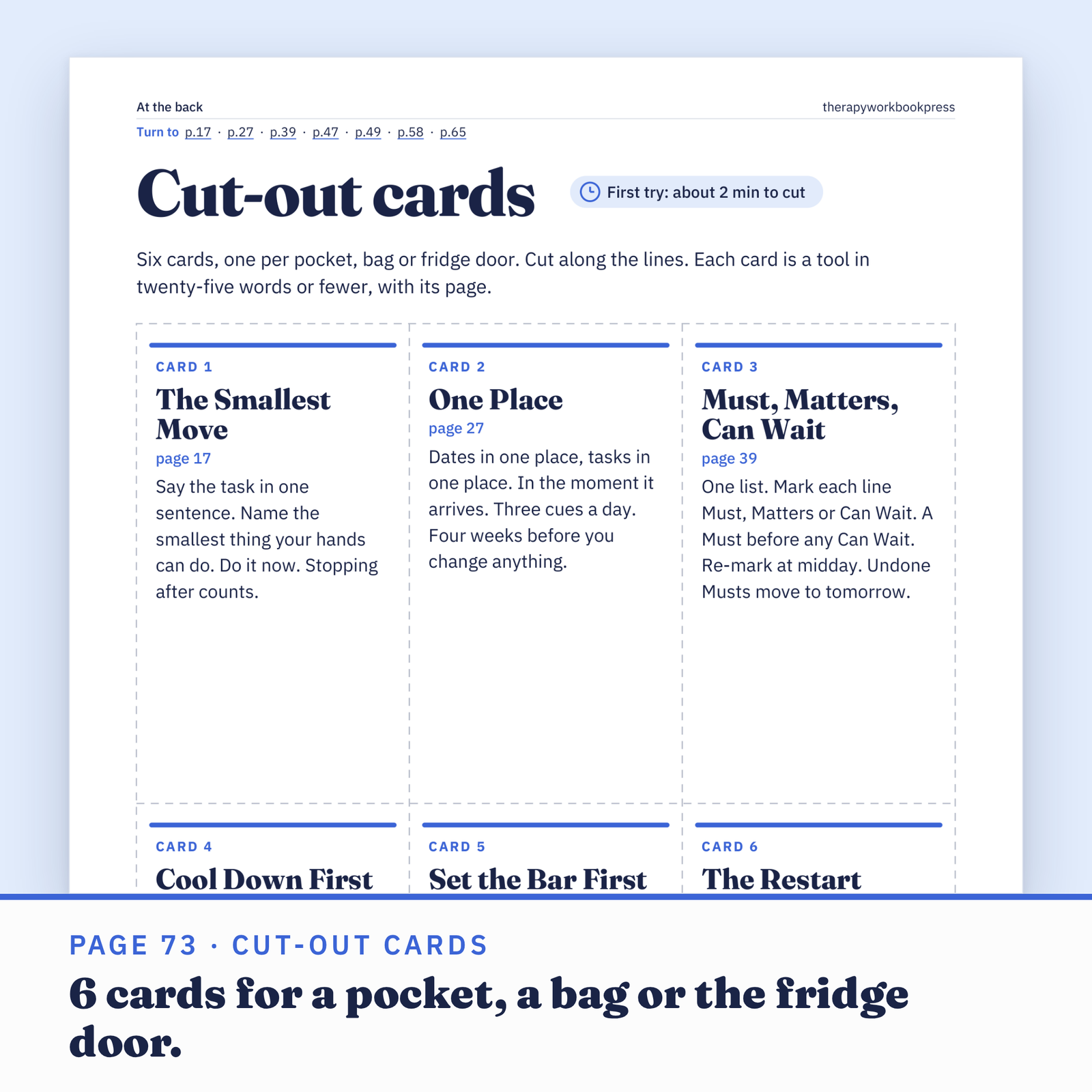
- At the back (pages 73 to 78). 6 cut-out cards, the Sources page, a page on how the evidence was used, and notes.
Task paralysis, ADHD burnout and rejection sensitivity are names people use. None is a diagnosis, and the workbook says so.
Counted from the file: 22 tools, 15 worksheets and 3 trackers.
Who It Is For, and Who It Is Not For
For: adults with ADHD, and adults with the pattern and no paperwork. That is how page 4 puts it. It suits people who know what to do and lose it at the moment of doing. Most of the examples come from a woman’s week: paid work on top of a household.
Not for: anyone who needs a diagnosis, because a workbook cannot give one. Anyone looking for treatment, or for something to replace medication or therapy. Anyone who wants a planner: only one page repeats, the weekly review on page 64.
What it does not do: repair the difficulty. Page 4 borrows that rule from Solanto: these tools work around the difficulty. They don’t repair it.
If what you are carrying is heavier than a workbook, please talk to a clinician first. Page 62 lists the signs. If you are not safe right now, call or text 988 in the US, 9-8-8 in Canada, or your local emergency number.
The Evidence, at Its Honest Size
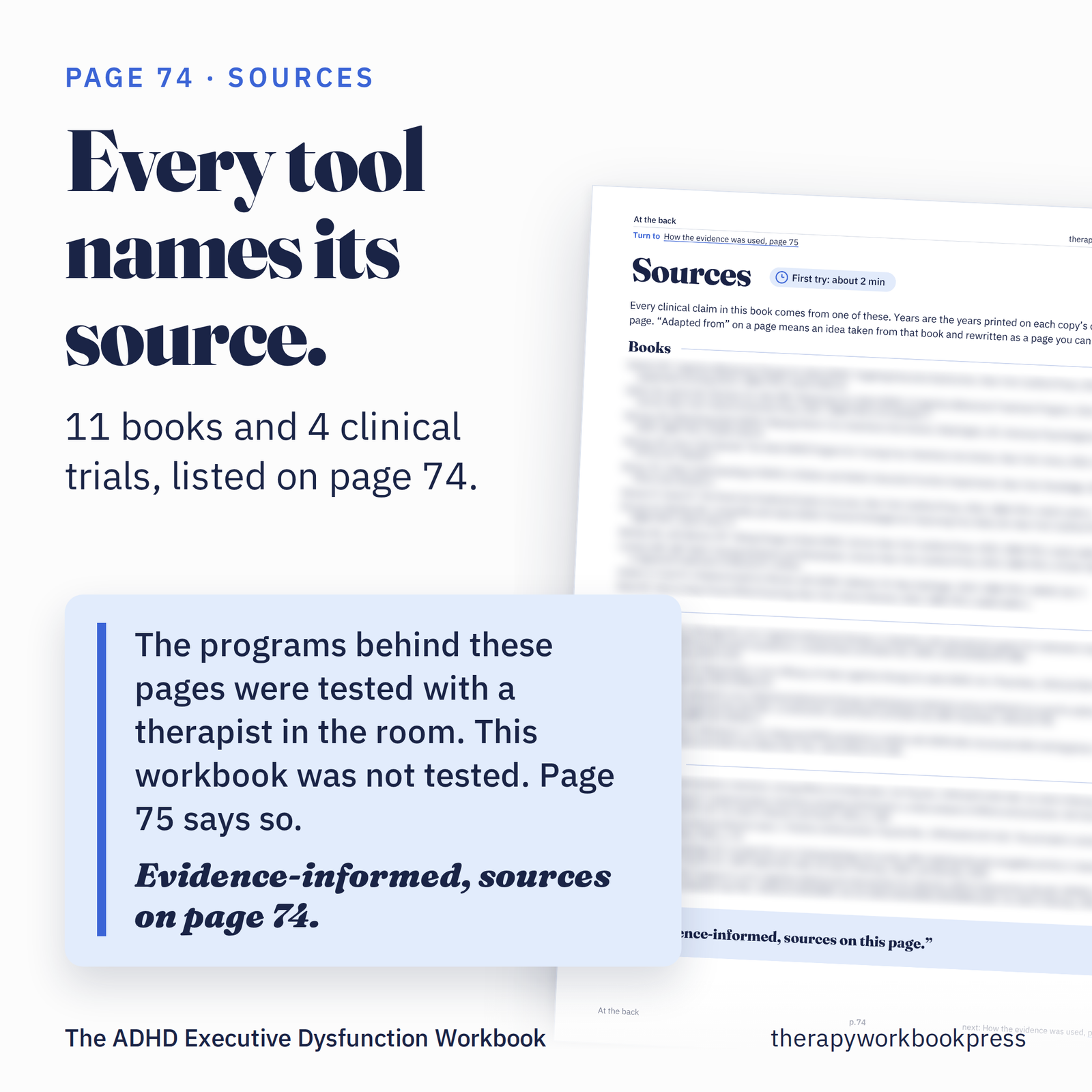
Every tool page names the book it was adapted from. Page 74 lists all of it: 11 books, 4 clinical trials and 5 further references.
One of those trials tested a program this workbook adapts (Safren and colleagues, JAMA, 2010). Adults already on medication met a therapist one to one, and more of them improved than in a comparison group. It was 86 adults and 12 sessions, and the gains were still there a year later.
But every program adapted here was tested with a therapist in the room. A 2018 Cochrane review of 14 trials of this kind of program rates the evidence low-quality. So page 75 says what this workbook is: a place to practice. It was not tested, and it does not treat ADHD.
Evidence-informed, sources on page 74. Attribution only: no author named here is affiliated with this workbook. DBT is a registered trademark of Marsha M. Linehan, and the DBT-informed pages are adaptations.
Format, Delivery and License
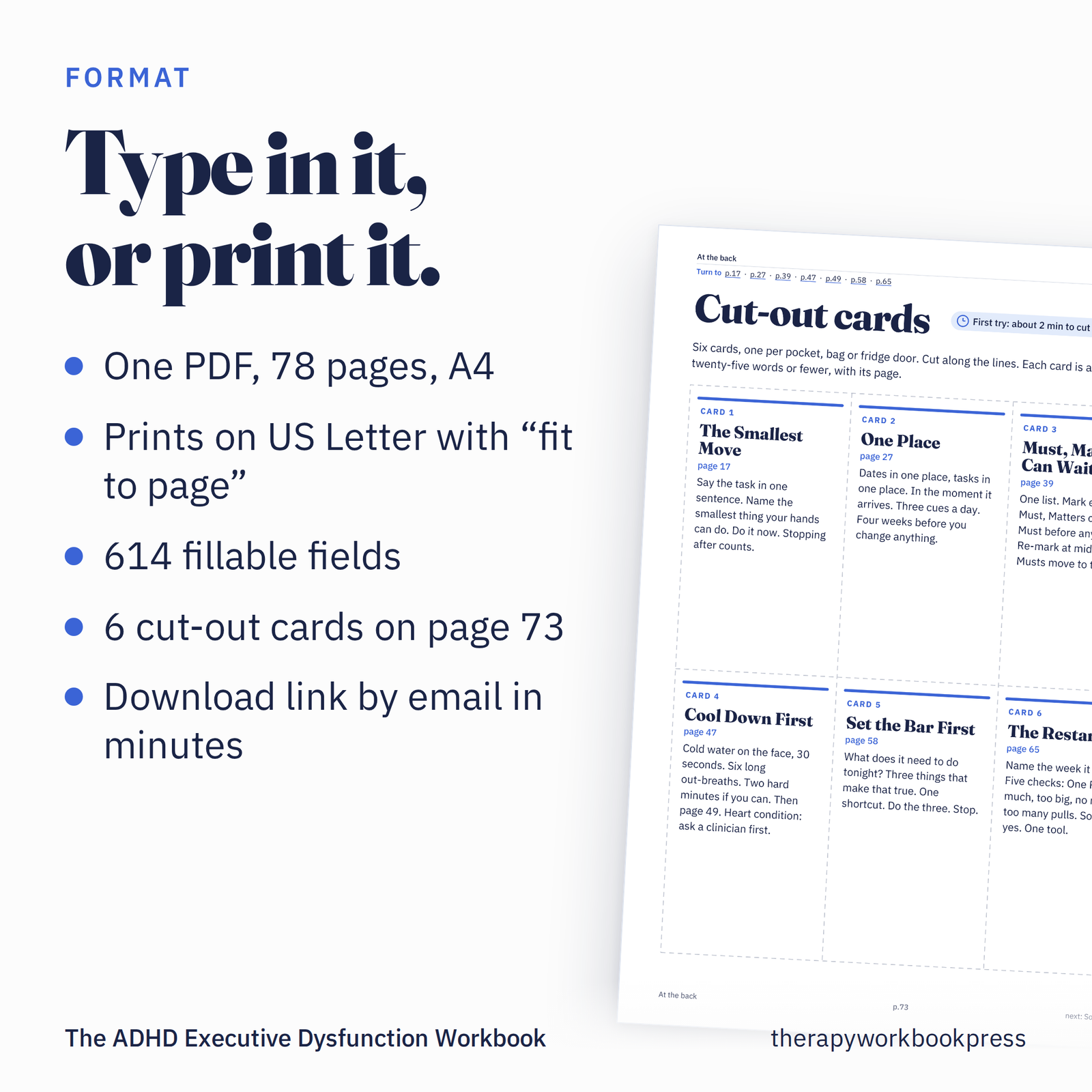
- One PDF, 78 pages, A4. It prints on US Letter with “fit to page” selected.
- Fillable. 614 fields to type or tap into, in a PDF reader such as the free Adobe Acrobat Reader. Or print it and use a pen.
- 6 cut-out cards on page 73, one per pocket, bag or fridge door.
- Instant download. The link arrives by email within minutes of purchase.
- Personal-use license. Print as many copies as you need for your own use. Clinician and group licenses: contact@therapyworkbookpress.com.
- One payment. No subscription and no app.
The 60-day guarantee. Print it. Write in it. Try every page. If it is not right for you, email contact@therapyworkbookpress.com within 60 days of your order, with your order number, and we refund you in full. You do not need to give a reason. If the Map never points you to a page worth trying, that is reason enough.
Questions
I have bought workbooks and planners before and never finished them. Is this one different? It is not built to be finished. No page needs the one before it, and stopping after the first small move counts. Page 65, The Restart, is written for the week you have not opened the book.
Do I need an ADHD diagnosis? No. The workbook was made for adults with ADHD and for adults with the pattern and no paperwork. It cannot diagnose anything.
Is it for task paralysis or ADHD paralysis? Those are names many people use for what Part 2 calls Starting: the task is open and nothing moves. Part 2 has 5 tools for that moment, and the first takes about 3 minutes to try. The workbook makes no promise about results.
Is this therapy, or a replacement for medication? No. It is a place to practice skills. Medication questions go to your prescriber, and page 62 lists the signs that it is time to talk to a clinician.
How long does it take? About 10 minutes for the Map and about 3 minutes for a first tool. After that, the book borrows a rule from Knouse and Barkley: give a tool a week before you judge it. Part 7 has a 4-week grid.
Is it only for women? No. Most of the examples come from a woman’s week, and the tools are the same for anyone.
What exactly do I receive? One PDF file, 78 pages, by email after checkout. Nothing ships.
Can I print it on US Letter? Yes. The pages are A4. Select “fit to page” and nothing is cut off.
Can I use it with my clients or my group? The standard license is for personal use. For a clinician or group license, email contact@therapyworkbookpress.com.
What if a page makes things feel worse? The book answers that on page 4: close it and turn to page 62.
Start with page 2. It takes about a minute.