
The exercise that worked on Tuesday did nothing on Thursday. I was not doing it wrong.


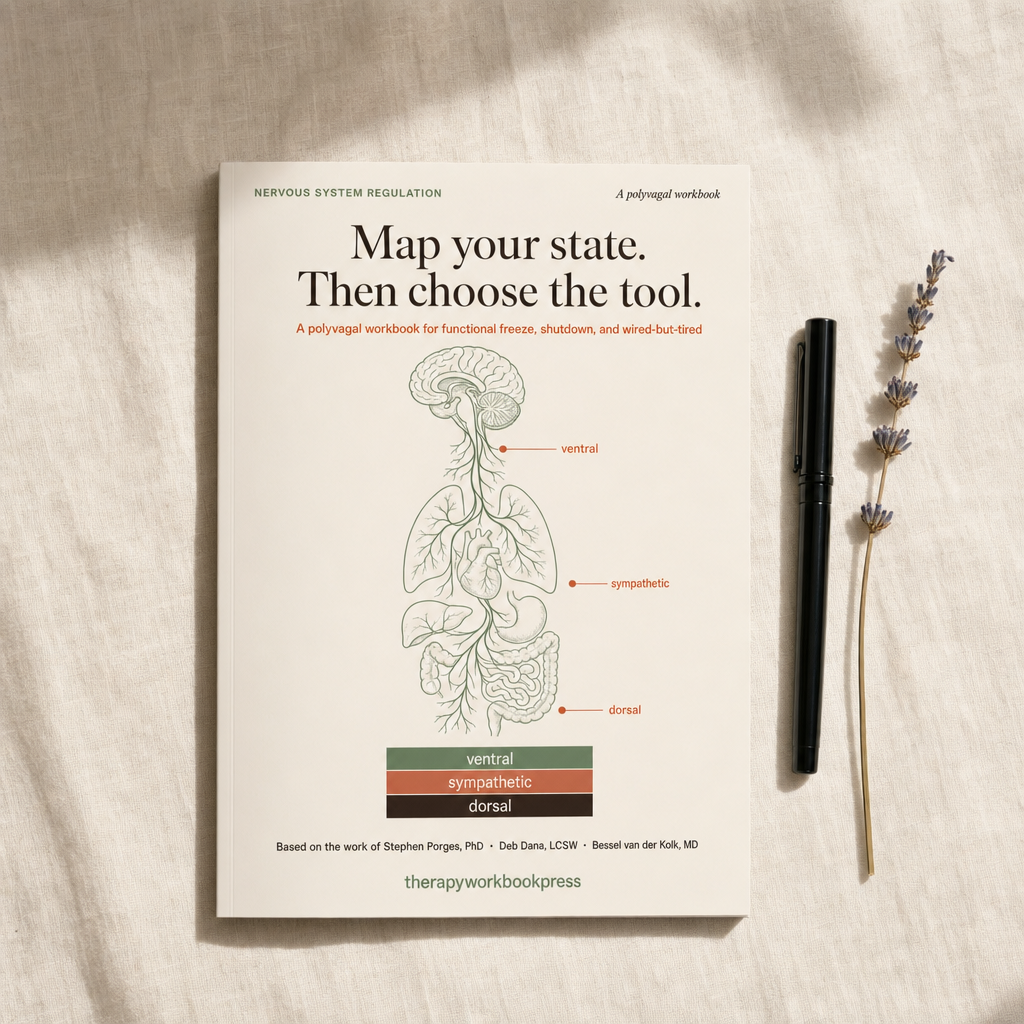


















Nervous System Regulation Workbook: Map Your State, Then Choose the Tool
The exercise that worked on Tuesday did nothing on Thursday. I was not doing it wrong.
$29.49$55.00
Instant PDF by email
60-day refund
Keep the file
Which one is it right now?
Tap one. This is the check from page 13, cut down to one question. The page asks three.
Settled. Page 13 points to the strengthening practices.
Humming, page 32Soothing touch, page 37Glimmer-spotting, page 23
Revved. Page 13 points to the discharge practices.
Voo breathing, page 30Physiological sigh, page 31Movement, page 38Cold, page 33
Shut down. Page 13 points to the upregulation practices: orienting, gentle movement, light and social contact.
Orienting, page 35Gentle movement, page 38Social contact, page 39
A teaching map, not a diagnosis.
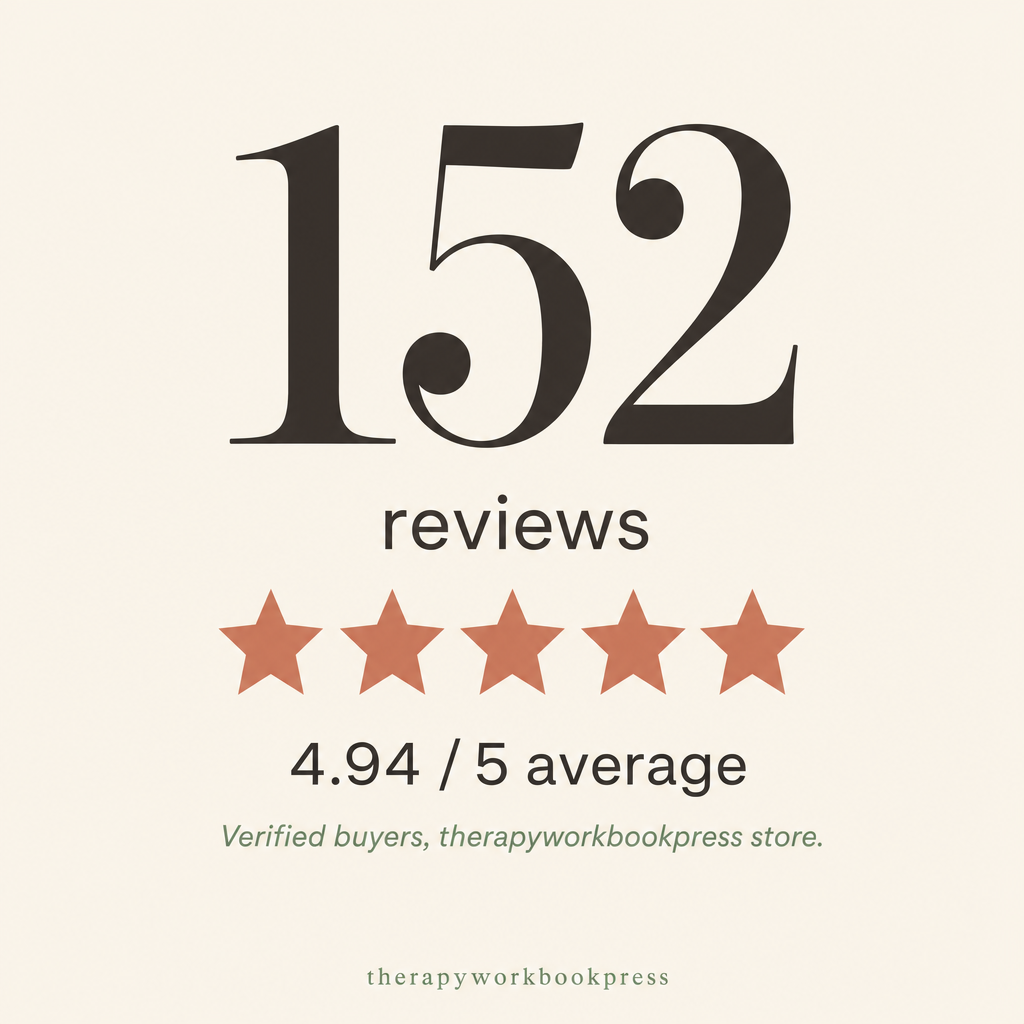
“Fabulous workbook! Very useful in my own life, with my children, and in my work as a life coach.” Trish, verified buyer, June 2026
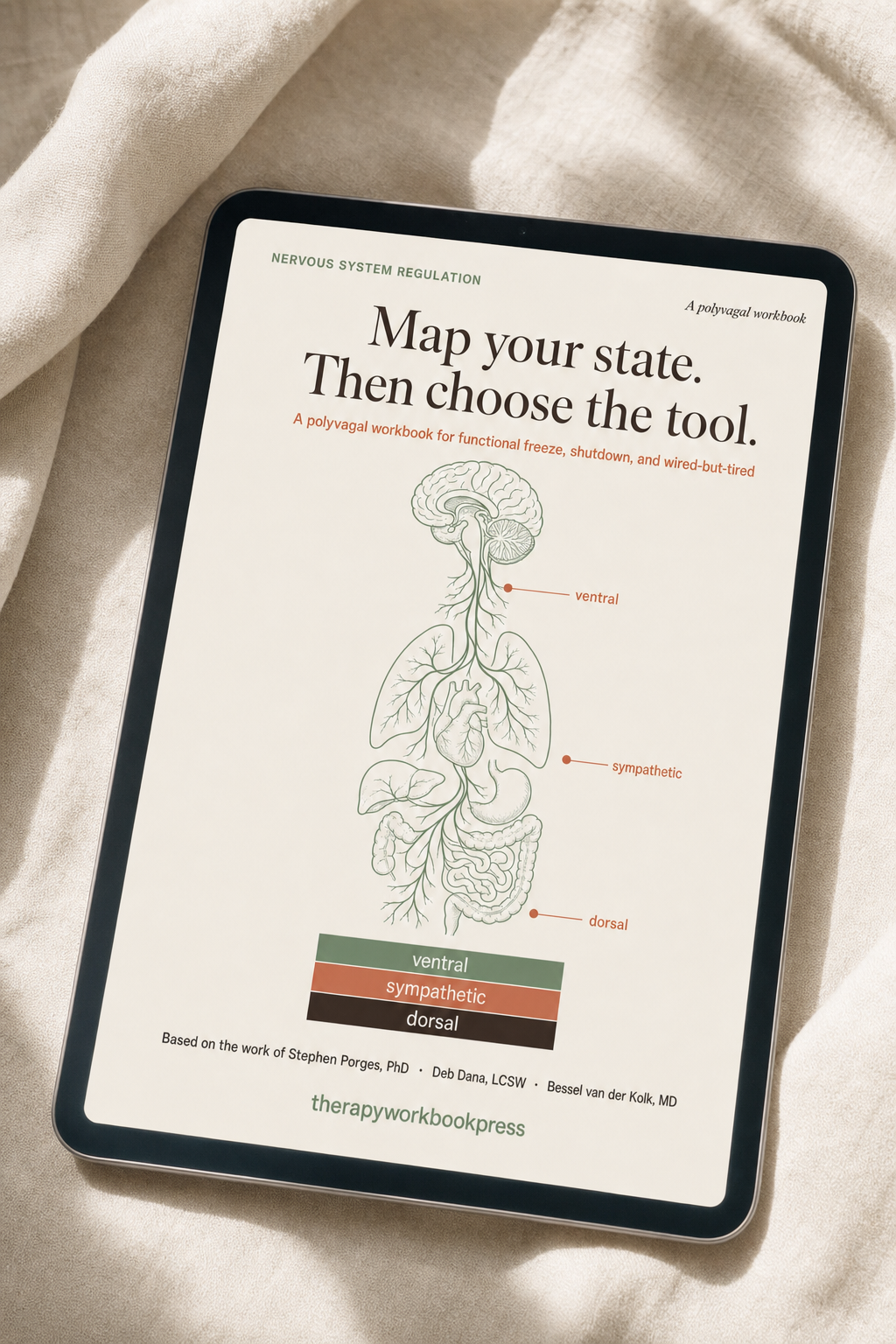
Practice, not more reading. A 51-page PDF workbook: a 60-second state check, 13 techniques marked for the state they serve, and 18 worksheet pages to type into or print. A4.
Instant download
Sent to your inbox right after checkout
Lifetime updates
Every future edition, free
60-day guarantee
Full refund, no questions, keep the file
Sources named
Porges, Dana, van der Kolk. 19 references on page 51
Print or tablet
A4. Type into the worksheets or print them
Which one is it right now?
Tap one. This is the check from page 13, cut down to one question. The page asks three.
Settled. Page 13 points to the strengthening practices.
Humming, page 32Soothing touch, page 37Glimmer-spotting, page 23
Revved. Page 13 points to the discharge practices.
Voo breathing, page 30Physiological sigh, page 31Movement, page 38Cold, page 33
Shut down. Page 13 points to the upregulation practices: orienting, gentle movement, light and social contact.
Orienting, page 35Gentle movement, page 38Social contact, page 39
A teaching map, not a diagnosis.
Instant download
Sent to your inbox right after checkout
Lifetime updates
Every future edition, free
60-day guarantee
Full refund, no questions, keep the file
Sources named
Porges, Dana, van der Kolk. 19 references on page 51
Print or tablet
A4. Type into the worksheets or print them
I was told to just breathe.
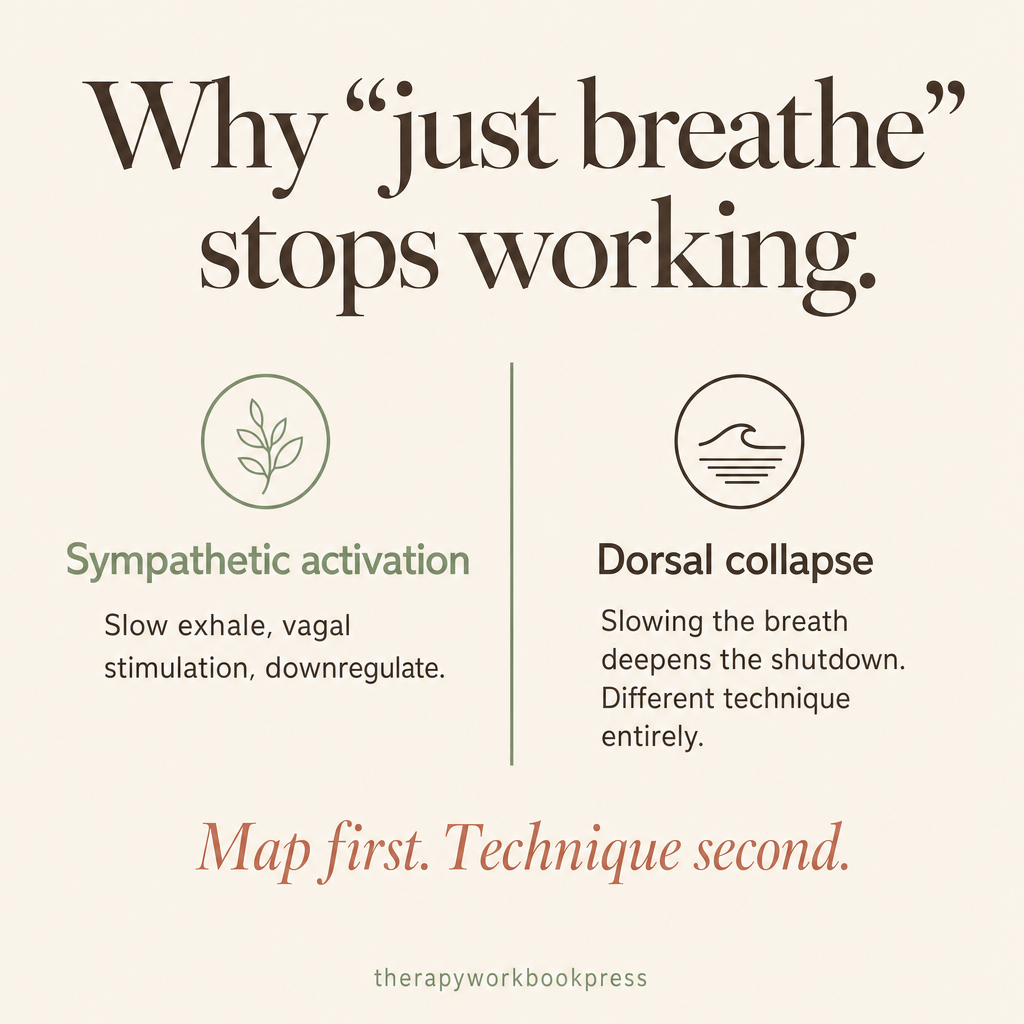
I was told to breathe through it. To ground. Some days that worked.
On the days that mattered most, the same exercise did nothing. Same exercise. Same chair. Same five minutes. I decided I was doing it wrong.
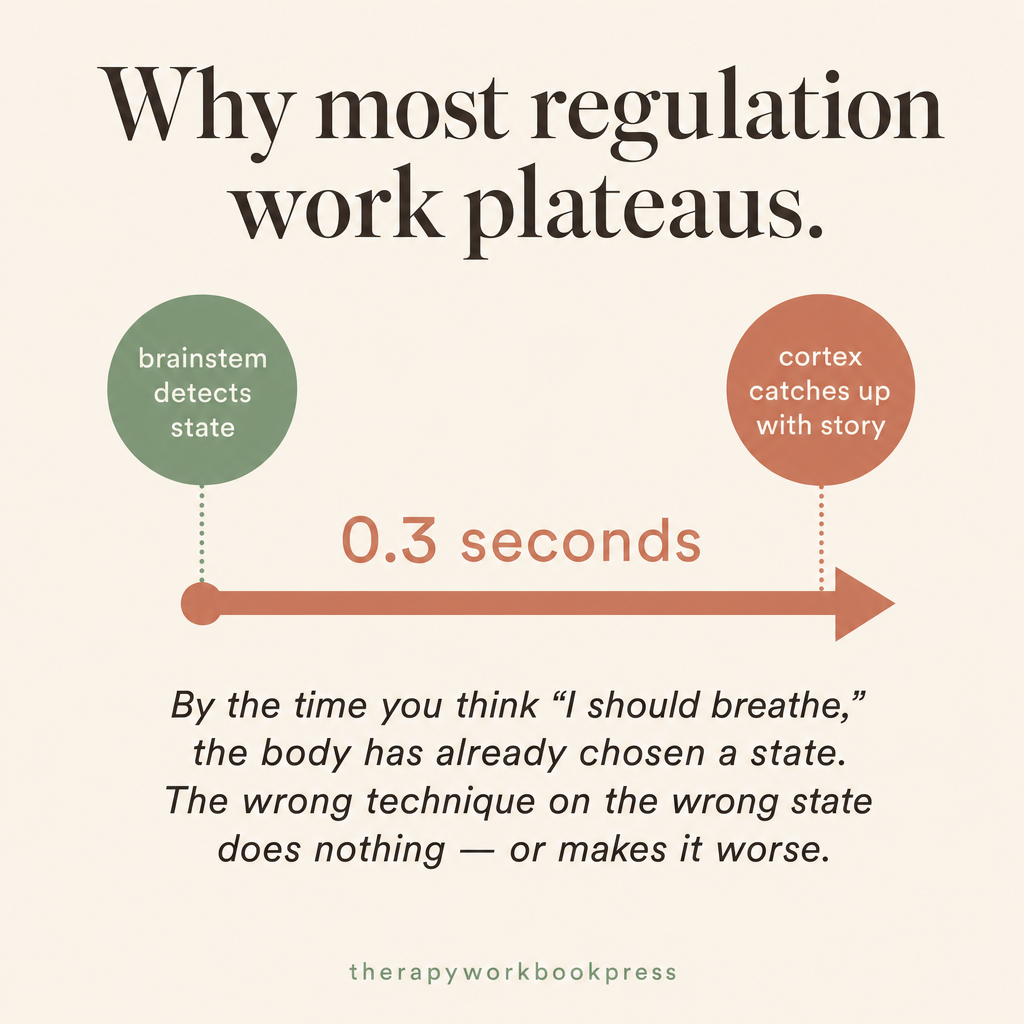
I was not doing it wrong. I was in a different state.
On Tuesday my system was revved, and a long exhale brought it down. On Thursday it was shut down, and there was nothing left to bring down. The tool was fine. The match was missing.
Why the last tool failed
Same exercise. Two different days.
Tuesday
Revved
tight chest, racing list
a long exhale met it and brought it down
Thursday
Shut down
heavy limbs, flat quiet
nothing left to bring down
The tool was fine. The match was missing.
State first, then the tool. That is how Deb Dana sorts practices.
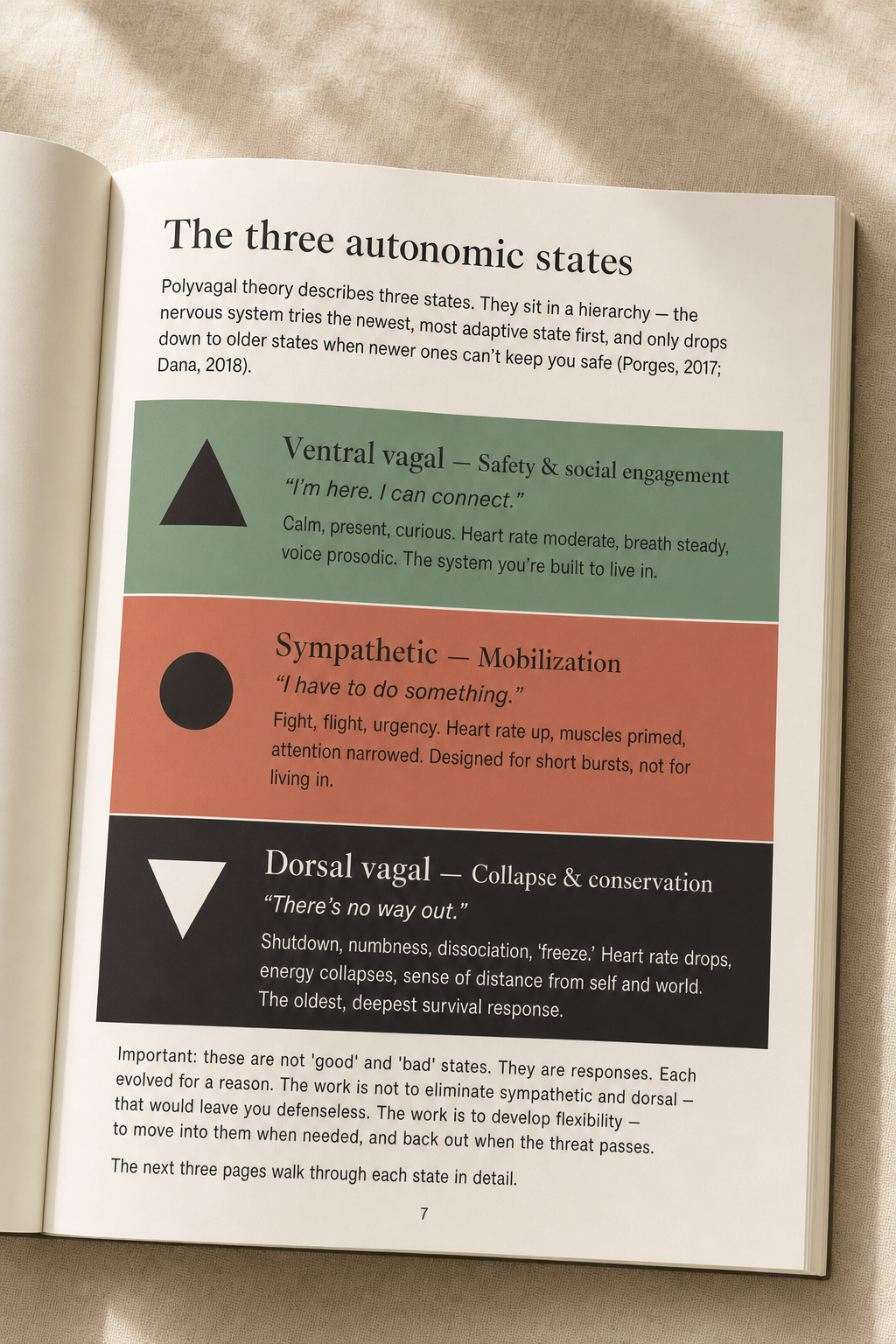
Three states, not two.
The advice I had been given knew two: stressed, and calm.
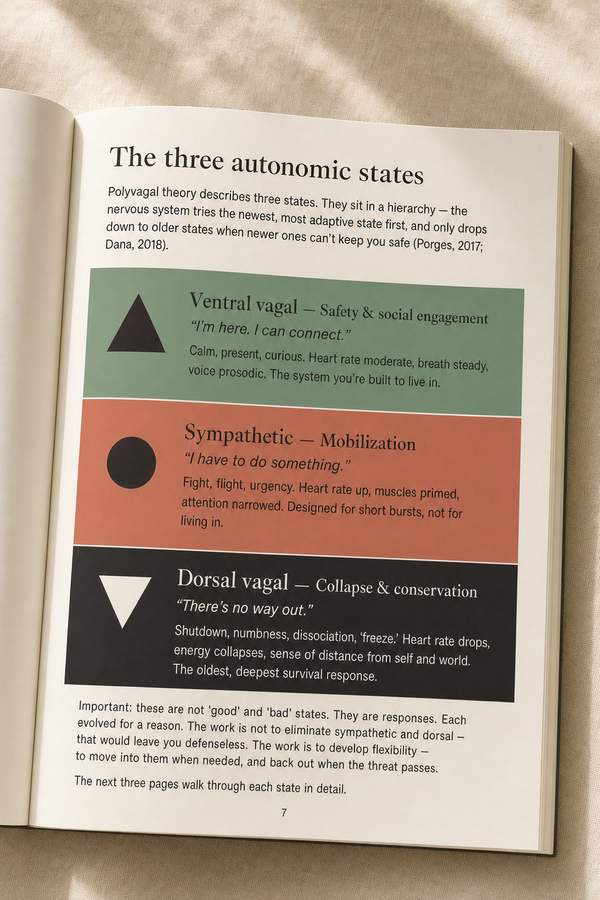
Stephen Porges describes three. Deb Dana, a clinician, teaches them as a map and sorts practices by state (Dana, 2018). In plain words: settled, revved and shut down. The workbook uses the clinical names: ventral, sympathetic and dorsal.
Her sorting is simple. A revved system needs a safe way to let energy out. A shut-down system needs a gentle return of energy, not a big shift.
So the first question is not which exercise. It is which state.
A list is not a map.
Most of what I had collected was lists. Ten ways to calm down. Five breathing exercises. A list tells me what to do. It does not tell me which one, today.
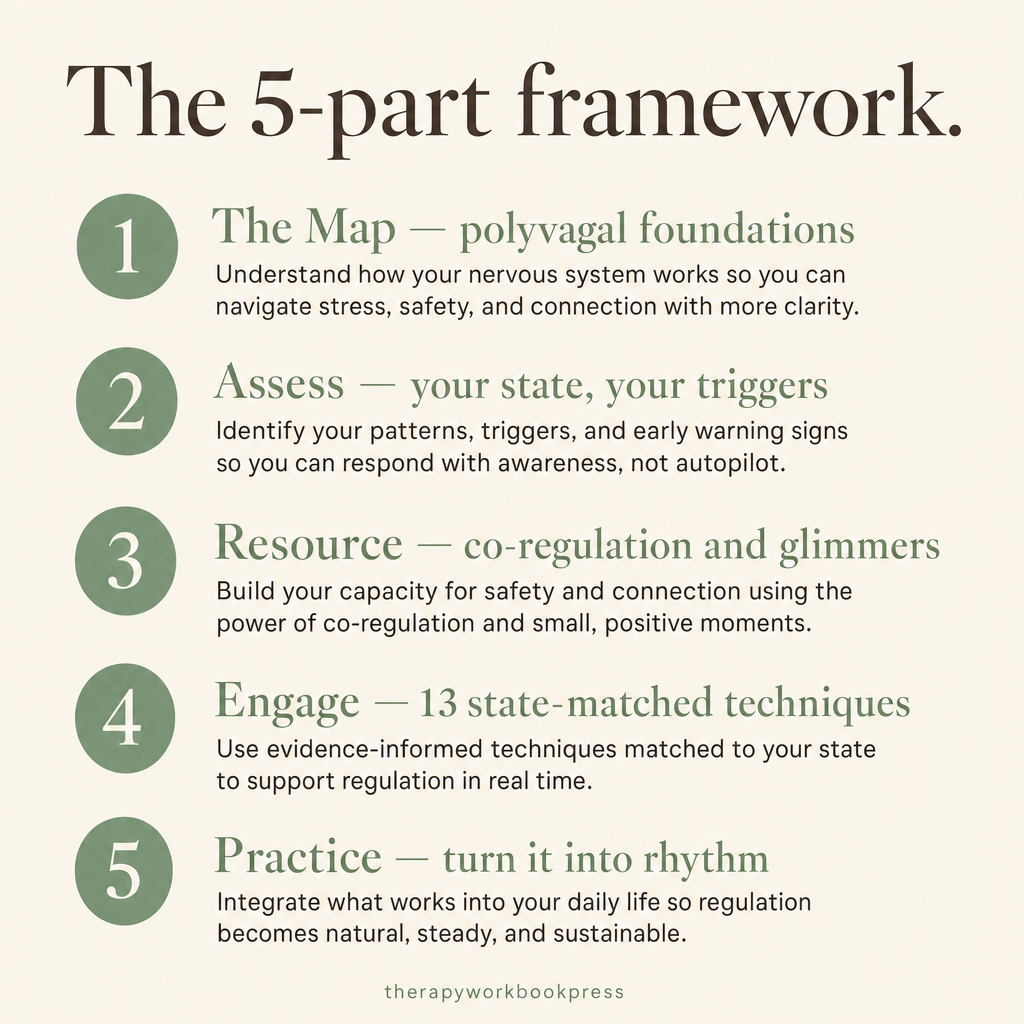
This workbook starts one step earlier. A 60-second check on page 13 names the state. A table on page 28 shows which of the 13 techniques are marked for it. Then I open one page and do it.
The first evening
- Open the workbook to page 13.
- Answer three questions: body, mind, and how I feel toward the world. Tick one line under each. It takes 60 seconds.
- Write the state on the line: ventral, sympathetic or dorsal. In plain words, settled, revved or shut down.
- The page names the technique family for that state. The table on page 28 gives the page number for each technique.
- Open one and do it. The physiological sigh on page 31 takes 30 to 90 seconds.
That is the method. The rest of the workbook teaches the map, helps me find my own patterns, and turns single exercises into a week.
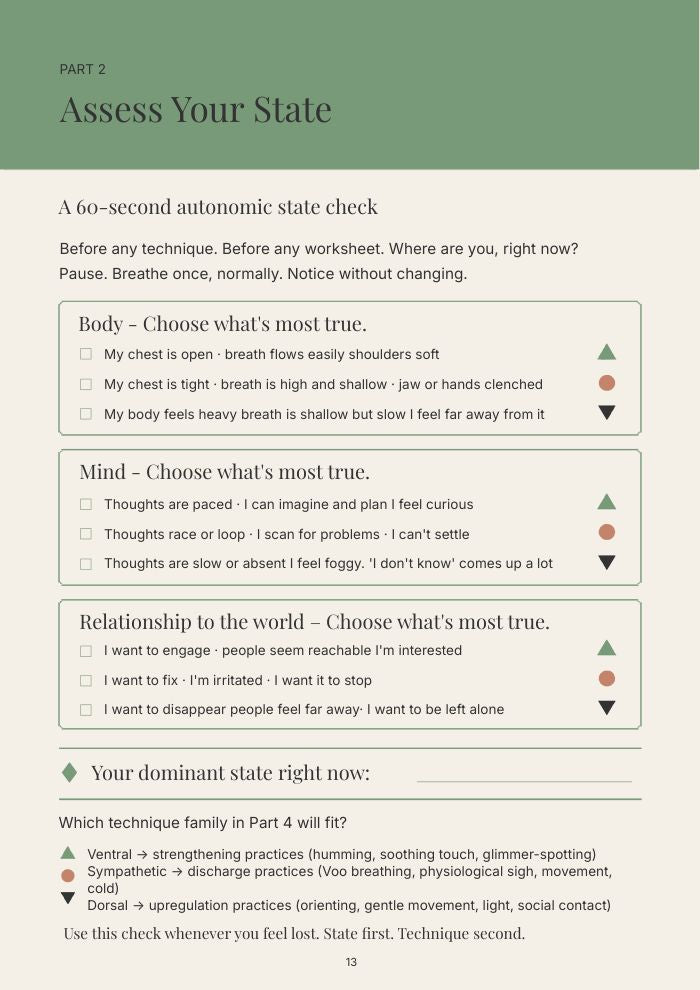
Page 13, the 60-second state check
What is in the workbook
51 pages. Five parts. One PDF.
Pages
01
The Mappages 5 to 12
The three states, one page each, with what each one feels like.
Neuroception, Porges's word for how the body reads safety and danger. Triggers and glimmers.
02
Assess Your Statepages 13 to 19
The 60-second state check.
A symptom decoder that reads 8 everyday symptoms three ways, from tiredness to restlessness.
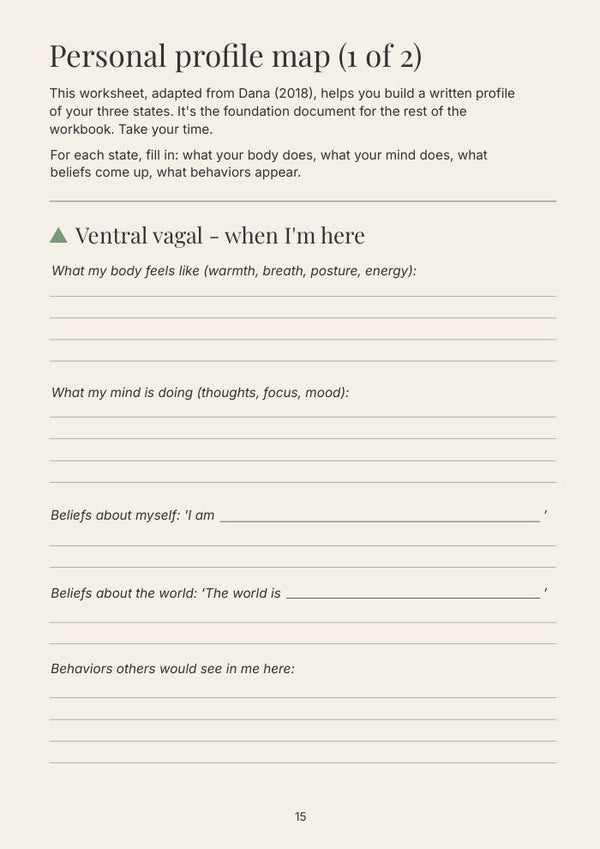
A personal profile map, a stress response log, and a triggers and glimmers map.
03
Resource and Resiliencepages 20 to 27
What brings me back to settled.
A co-regulation worksheet. A glimmer-spotting practice, about 3 minutes a day.
The 3 Cs of safety: choice, context, connection. A 10-step emotional regulation worksheet.
04
Active Engagementpages 28 to 43
13 techniques, one per page, each marked for the state it serves.
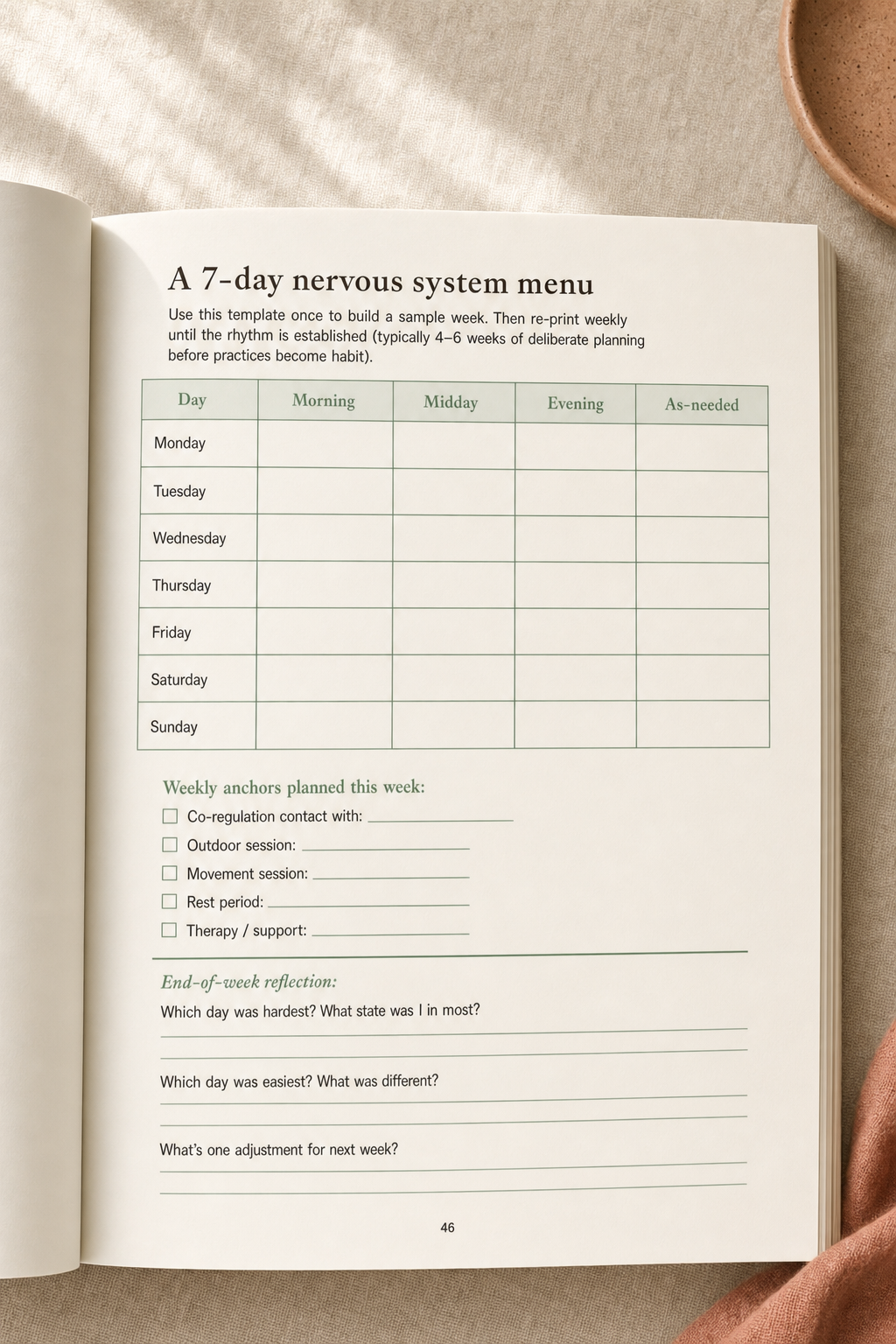
The technique table on page 28. A daily menu for morning, midday and evening.
05
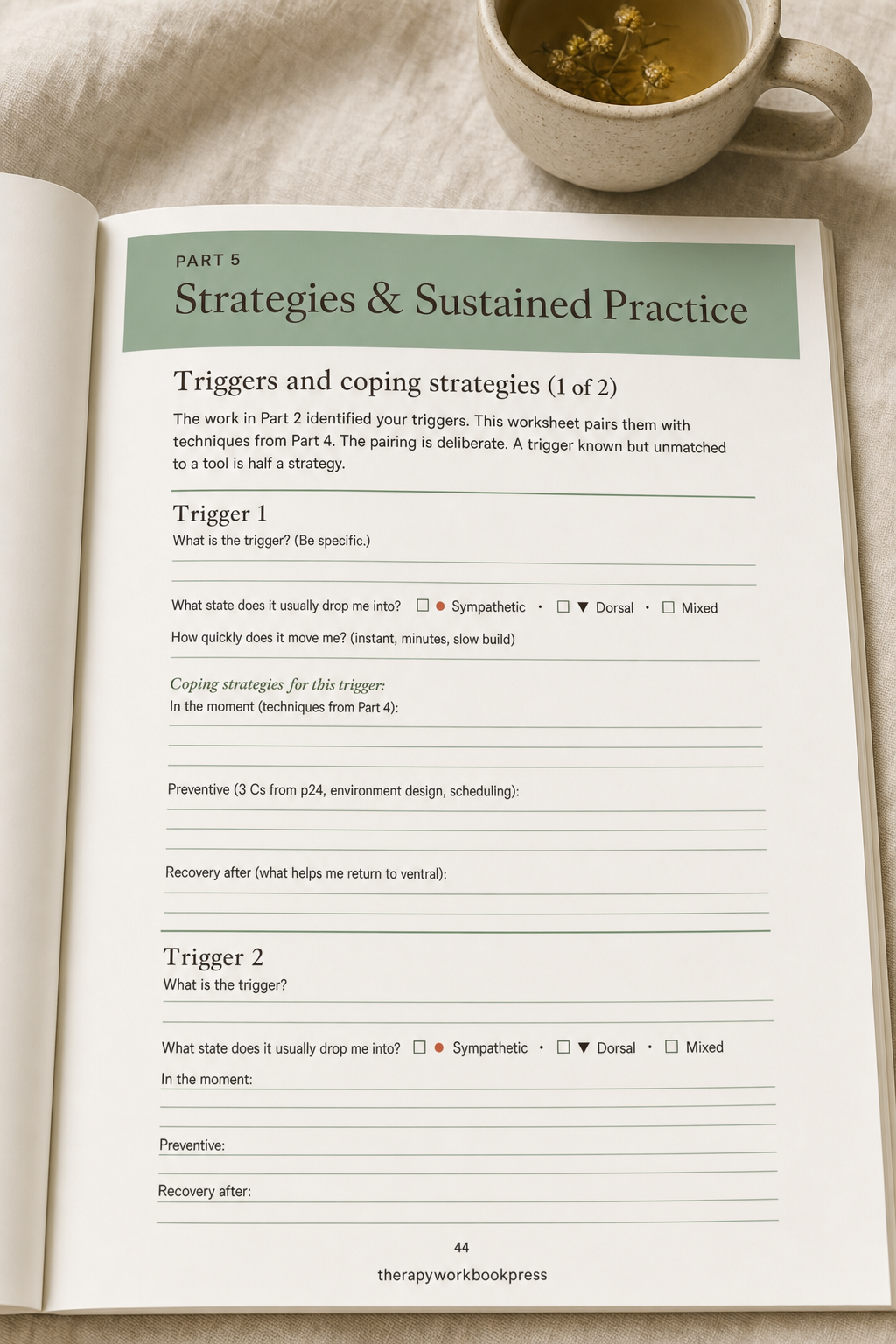
Strategies and Sustained Practicepages 44 to 50
Turning single exercises into a week.
Triggers paired with coping strategies. A 7-day menu. A self-care plan. 18 question cards.
+
Referencespage 51
19 references, printed in the workbook.
The 13 techniques, one per page:
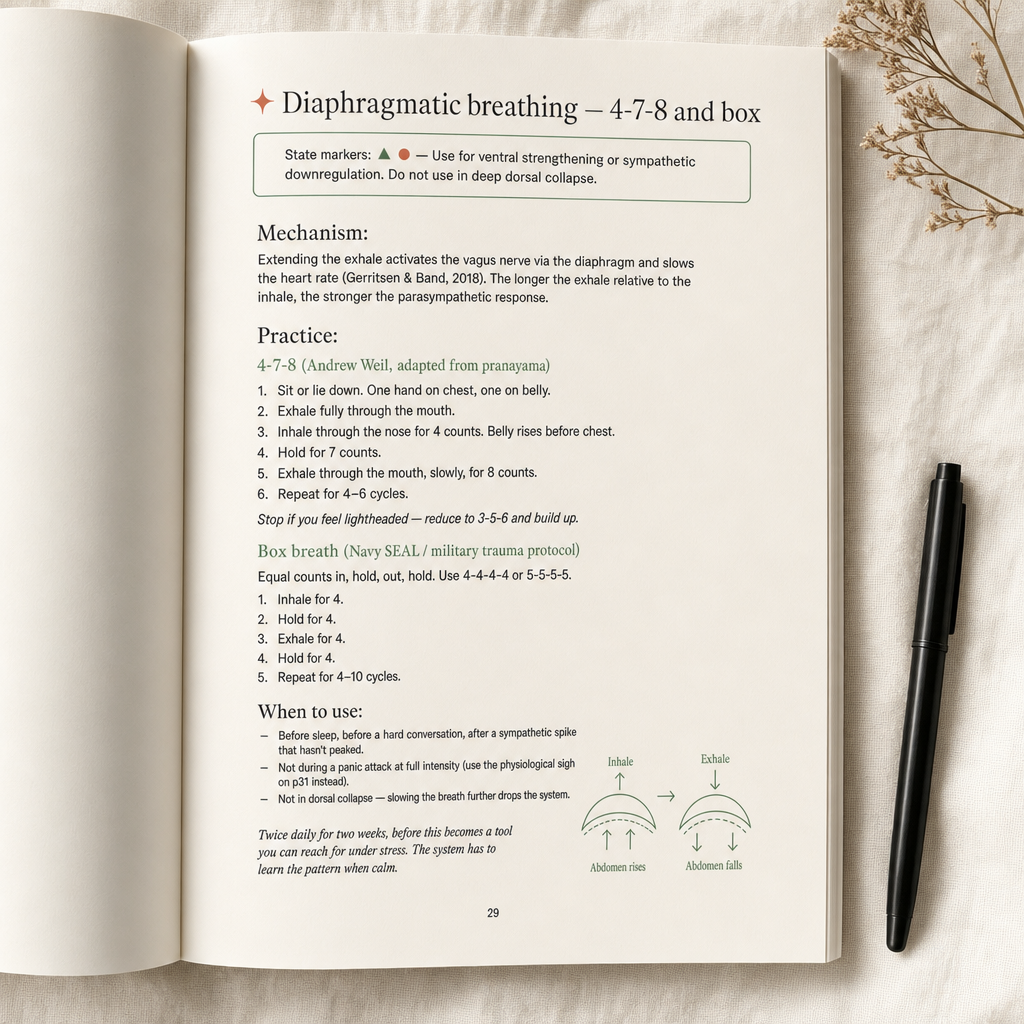
- Diaphragmatic breathing29
- Voo breathing30
- The physiological sigh31
- Humming and toning32
- Cold exposure33
- The Butterfly Hug34
- Orienting35
- Tongue release and soft palate36
- Soothing touch, five hand positions37
- Movement to discharge38
- Co-regulation cues39
- Concentration meditation40
- Eye reset41
By state, from the table on page 28: 12 are marked for revved days, 5 for shut-down days and 8 for settled days. The 5 for shut-down days are cold exposure, orienting, soothing touch, movement and co-regulation cues.
List price$55.00
The workbook$29.49
Instant PDF by email. 60-day refund. Keep the file.
One payment. No subscription. Every future edition, free.
Why it is built this way
- The check comes first, so I stop guessing which exercise to try.
- Each technique is marked for its state, so I can see what fits today.
- One technique per page, so I can use it in the moment without reading a chapter.
- 18 worksheet pages have fields, so I can type on a tablet or print and write by hand.
- The 7-day menu turns single exercises into a week I can repeat.
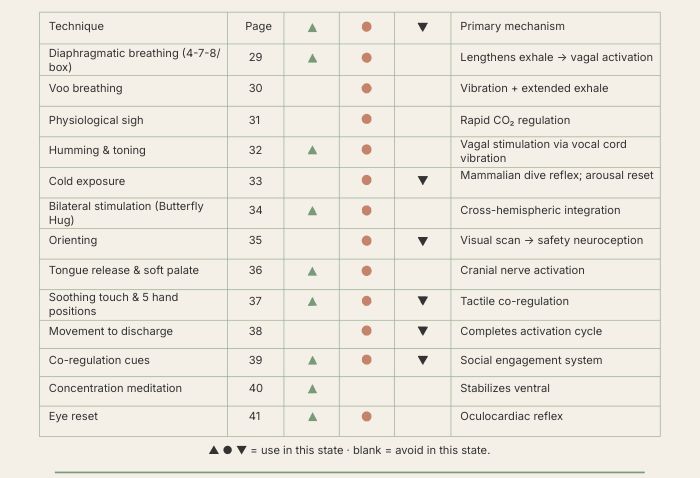
The technique table on page 28 (detail)
Real pages from the workbook
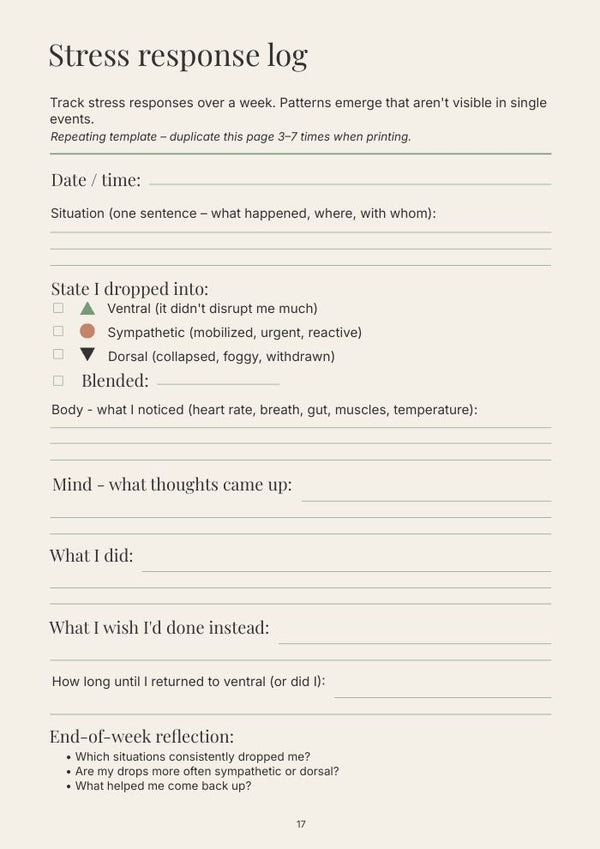
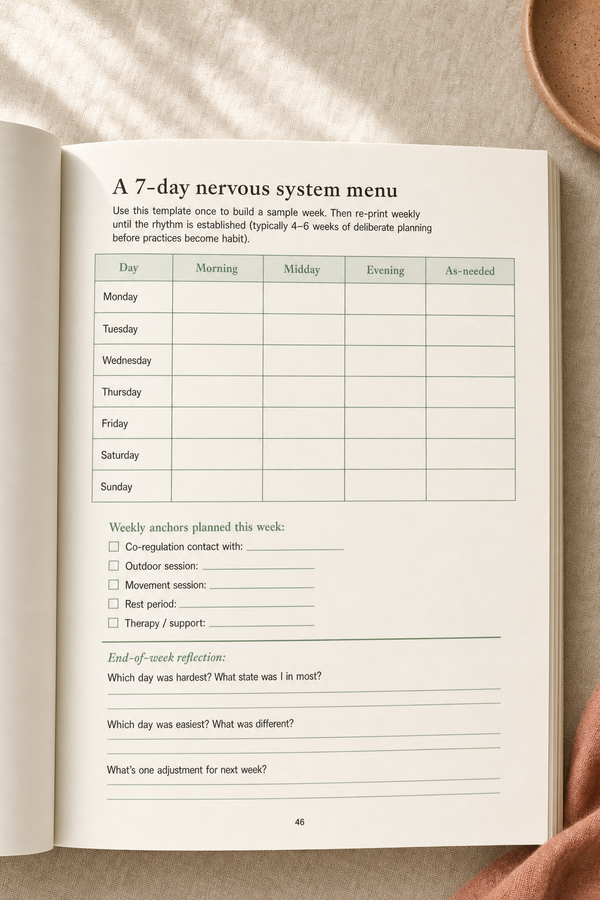
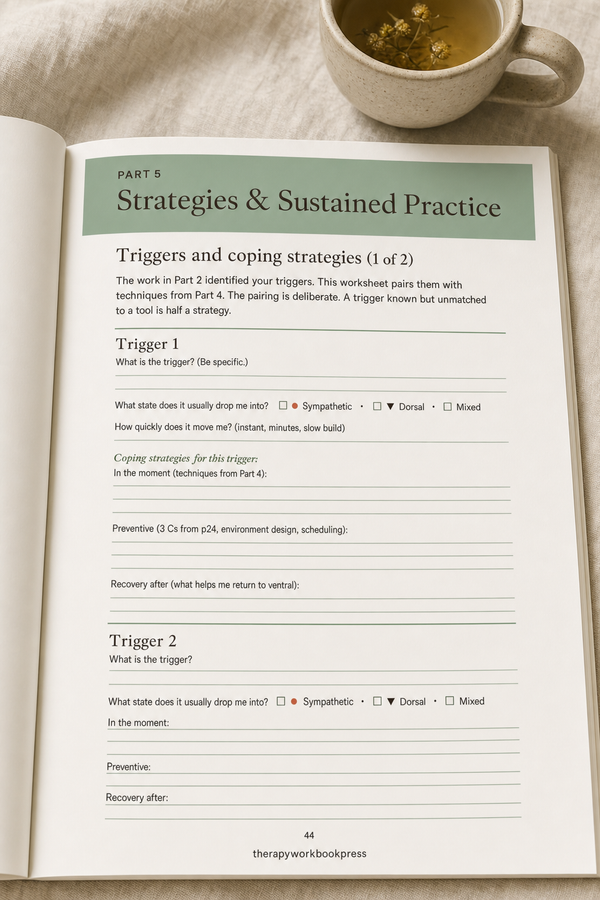
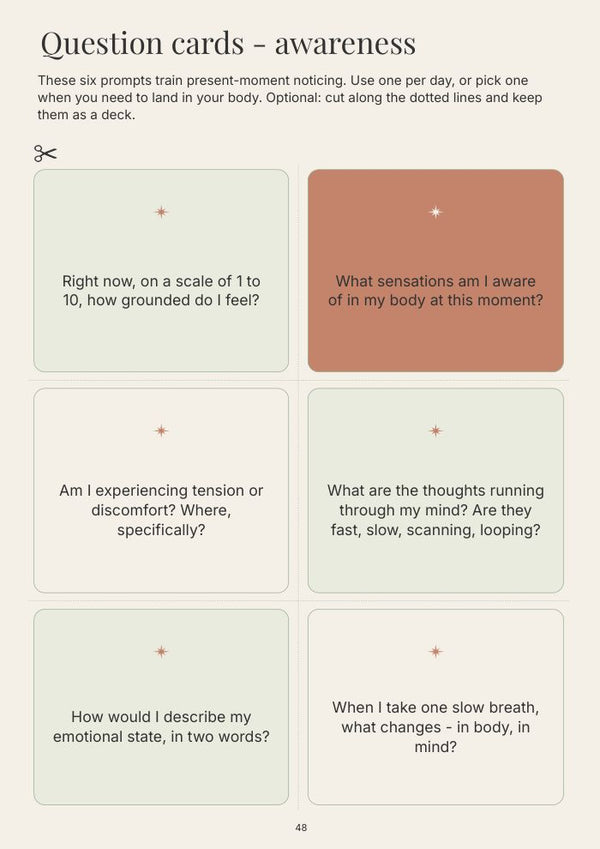
“It’s great resource for people with trauma” Verified buyer, January 2026
More than 2,000 orders since December 2025.
Polyvagal-informed, and honest about it
The state language comes from Stephen Porges and Deb Dana. Two of the worksheets are adapted from Dana's clinical maps, and say so on the page.
The biology behind the theory is disputed among researchers. So the workbook uses the three states as a map for noticing, not as a diagnosis.
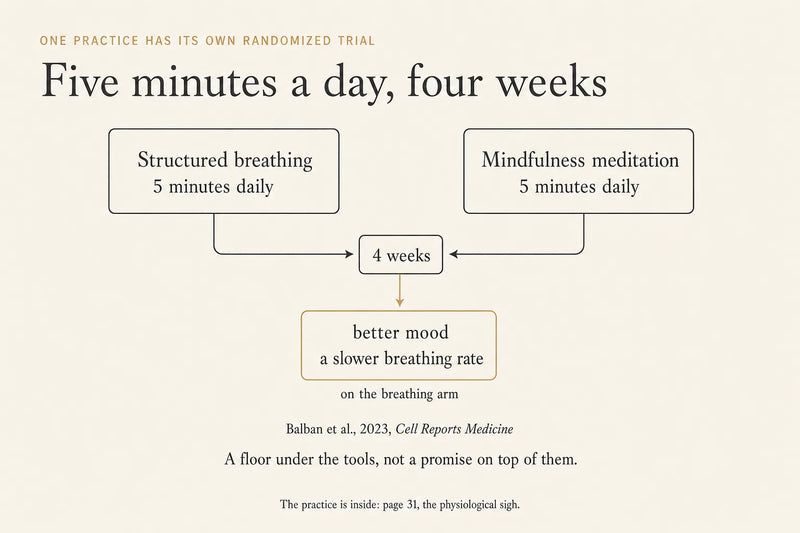
One practice inside has its own randomized trial. Stanford researchers followed 108 people for a month. Most people expect meditation to win. Five minutes a day of structured breathing lifted mood more than mindfulness meditation, and the double-inhale, long-exhale pattern did best (Balban et al., 2023, Cell Reports Medicine). That pattern is on page 31.
One trial, small groups, done remotely. A floor under the tools, not a promise on top of them.
Who it is for
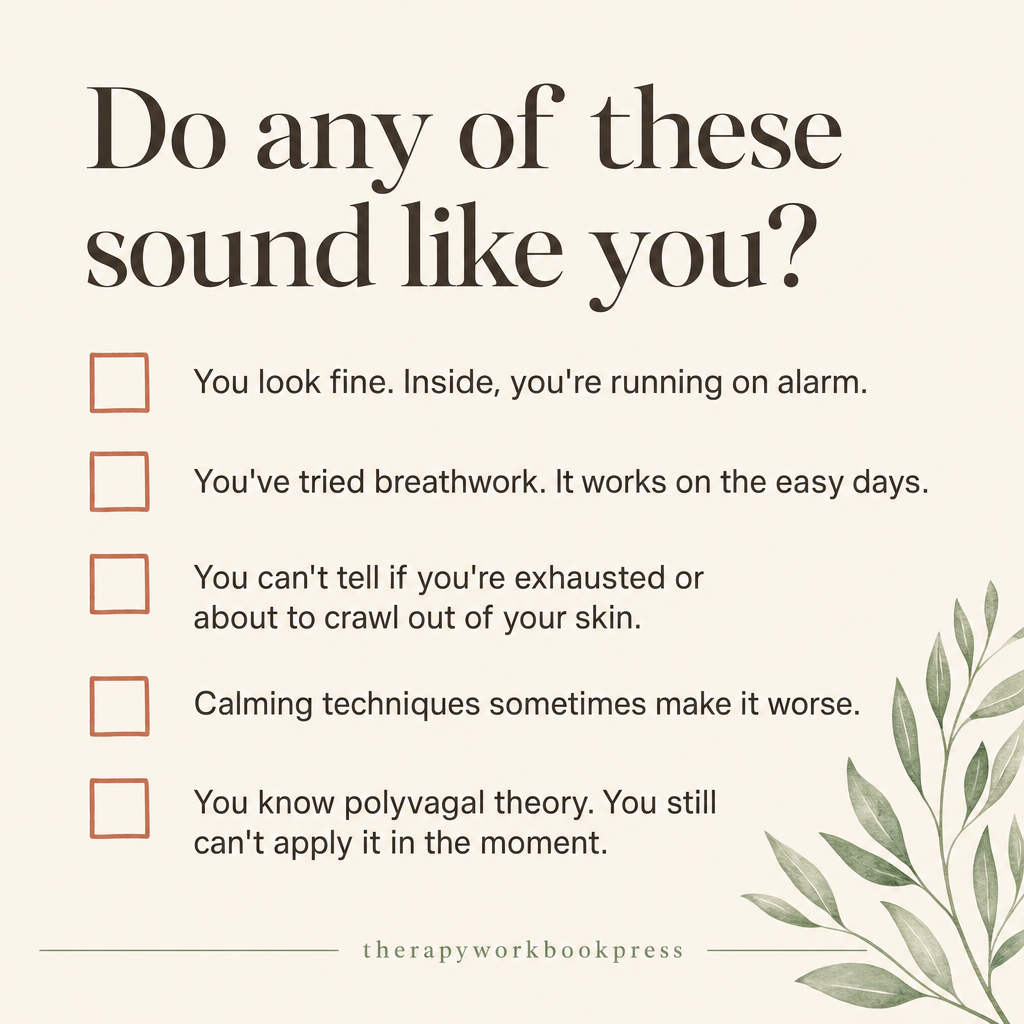
- Those of us who tried the exercises and decided they did not work.
- People who know the theory and still need a page to open in the moment.
- People with wired days and flat days who cannot always tell which is which.
- People in therapy who want pages for the days between sessions.
- Anyone who wants to type into a workbook on a tablet, or print it.
Who this is not for
Anyone looking for one exercise that fixes everything by Friday. These are practice pages, used a few minutes at a time.
Anyone looking for therapy. This is education and practice. It sits next to therapy, not in place of it.
Anyone in crisis today. Please contact a clinician or your local emergency number first.
Anyone who wants a printed book in the mail. This is a PDF.
The state map is a teaching tool. It does not diagnose anything.
Questions before you buy
I have tried breathing exercises. Some days they did nothing.
Some days they did nothing for me either. That is the Tuesday and Thursday problem above. Here the state check comes first, and each technique is marked for the state it serves.
A calming exercise once made me feel worse. Was that me?
No. Researchers have a name for it: relaxation-induced anxiety. In a small 1983 study of 14 tense adults, 31% reported more tension after a muscle-relaxation session and 54% after a mantra meditation session (Heide and Borkovec, 1983). Each technique page in the workbook says which states it is for.
I already own books on this.
So did I. This one is built to be used, not read through. A 60-second check, then one page to do.
Do I need a diagnosis, or to know polyvagal theory?
No. Part 1 teaches the map in 8 pages. The check asks about body, mind and mood in plain sentences. It is a teaching tool, not a diagnosis.
Is it only for anxiety? Mine is the flat, can't-start kind of day.
No. The check separates revved from shut down. 5 of the 13 techniques are marked for shut-down days: cold exposure, orienting, soothing touch, movement and co-regulation cues.
How much time does it take?
The state check takes 60 seconds. Several techniques take about a minute: the physiological sigh is 30 to 90 seconds, the eye reset 30 to 60. Concentration meditation is the long one, at 10 to 15 minutes.
Is this a printed book?
No. It is a PDF, sent by email right after checkout. Nothing is printed or posted. The photos show it printed so the pages are easy to see.
Can I use it on my phone or tablet? Do I need a printer?
Yes, and no. The PDF opens on any phone, tablet or computer. 18 worksheet pages have fields to type into in a PDF app. Or print the pages you want. It is A4 and prints on US Letter with fit to page.
Is polyvagal theory proven?
No. The biology behind the theory is disputed. In 2026, 39 researchers published a paper calling it untenable, and Porges published a reply in the same journal. The workbook uses the practical part: three states described by how they feel, as a map for noticing. One of its breathing practices has its own randomized trial.
Is this therapy?
No. It is education and practice pages, meant to sit alongside therapy, not replace it.
I am a therapist. Can I use it with clients?
The workbook is licensed for personal use. For client handouts, email us about a practitioner licence.
What if it is not right for me?
Email us within 60 days for a full refund. You keep the file.
How you get it
- Check out with card, Apple Pay, PayPal or Klarna.
- Your download link arrives by email right after payment.
- Open the PDF on any device. Type into the worksheets, or print the pages you want.
“Cool beans” Kirk, verified buyer, August 2026
The 60-day keep-the-file guarantee
Take the state check on page 13. Open the page it points to. Use the workbook for 60 days. If it is not right for you, one email gets a full refund. You keep the file. No forms, nothing to send back.
$29.49 List price $55.00
Instant PDF by email. 60-day refund. Keep the file.
The state check takes 60 seconds. It can be tonight.
This workbook is education and self-reflection. It is not therapy and it does not replace care that is working. If a practice stirs up more than it settles, stop, and take that as useful information. Check with a healthcare provider before new breathing or cold practices if you have a heart condition, a history of seizures, or are pregnant. Heavier histories deserve a trained clinician alongside, and this workbook sits well next to that work.