
You want an ordinary day back: to sleep without waking at every noise, to drive to the store, to say yes to a friend. This workbook gives you the steps toward it, about 15 minutes most days, and it never asks you to write out what happened.


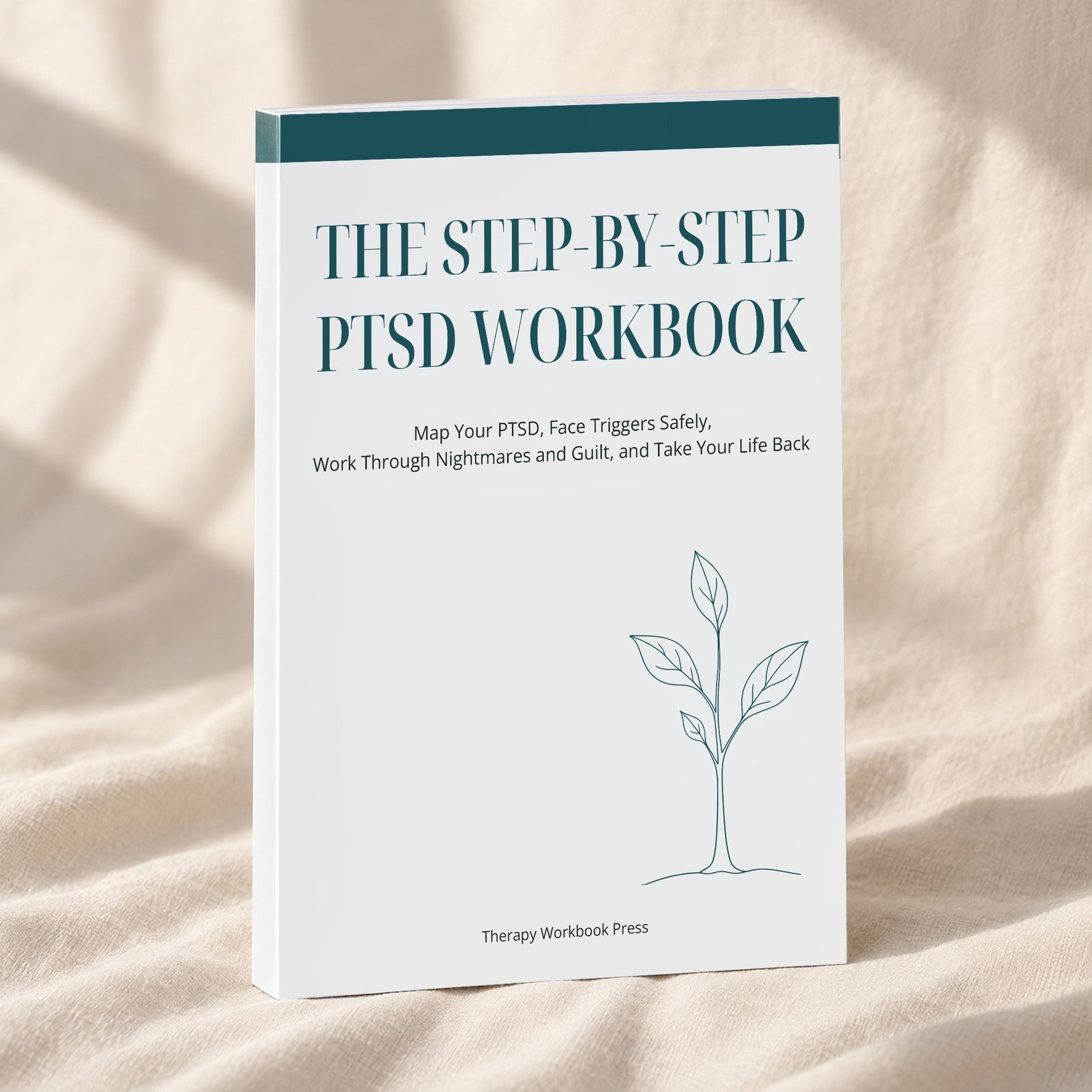














The Step-by-Step PTSD Workbook: Map Your PTSD, Face Triggers Safely, Work Through Nightmares and Guilt, and Take Your Life Back (109 Pages, PDF)
You want an ordinary day back: to sleep without waking at every noise, to drive to the store, to say yes to a friend. This workbook gives you the steps toward it, about 15 minutes most days, and it never asks you to write out what happened.
$37.49
Instant PDF by email
60-day refund
Keep the files
The Step-by-Step PTSD Workbook is a 109-page PTSD workbook and worksheets PDF. You map your own PTSD first, then start where it fits you: the memories that pull you back, the nights, the anger, the guilt, or the places you’ve stopped going.
Built on the methods that the main treatment guidelines rate highest. Made to use on your own, between appointments, or while you wait for one.
- ✔ You never write out what happened. A short headline, like “the crash,” is all you ever name.
- ✔ Map your PTSD on one page (page 21), then six rules on page 23 show you where to start.
- ✔ Find your PTSD triggers (page 42) and face what you’ve been avoiding one safe step at a time, on a ladder you build yourself.
- ✔ Rewrite nightmares that keep coming back with image rehearsal, the method the American Academy of Sleep Medicine recommends for nightmares linked to PTSD.
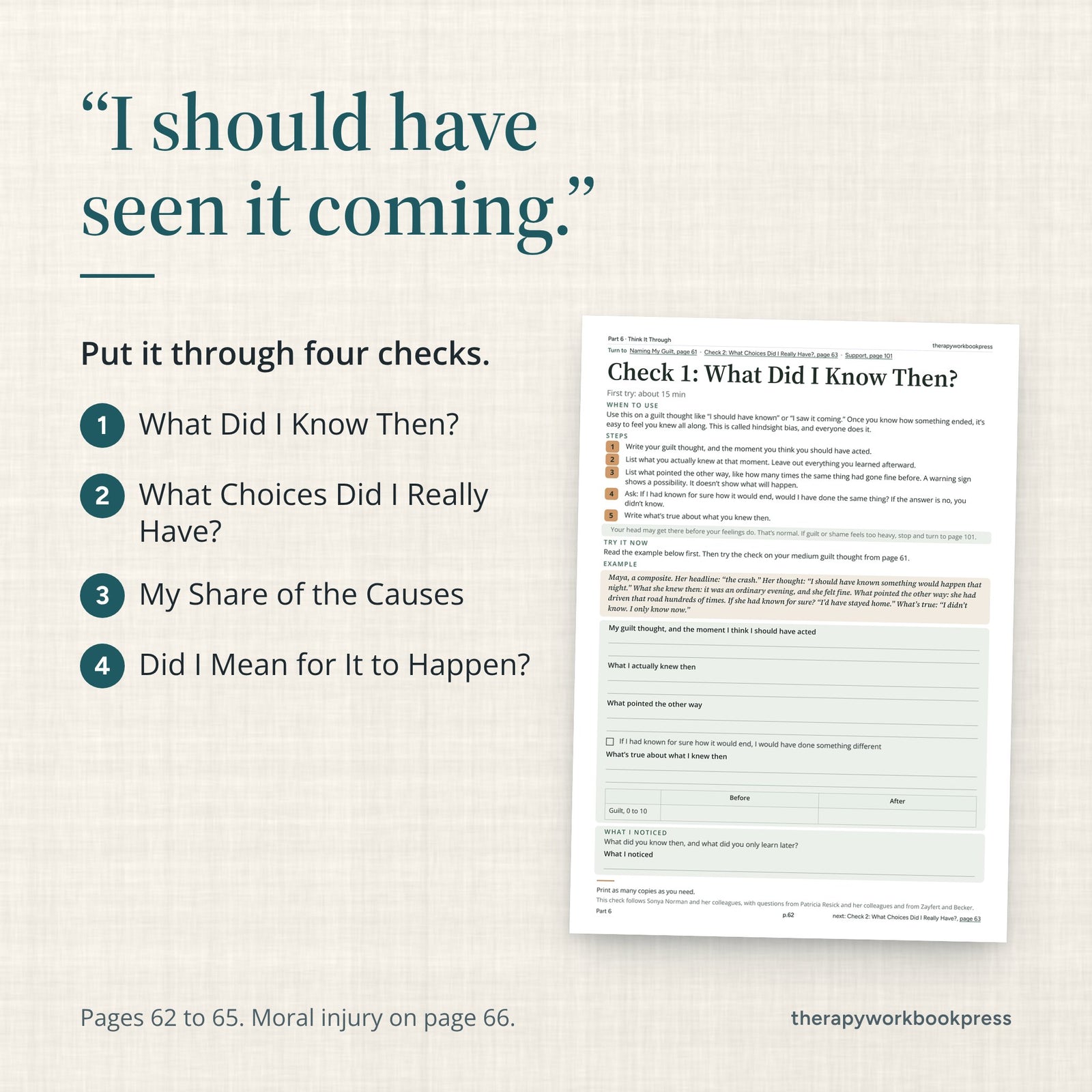
- ✔ Put “I should have seen it coming” through four guilt checks (pages 62 to 65).
Instant PDF download you can print or fill in on screen · 109 pages · A4 + US Letter · $37.49, paid once · 60-day money-back guarantee
When you just want a normal day again
The drive to the store takes the long way, or it doesn’t happen. A door slams down the hall, and your heart is pounding before you know why. You wake at every noise, then lie there until it’s light. A friend asks about dinner, and you say you’re busy. In a restaurant, you take the seat facing the door.
Luna Day opens the book with a letter. “Something happened that your mind and body haven’t been able to set down.” And: “Reactions like these are common after a frightening event, and they can change.” (page 3)
This workbook gives you a way to work on them, one step at a time. So the first question is a fair one: will working on it make things worse?
Will this make it worse? Safe by design
If talking or writing about what happened has made things worse before, this book was built with you in mind.
- You never write out what happened. You name it with a short headline of your own, “and that’s as much as you’ll ever need to say about it.” (page 3)
- Writing is up to you. “Every writing page can also be done by checking, circling, or saying your answers out loud.” (page 4)
- The memory work stays with a therapist. The book leaves out going over the memory in detail, out loud or in writing; calling up its worst moments on purpose; going back to the place where it happened; replaying it moment by moment; and EMDR in any form (page 94).
- Checks before and during. A readiness check before you start (page 7). One 0 to 10 rating for the whole book: at 5 or lower, keep working; at 6, keep going gently; above 6, ground yourself first (page 5). Stop rules for hard days, and a one-minute check-in after each session (page 4).
- No one’s real story. Four composite examples run through the book. Each event is named by a headline, like “the convoy,” and never described (page 104).
- Support is in the book. Crisis and support numbers for the US, Canada, the UK, Ireland and Australia, and the Veterans Crisis Line (page 101).
Start where it hurts
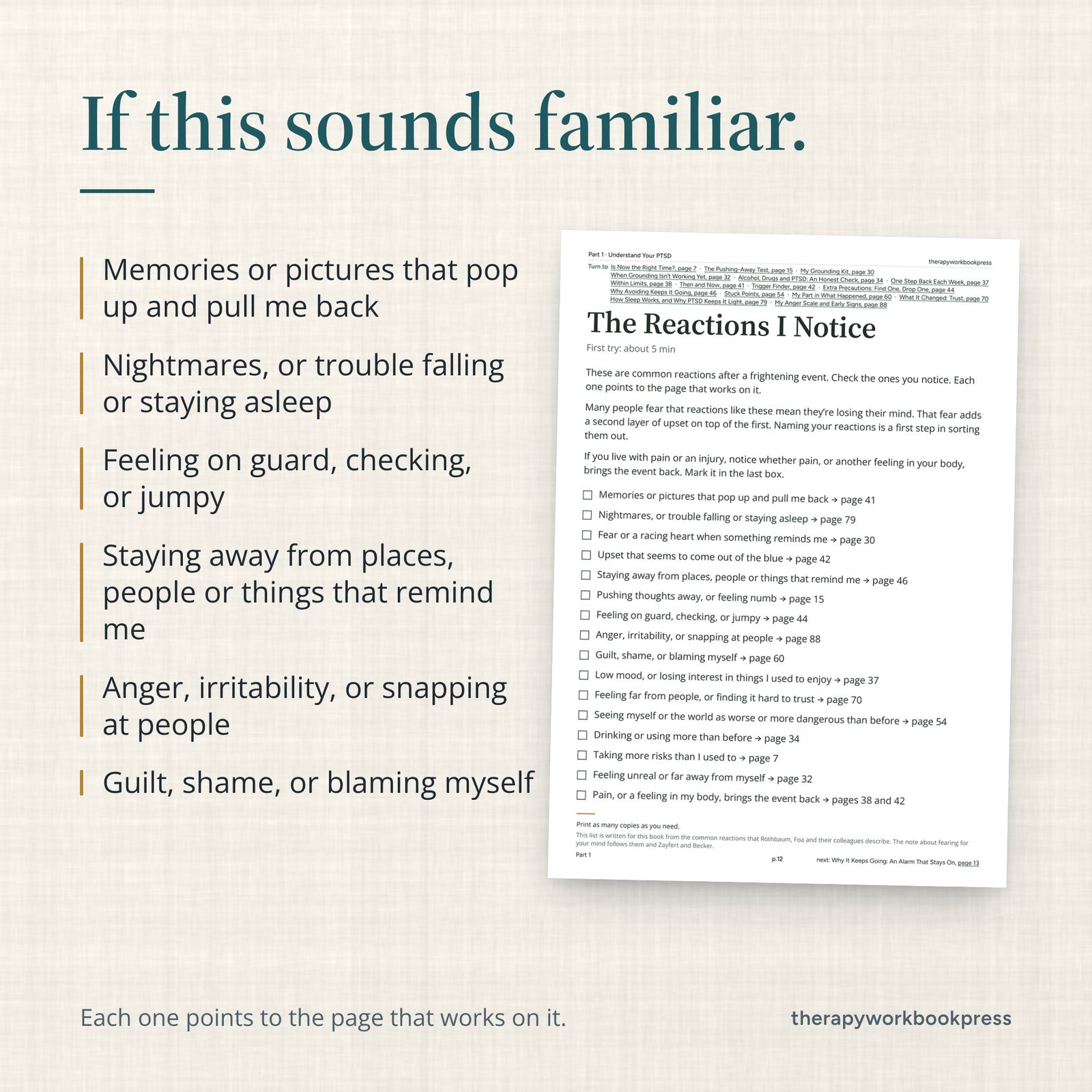
Page 12 lists 16 reactions people notice after a frightening event, and each one points to the page that works on it. Feeling stuck on guard, always waiting for the other shoe to drop, or waking at every noise are on this list too.
Tap what you’ve noticed lately. Your taps stay on this screen. Nothing is saved or sent.
Your pages: Your pages will show here.
Why PTSD keeps going: an alarm that never got the news it’s over
After a frightening event, the alarm can stay set to go off fast. A sound, a smell, a place or a time of day can set it off, even when you’re safe now. Anke Ehlers and her colleagues explain why it stays on: “The worst moments of the memory were never updated with what came after, so they can come back as if they were happening now.” (page 13)
Then come the things you do to get through: staying away, checking, pushing memories away, going over and over it, or drinking. “Each one brings quick relief. Over time, they keep the alarm on, because your mind never gets the chance to learn that now is different from then.”

The loop that keeps PTSD going, from My Loops on page 14.
Here is the loop for Maya, a composite example from the book (page 14). Merging onto the highway sets off her alarm at 8 out of 10. She takes the back roads and feels calm within minutes. The cost: forty extra minutes every day, and the highway feels scarier each month.
That’s the loop. This book starts by drawing yours.
If you’ve wondered whether you’re losing your mind, page 12 answers it plainly: “Many people fear that reactions like these mean they’re losing their mind. That fear adds a second layer of upset on top of the first.”
How the PTSD workbook works: score it, map it, start where it fits
- Score it. The PCL-5, the PTSD checklist from the National Center for PTSD, for the past month (page 18). Your scores page shows which of four areas weighs most: reliving, avoiding, thoughts and mood, or being on edge (page 19).
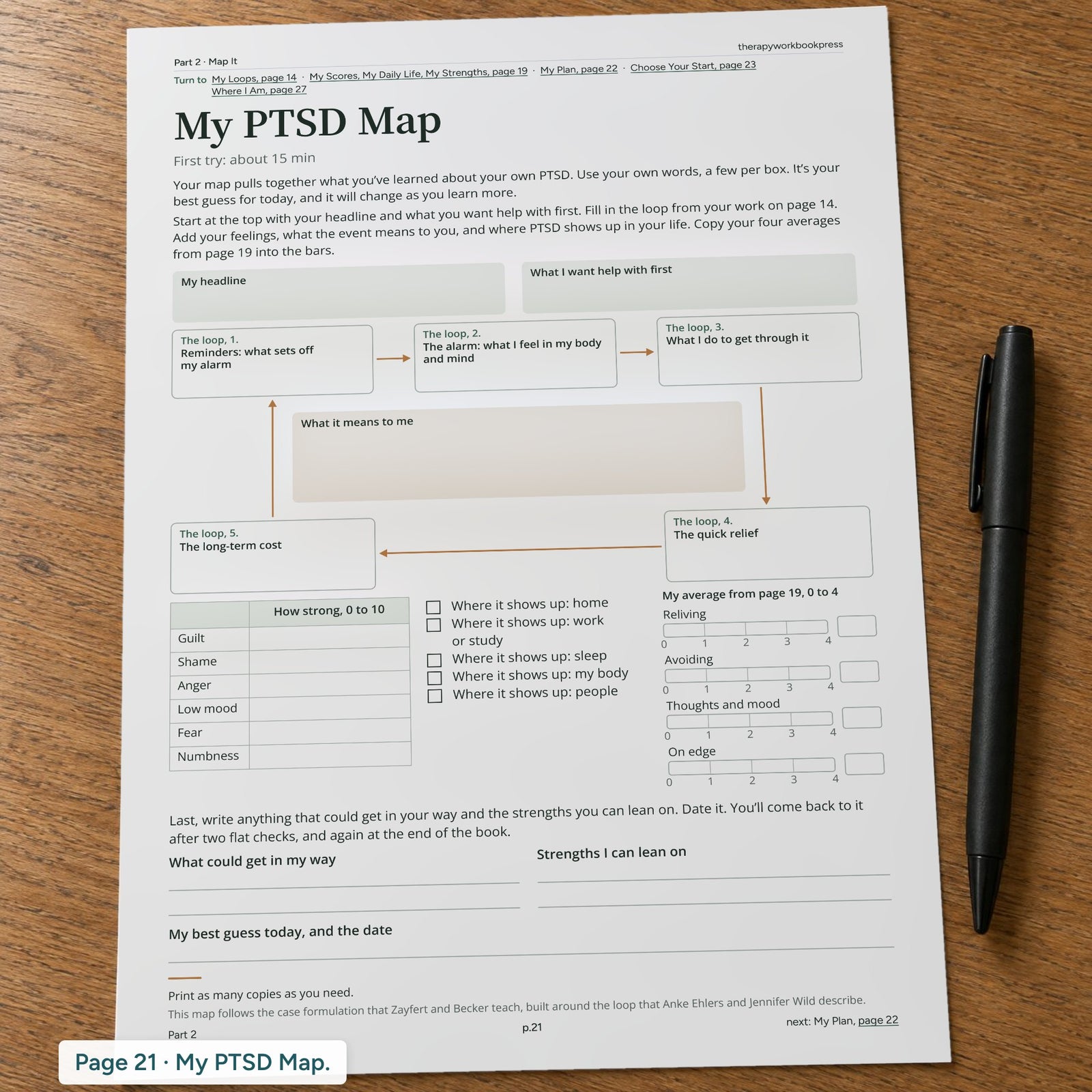
- Map it. My PTSD Map puts your headline, your loop, what the event means to you, your feelings and four 0 to 4 bars on one page (page 21).
- Start where it fits. Six rules on page 23 show you where to begin: anger that puts people at risk first, then heavy guilt or shame, low mood, sleep, and otherwise your highest score. “Your start changes the order, not the destination.”
After that, it’s one step of about 15 minutes, most days, with about a week on each step (page 4). Your plan on page 22 has an end date and small rewards along the way. Every two weeks, a past-week checklist (page 26) and the Where I Am tracker (page 27) show what’s changing. The book is straight about it: a score “can rise before it falls.”
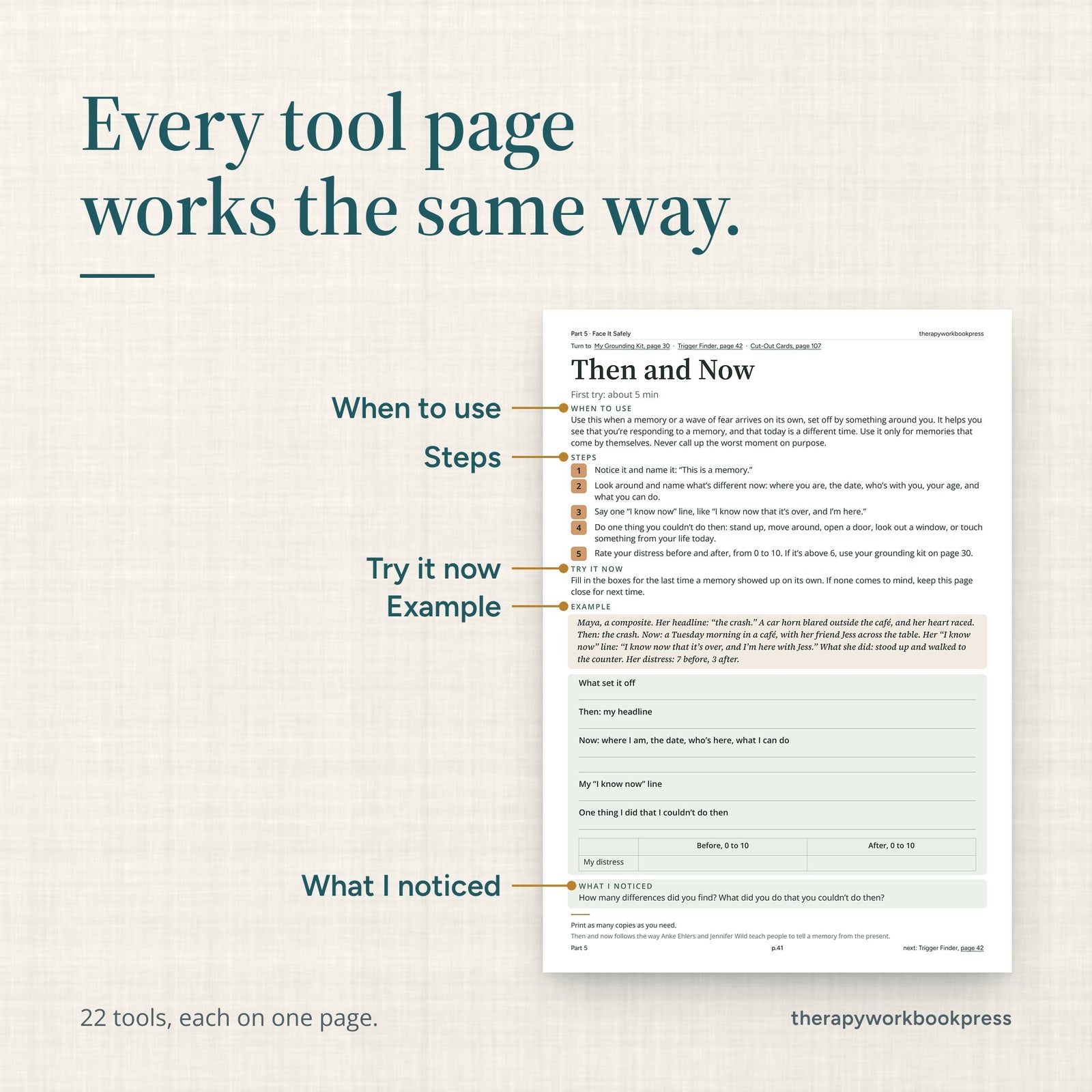
Every tool page is laid out the same way
All 22 step-by-step tools share one layout: When to use, Steps, Try it now and What I noticed, and most add a worked example. You never have to work out how to use a page.

Page 41, Then and Now: the tool for when a memory hits. The worked example follows Maya, a composite example from the book.
For a hard moment, starting today
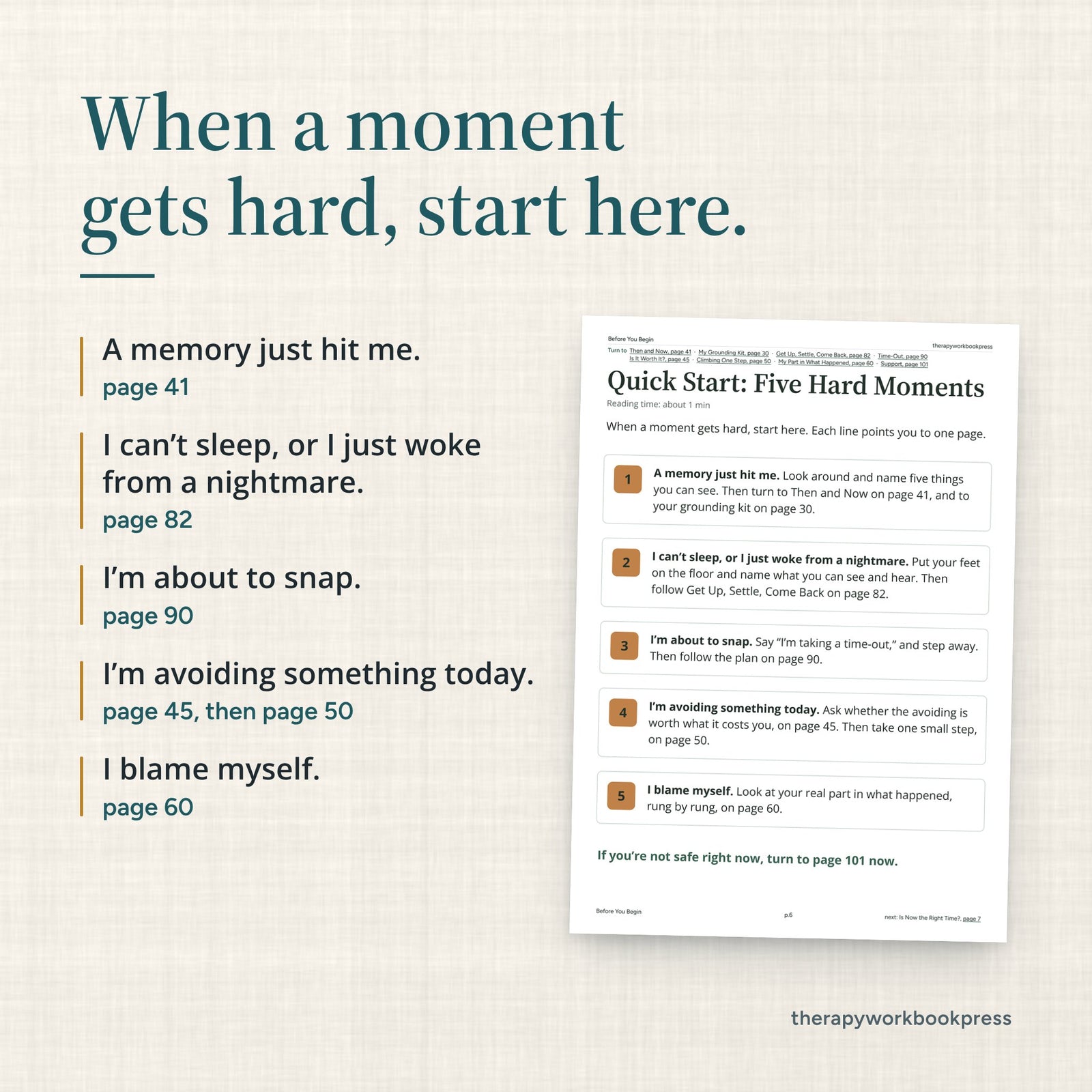
Before you’ve mapped anything, the Quick Start on page 6 covers five hard moments: a memory just hit you; you can’t sleep, or you just woke from a nightmare; you’re about to snap; you’re avoiding something today; you blame yourself. Each one gives you a first thing to do and the page to turn to. “If you’re not safe right now, turn to page 101 now.”
What you’ll have after Parts 1 and 2
Part 1 takes about 30 minutes in all. Part 2 is best spread over a week or two. At the end, three pages are yours: your scores (page 19), your map (page 21) and your start (page 23). If you see a therapist, the appointment sheet on page 96 is built from your scores and your map.

Pages 19, 21 and 23: My Scores, My PTSD Map and Choose Your Start.
Inside the workbook, part by part
Before Part 1 come the first pages (2 to 9): how to use the book, your headline and your rating, the Quick Start, “Is Now the Right Time?” and “Which Book Fits You?” Then each part opens with what it covers, how long it takes, and the one thing to do if you only do one.
Part 1 · Understand Your PTSD pages 10 to 16
What PTSD is, why it keeps going, and what your own loop looks like. Six pages, about 30 minutes in all.
- The Reactions I Notice: 16 reactions, each with the page that works on it (page 12)
- An Alarm That Stays On, and My Loops (pages 13 and 14)
- The Pushing-Away Test, for when you push thoughts away or feel numb (page 15)
If you only do one thing: draw one loop on page 14.
Part 2 · Map It pages 17 to 27
Score your PTSD, map your own loop, and choose where to start.
- The PCL-5 for the past month, and My Scores (pages 18 and 19)
- What PTSD Has Taken (page 20), My PTSD Map (page 21) and My Plan (page 22)
- Choose Your Start (page 23), with a page for an event in the last few weeks (page 24) and a page for grief after a death (page 25)
- The PCL-5 for the past week, every two weeks, and the Where I Am tracker (pages 26 and 27)
If you only do one thing: the checklist on page 18 and the map on page 21.
Part 3 · Steady Yourself: grounding for PTSD pages 28 to 35
Skills to steady yourself when a memory, an alarm or an urge hits.
- Grounding: Back to the Room, Back to Now. Eyes open, and “no one has to know you’re doing it.” (page 29)
- My Grounding Kit: things for your mind, your body and kind words, practiced while you’re calm so it’s ready when you need it (page 30)
- Calm Breathing: The Slow Out-Breath (page 31), and When Grounding Isn’t Working Yet (page 32)
- Alcohol, Drugs and PTSD: An Honest Check. “You don’t have to stop drinking before you get help for PTSD.” (page 34)
If you only do one thing: build your grounding kit on page 30 and practice it once a day.
Part 4 · Take Your Life Back pages 36 to 39
“PTSD can shrink your life.” Bit by bit, you give up places, people and things you used to do. This part takes them back one small step a week.
- One Step Back Each Week (page 37)
- Within Limits, for when an injury, pain, illness or older age makes old activities harder (page 38)
- Who to Tell, How Much, and My Check-In Person. Your headline is enough (page 39)
If you only do one thing: plan one step on page 37 and do it this week.
Part 5 · Face It Safely: PTSD triggers and avoidance pages 40 to 52
Tell then from now, find your triggers, drop the habits that keep the alarm on, and take back what you’ve been avoiding, one safe step at a time. If driving, the grocery store or a night out has gone missing, this is where you work on it, one rung at a time.
- Then and Now, for when a memory hits (page 41); the Trigger Finder (page 42); Memory or Dwelling? (page 43)
- Extra Precautions: Find One, Drop One, for habits like always sitting facing the door (page 44)
- Why Avoiding Keeps It Going (page 46), then Build My Ladder: 10 to 15 steps, starting at about 4 or 5 out of 10, with only situations that are safe now (page 49)
- Climbing One Step, a practice log, and what to do when a step isn’t working (pages 50 to 52)
The ladder follows the step-by-step practice that Rothbaum, Foa and their colleagues teach, with Zayfert and Becker’s focus on testing predictions (page 46). Each step is a situation that’s safe now. It isn’t talking or writing about what happened (page 48).

Page 49, Build My Ladder. The example ladder belongs to Maya, a composite example from the book: from sitting in the parked car for 20 minutes up to the highway alone at rush hour.
If you only do one thing: use Then and Now on page 41 the next time a memory hits.
Part 6 · Think It Through: guilt, stuck points and moral injury pages 53 to 77
Look at what the event means to you: the thoughts that keep you stuck, your real part in what happened, guilt and moral injury, and what the event changed in your life.
- Stuck Points, like “I should have seen it coming” or “I’m never safe” (page 54), sorted with Fact, Thought or Feeling? (page 56) and the Balanced-Thought Sheet (page 58)
- My Part in What Happened: a ladder with three rungs to find your real part (page 60). Naming My Guilt: “Guilt says, ‘I did something bad.’ Shame says, ‘I am bad.’” (page 61)
- Four guilt checks for the question of what you could have done better: What did I know then? What choices did I really have? My share of the causes. Did I mean for it to happen? (pages 62 to 65)
- Moral Injury (page 66). It was first described in people who served in war, “but anyone whose deeply held values were broken in a traumatic event can feel it.” Then From Guilt to What I Value (page 67).
- What the event changed: safety, trust, power and control, how you see yourself, and closeness (pages 68 to 77)
Looking for cognitive processing therapy worksheets? Part 6 draws on cognitive processing therapy as Patricia Resick and colleagues teach it, and on Sonya Norman and colleagues’ method for guilt after trauma.

Page 62, Check 1: What Did I Know Then? The first of four guilt checks.
If you only do one thing: sort one thought on page 56.
Part 7 · Sleep, Nightmares and Anger pages 78 to 92
Sleep more steadily, take the sting out of bad dreams, and catch anger before it takes over.
PTSD nightmares and sleep
If you’ve started putting off bed because you know what’s waiting, or you’ve tried sleep aids, night lights and journaling and the dreams still come, this part gives you something specific to do. As page 79 puts it, “Sleep problems often stay after other PTSD symptoms improve, so they deserve their own work.”
- Before You Change Your Sleep: a safety check first (page 80), then a Two-Week Sleep and Nightmare Diary (page 81)
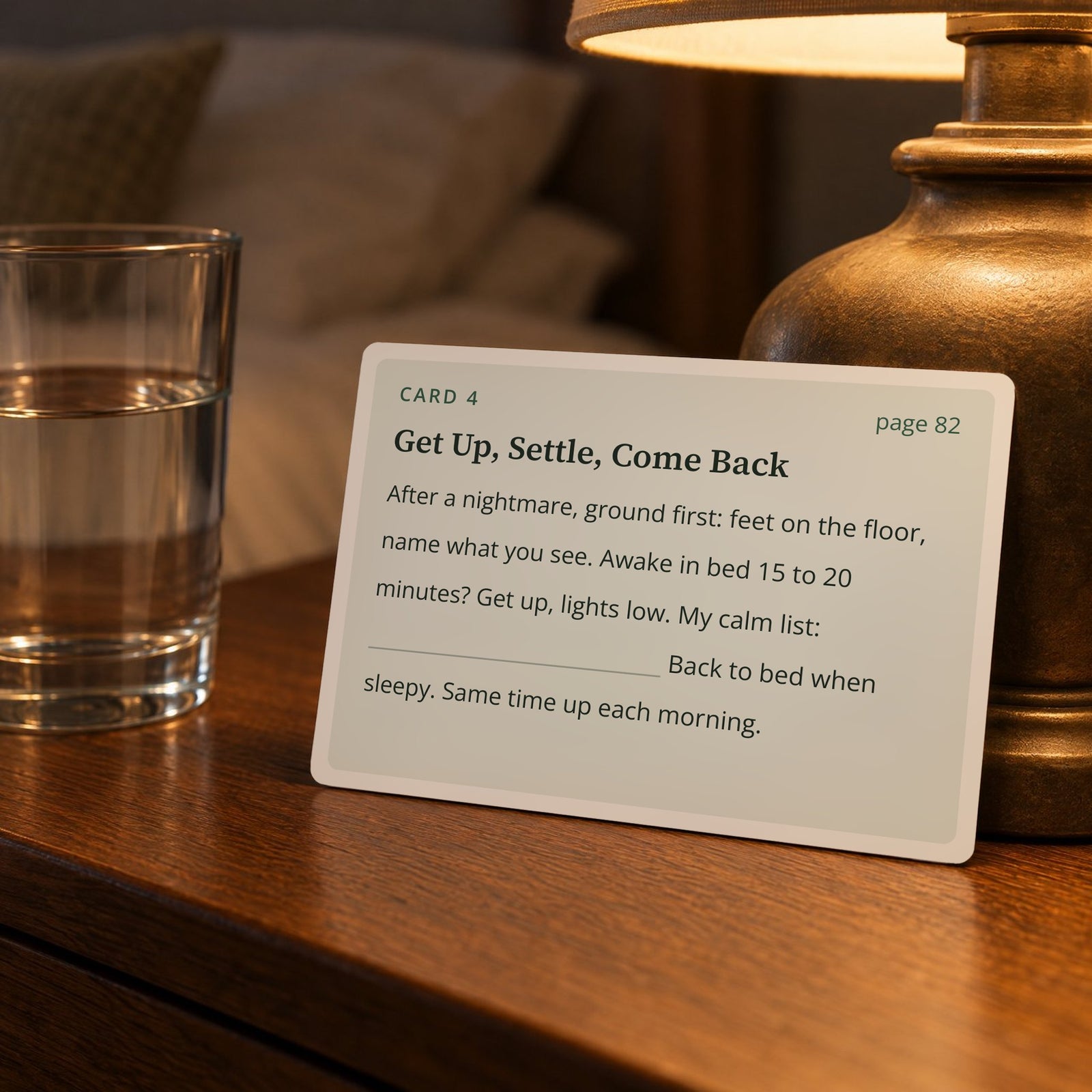
- Get Up, Settle, Come Back, for when you’ve been awake about 15 to 20 minutes or wake from a nightmare: ground first, get up, do something calm, and go back to bed only when you feel sleepy (page 82)
- My Sleep Window: match your time in bed to the sleep your body makes right now, never below 5 and a half hours (page 83). Then a Wind-Down Hour and Worry Page, and Night Habits (pages 84 and 85)
- Rewrite a Nightmare: start with a dream that’s less intense and isn’t a replay of the event, change it any way you like, and rehearse only the new version for 10 to 20 minutes a day while you’re awake. You never write out the old dream (page 86)
- My Six-Week Nightmare Plan, with a short daily diary (page 87). The book is straight with you: “A few people find their nightmares get worse. If yours do, or they’re still frequent after six weeks, see a clinician.”
If you only do one thing: Get Up, Settle, Come Back on page 82.
Ray, a composite example from the book, wakes from a nightmare at 2:00 a.m. He presses his feet into the floor, names the things on his dresser, and does a crossword under a low lamp in the kitchen until his eyes get heavy (page 82).


Pages 86 and 87: Rewrite a Nightmare, and My Six-Week Nightmare Plan. The diary example follows Ray, a composite example from the book.
PTSD and anger: protect the people you love
If anger is spilling onto the people you love, and the shame comes after, the book puts this first. When anger outbursts or a fear of hurting someone fit you, page 23 sends you to the anger pages before anything else.
- My Anger Scale and Early Signs: “Anger rarely jumps straight to 10. It climbs, and there’s time to act at each step.” Venting, like yelling or punching a pillow, tends to make anger stronger, so these pages work on catching it early (page 88)
- My Anger Plan, Stage by Stage, with the red flags that mean talking to a clinician first (page 89)
- Time-Out: “I’m taking a time-out. I’ll be back.” At least 30 minutes, agreed ahead of time with the people you live with (page 90)
- A Thinking Step for Anger (page 91), and Saying It Straight: raise what’s bothering you “without blowing up or swallowing it” (page 92)
Part 8 · Keep Going pages 93 to 100
Find the right help, plan for hard days, and see how far you’ve come.
- The therapies the American Psychological Association’s 2025 guideline rates highest, in plain words, and how to choose and what to ask (pages 94 and 95)
- My Appointment Sheet: “You don’t have to tell the story of what happened. Your headline is enough.” (page 96)
- My Warning Plan: “A hard week doesn’t wipe out what you’ve learned.” (page 97), and When Fear Comes Back (page 98)
- Final Check: How Far I’ve Come, and What It Means to Me Now (pages 99 and 100)
If you only do one thing: the warning plan on page 97.
Resources (pages 101 to 109): support numbers (page 101), the research behind the book (page 102), two pages for therapists (pages 103 and 104), a page for the people close to you (page 105), your toolkit at a glance (page 106), and five cut-out cards for your pocket (page 107).
Is what happened to me enough?
No one is grading what happened to you, and you don’t need to have been in combat. PTSD can follow a disaster, combat, a serious accident, or an assault, including sexual assault. It can follow a sudden illness that put your life at risk, like a heart attack, seeing someone badly hurt or killed, or learning that someone you love died suddenly or violently (page 11). And it doesn’t have to be recent: “PTSD usually starts within three months of the event, but it can start later.”
You’re far from alone. About 5 out of every 100 adults in the US have PTSD in any given year, according to the National Center for PTSD.
If the reactions have stayed with you, the map starts where you are. The checklists track change over time, and a diagnosis comes from a clinician (page 18).
A PTSD workbook for military, police, fire, EMS and healthcare
Page 7 says it plainly: “If your job carries risk, like military, police, fire or emergency work, that’s no reason to wait. You’re welcome here.”
Maybe it’s a call or a shift that comes back at night. Maybe your pulse jumps when you’re sent to an address that looks like one you know. Maybe it’s the question of what you could have done better, after you did everything you could.
Most steps take about fifteen minutes, so they fit around shifts. Ray, a composite example from the book (his headline is “the convoy”), runs through the sleep, anger and appointment pages. Moral injury has its own page (page 66). The Veterans Crisis Line is on page 101: dial 988, then press 1, or text 838255.
Who it’s for, and who it isn’t
It was made for you if:
- Something frightening happened to you as an adult, once or a few times: a crash or accident, an assault, combat or frontline work, a medical emergency, a sudden death, or an event in the last few weeks (pages 24 and 25).
- You’ve read enough about PTSD and want steps to do.
- You’re in therapy, waiting for it, or working on your own.
- You’re a therapist who wants print-ready pages for between sessions.
- You have about 15 minutes, most days.
It isn’t for you if:
- What you’re living with was long, repeated or hard to escape, such as abuse in childhood. The Complex PTSD & Childhood Trauma Recovery Workbook was made for that pattern.
- You’re in crisis right now. If you’re in danger, call 911 in the US or your local emergency number. To talk to someone now, call or text 988 in the US.
- You want to write out the whole story of what happened on your own. The book leaves that to work with a therapist (page 94).
- You’re looking for memories you don’t have. “This book is not for searching for memories you don’t have.” (page 7)
- You want something to read rather than write in.
“This workbook is for education and self-guided practice. It does not replace care from a licensed professional.” (page 2)
PTSD or complex PTSD: which book fits you?
The Step-by-Step PTSD Workbook
This book · 109 pages · $37.49
Made for the core of PTSD: reliving, avoiding, and feeling on guard. Most often after one frightening event, or a few.
The Complex PTSD & Childhood Trauma Recovery Workbook
Sister book · 104 pages · $37.49
For the core of PTSD plus lasting trouble with calming down, with how you see yourself, and with staying close to people. “Complex PTSD most often follows long or repeated events that were hard to escape, such as abuse in childhood.” (page 9) See that book
Inside, a short pattern check on pages 8 and 9 helps you choose, and you can use the two books together. Not sure yet? Parts 1 and 2 of this book will make the picture clearer (page 9).
Between appointments, on a waitlist, or on your own
The book pairs with therapy and doesn’t replace it. If you’re waiting for a first appointment, or one hour a week leaves the other days empty, the steps give you something to do in between. Page 94 explains the therapies the American Psychological Association’s 2025 guideline rates highest, and adds: “Research hasn’t shown that any one of these works better than the others. So the one that suits you best is a good place to start.” Page 95 helps you choose and know what to ask, and the appointment sheet on page 96 helps you say what matters in a few minutes.
For therapists
Pages 103 and 104 map each part to its methods and list what stays in session, including imaginal exposure and detailed written or spoken trauma accounts. The book prints no cutoff. The license covers a practitioner using the book with individual clients, printing as many copies as needed (page 2). For clinician and group licenses, write to contact@TherapyWorkbookPress.com.
For the people close to you
Page 105 is written for a partner, a friend or family. It asks them not to press for details and to ask what would help. “Their pages are theirs, and they’ll share what they choose.”
The PTSD workbook PDF: format and delivery
- Two fillable PDFs, A4 and US Letter, each laid out for its own paper. Type on screen on an iPad, a laptop or a phone, or print at home.
- 1,698 fields you can type in, across 81 pages, with clickable page links and 119 bookmarks to move around.
- Every form is printed once and marked “Print as many copies as you need.”
- Five cut-out cards on page 107: your grounding kit, Then and Now, Time-Out, Get Up, Settle, Come Back, and support numbers.
What happens after you tap Add to cart
- Check out with your card, Apple Pay, Google Pay, PayPal or Klarna.
- Your download link appears on the thank-you page and arrives by email within minutes. Nothing ships to your door.
- Start with page 5: your headline, your rating and your check-in, about five minutes.
Why $37.49?
You pay once. There’s no subscription and nothing to renew. For that you get 109 pages, 78 of them tools, worksheets and trackers, and you print each form as often as you need it.
You can start the day it arrives: the Quick Start on page 6 covers five hard moments, and most steps take about fifteen minutes. Because you map first, your time goes to the pages that fit you. If you’re in therapy, it gives you something to do between sessions.
The Earn-Its-Place Guarantee: 60 days
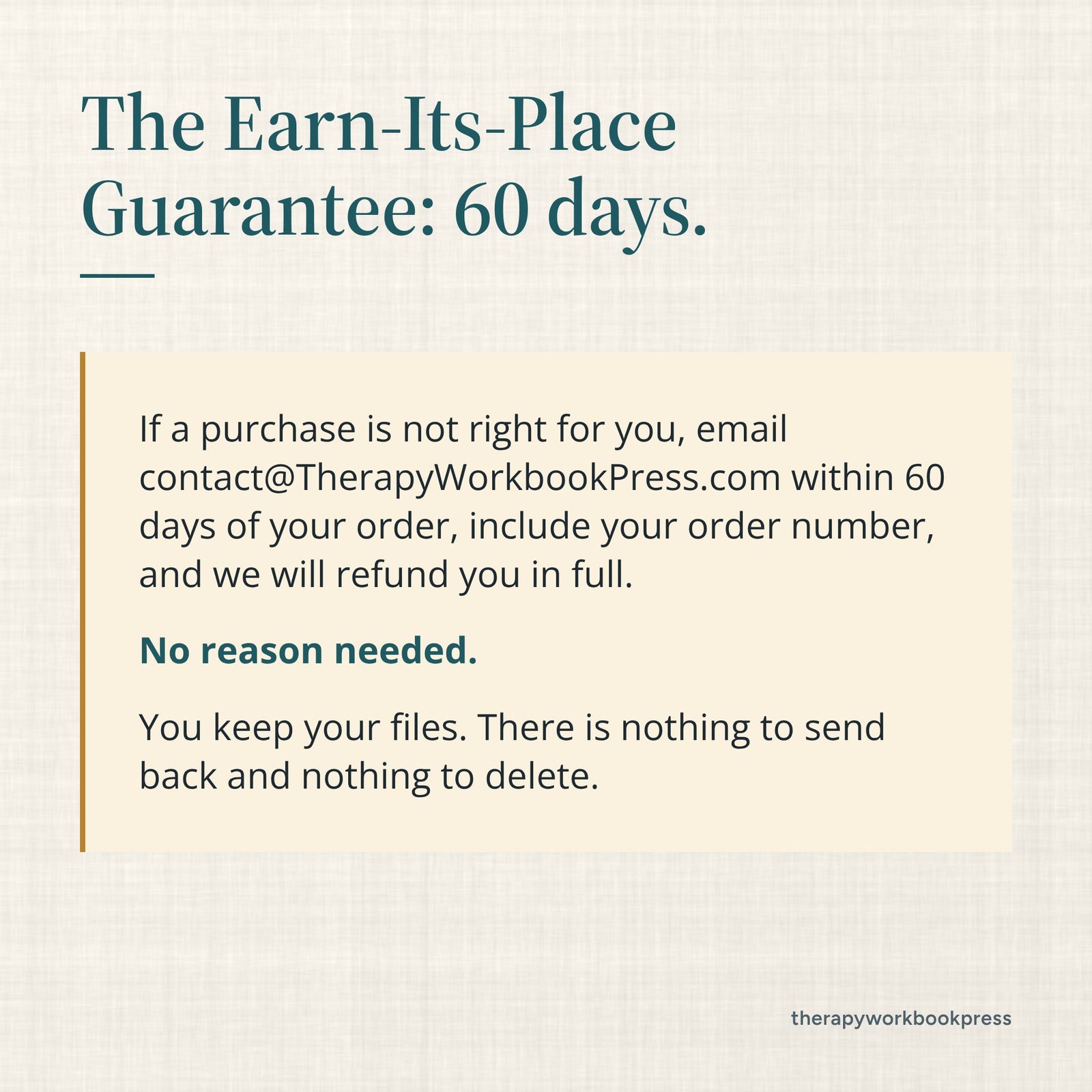
Read it, print it, write in it, and use it on the hard nights and the ordinary days. If it hasn’t earned its place within 60 days, email contact@TherapyWorkbookPress.com with your order number and you’ll get a full refund. You don’t need to give a reason, using the workbook doesn’t void it, and you keep your files. Refund policy
The research this book stands on
Built on the methods that the main treatment guidelines rate highest. The American Psychological Association’s 2025 guideline rates three therapies highest: cognitive processing therapy, prolonged exposure, and trauma-focused cognitive behavioral therapy. The guidelines of the US Department of Veterans Affairs and Department of Defense, the UK’s National Institute for Health and Care Excellence (NICE) and the International Society for Traumatic Stress Studies (ISTSS) also strongly recommend trauma-focused therapies like these.
- Parts 1 and 2 draw on the World Health Organization’s ICD-11 description, the PCL-5 from the National Center for PTSD, and the case formulation of Claudia Zayfert and Carolyn Black Becker.
- Part 3 draws on the coping skills of Lisa Najavits, and calm breathing adapted from Barbara Rothbaum, Edna Foa and colleagues.
- Parts 4 and 5 draw on cognitive therapy for PTSD as Anke Ehlers and Jennifer Wild describe it, prolonged exposure as Rothbaum, Foa and colleagues teach it, and Zayfert and Becker’s way of testing predictions.
- Part 6 draws on cognitive processing therapy as Patricia Resick and colleagues teach it, and guilt checks from Sonya Norman and colleagues’ method for guilt after trauma.
- Part 7 draws on the insomnia work of Colleen Carney and Rachel Manber, SAMHSA’s anger management program, and the American Academy of Sleep Medicine, which recommends image rehearsal for nightmares linked to PTSD.
- Part 8 draws on Najavits, Zayfert and Becker, and Rothbaum, Foa and colleagues. The safety pages draw on NICE, SAMHSA’s guide to trauma-informed care, and the VA.
The PCL-5 (the PTSD Checklist for DSM-5) is by Weathers and colleagues at the National Center for PTSD and is in the public domain. The pattern check on page 8 uses the International Trauma Questionnaire by Cloitre and colleagues (2018), which is freely available.
None of them is affiliated with Therapy Workbook Press, and naming them does not mean they endorse this book.
Questions
Is this therapy?
No. It’s a workbook for education and self-guided practice, and it doesn’t replace care from a licensed professional (page 2). It’s built on the methods the main treatment guidelines rate highest, and it’s made to use alongside therapy too. Page 96 is a sheet to take to appointments.
Do I need a diagnosis?
No. The checklists help you see your pattern and track change over time. A diagnosis comes from a clinician (page 18). If your reactions get in the way of your life, the map shows you where to start.
Do I have to write about what happened? Will it bring memories up?
You never write out what happened. A short headline is all you name, and every writing page can be done by checking, circling or saying your answers out loud (pages 3 and 4). Some steps ask you to face reminders that are safe now, and feelings can come up for a while. That’s what the 0 to 10 zones and your grounding kit are for (pages 5 and 30). The memory work itself stays with a therapist (page 94).
I tried exposure work on my own once and it went badly. Is this different?
The ladder uses only situations that are safe now, starts at about 4 or 5 out of 10, and never asks you to talk or write about what happened (pages 46 and 48). Calling up the memory on purpose is left to a therapist (page 94). The stop rules tell you when to ground first and when to pause the book (page 4).
Therapy hasn’t helped yet, or I can’t get in. Will this help?
It gives you something structured to do: one step of about 15 minutes most days, a plan with an end date, and a check every two weeks so you can see what’s changing. If you’re waiting for therapy, pages 94 to 96 help you ask for the kind of help you want. “Research hasn’t shown that any one of these works better than the others. So the one that suits you best is a good place to start.” (page 94)
My event wasn’t combat, or it doesn’t feel big enough. Is this for me?
There’s no ranking of events in this book. PTSD can follow a crash, an assault, a sudden illness, a death, and more (page 11). If the reactions have stayed with you, the map starts where you are.
It happened recently. Is it too soon?
Page 24 is for an event in the last few weeks. Strong reactions are common then, and for most people they ease over the weeks and months that follow. The page helps you focus on the basics and check in at about four weeks. If you can’t manage daily life, or your reactions keep getting worse, get help now (page 101).
Someone died.
Page 25 is for grief after a death, including a sudden or violent one. It helps you tell grief from PTSD, and it tells you when grief that stays stuck is worth taking to a clinician.
I’m a veteran, first responder or healthcare worker.
You’re welcome here (page 7). Moral injury has its own page (page 66), the guilt checks are on pages 62 to 65, and the Veterans Crisis Line is on page 101. Most steps take about fifteen minutes, so they fit around shifts.
Will the examples upset me?
The four people in the examples are composites, and each event is named by a headline, like “the ICU,” and never described (page 104). You won’t read anyone’s real story.
Can I use it with my therapist?
Yes. The appointment sheet (page 96) helps you say what matters in a few minutes, and two pages for therapists (pages 103 and 104) show which methods each part draws on.
Can I fill it in on an iPad or print it? A4 or Letter?
Both. You get two fillable PDFs, A4 and US Letter, each laid out for its own paper. Type in them on an iPad, a laptop or a phone, or print at home. Every form is printed once, so print as many copies as you need.
How long does it take, and how much work is it?
Most steps take about fifteen minutes, most days (pages 3 and 4). Part 1 is about 30 minutes in all, and Part 2 is best spread over a week or two. After that, your plan sets the pace, and no step is required. Every form appears once, and you print copies as you need them.
Is this the PCL-5? Can I track my score?
Yes. The book prints the PCL-5, the PTSD Checklist for DSM-5 from the National Center for PTSD, for the past month (page 18) and the past week (page 26), with a tracker on page 27. It tracks change. It isn’t a PTSD test, and the book prints no cutoff. “A change of about 10 points or more between checks is a change worth noticing.” (page 27)
Is it the same as cognitive processing therapy worksheets?
Part 6 draws on cognitive processing therapy as Patricia Resick and colleagues teach it: stuck points, the balanced-thought sheet, and pages on safety, trust, power and control, how you see yourself, and closeness. The rest of the book adds triggers, the ladder, sleep, nightmares and anger. The therapy itself is done with a therapist, and page 94 explains what it involves.
PTSD or complex PTSD: which book?
This book is made for the core of PTSD: reliving, avoiding and feeling on guard, most often after one frightening event, or a few. If what happened was long, repeated or hard to escape, such as abuse in childhood, The Complex PTSD & Childhood Trauma Recovery Workbook may fit you better. You can also use the two together (page 9).
What if it isn’t right for me?
Email contact@TherapyWorkbookPress.com within 60 days of your order, with your order number, and you’ll get a full refund. You don’t need to give a reason, and you keep your files. Refund policy
Can clinicians use it with clients?
Yes. The license covers a practitioner using it with individual clients, printing as many copies as needed (page 2). For clinician and group licenses, write to contact@TherapyWorkbookPress.com.
Start with one page. As Luna Day writes on page 3, “You choose the order, the pace and how much you write.”
The Step-by-Step PTSD Workbook · 109-page PDF
$37.49
Instant PDF by email. 60-day refund. Keep the files.