




















The Time Blindness Workbook: Map Where Your Time Goes, Then Use the Tool That Fits (72 Pages, PDF)
$21.49
Instant download. Your link arrives by email within minutes and also shows on your order page. Open it on any phone, tablet or computer, or print it at home.
60-Day Write-In-It Guarantee. Use every page. If it isn't worth it to you, email us within 60 days for a full refund. Writing in it never voids it.
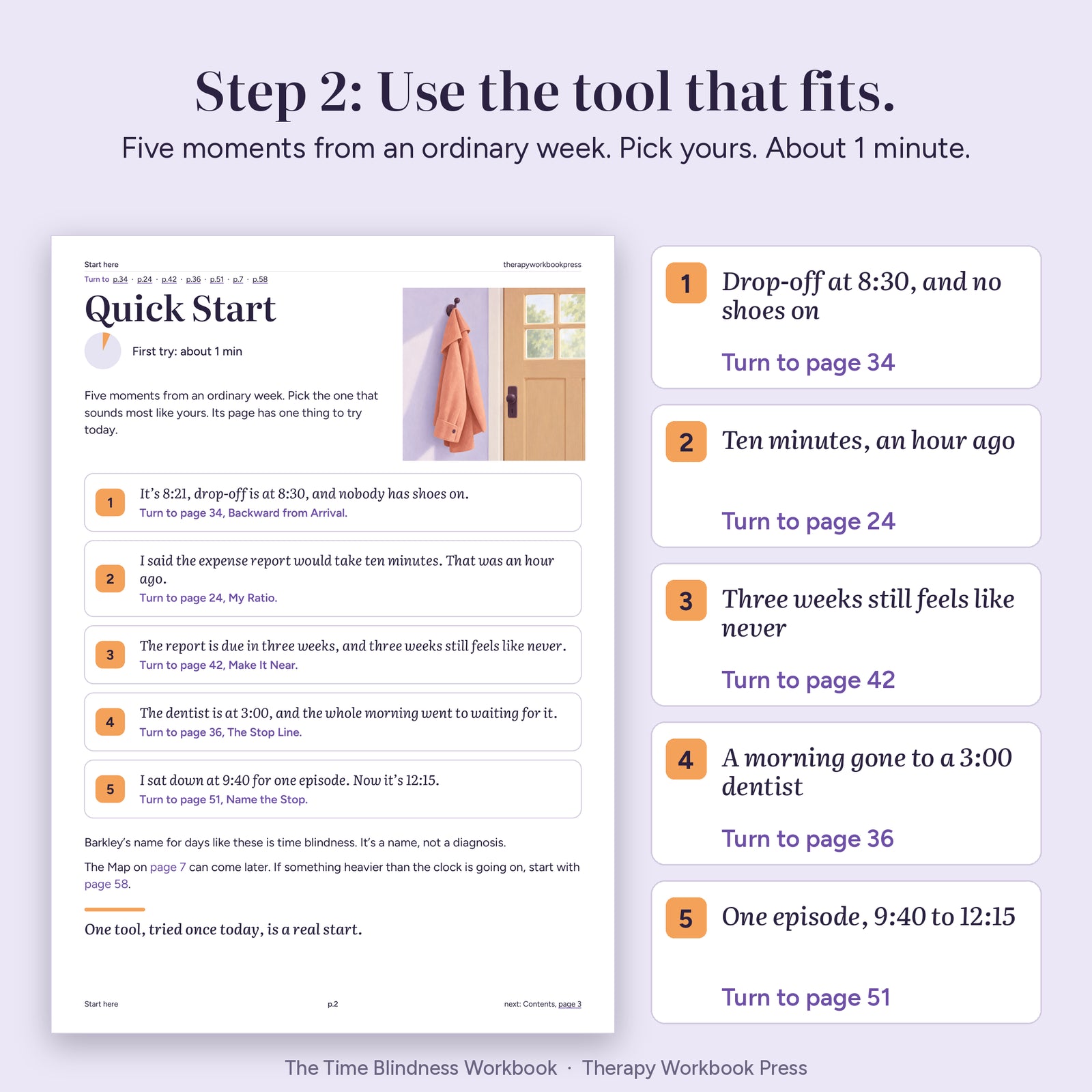
“I sat down at 9:40 for one episode. Now it’s 12:15.”
That line is printed on page 2 of this workbook, one of five moments from an ordinary week. The expense report that would take ten minutes, an hour ago. The report due in three weeks that still feels like never. Drop-off at 8:30, and at 8:21 nobody has shoes on. A dentist at 3:00, and a whole morning gone to waiting for it. Each moment comes with one page to turn to.
The Time Blindness Workbook is a 72-page printable PDF for adults that maps where your time goes first, then gives you the tool that fits. It holds 18 tools, one page each. Quick Start on page 2 takes about a minute.
A Name, Not a Diagnosis
Page 5 is titled The name on the cover, and it starts with where the name came from. Barkley coined it. He uses time blindness for a kind of nearsightedness about the future: what’s far off stays blurry until it’s suddenly here.
The page is careful about the rest. The diagnostic manual doesn’t use the phrase, though its examples include trouble managing time, missed deadlines and missed appointments. Lab studies find timing differences most clearly in children and teens. In adults, the findings are few and mixed. And most people guess short about their own tasks: Buehler and colleagues found it in five studies of students.
So the book doesn’t hand you a label. It has you measure your own numbers: how long your “ten-minute” jobs really take, and how long you really need to get out the door. The tools then run on those numbers. As page 4 puts it, the only numbers about you in this book are the ones you write.
That matters if you have heard “try a timer” one time too many. Solden and Frank write about that advice, offered to women with ADHD as if it were obvious, and how it can sound as if you haven’t been trying. So nothing in this book is an order. Each tool is an offer. Give one a week, then keep it or drop it.
How It Works: Map First, Then the Tool That Fits
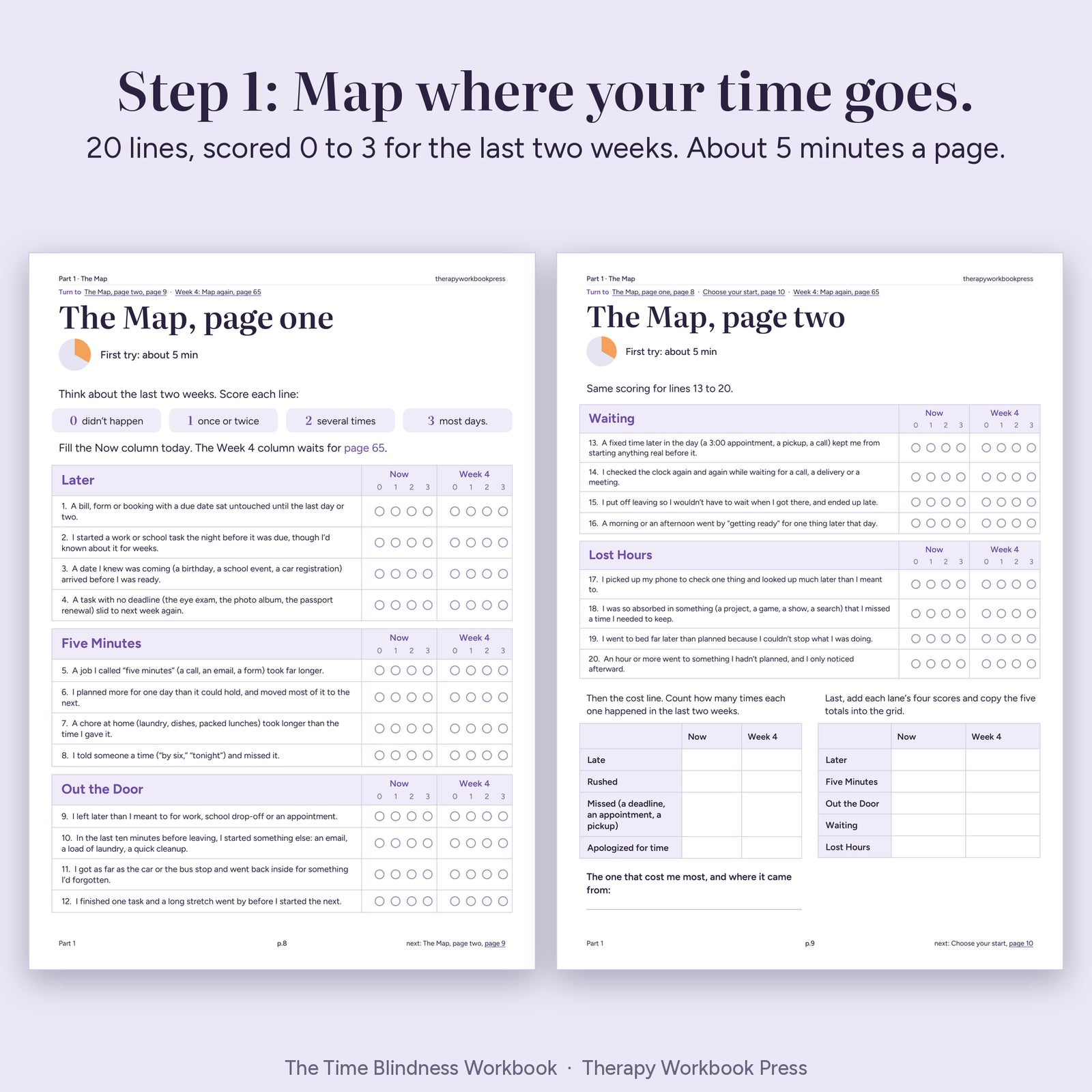
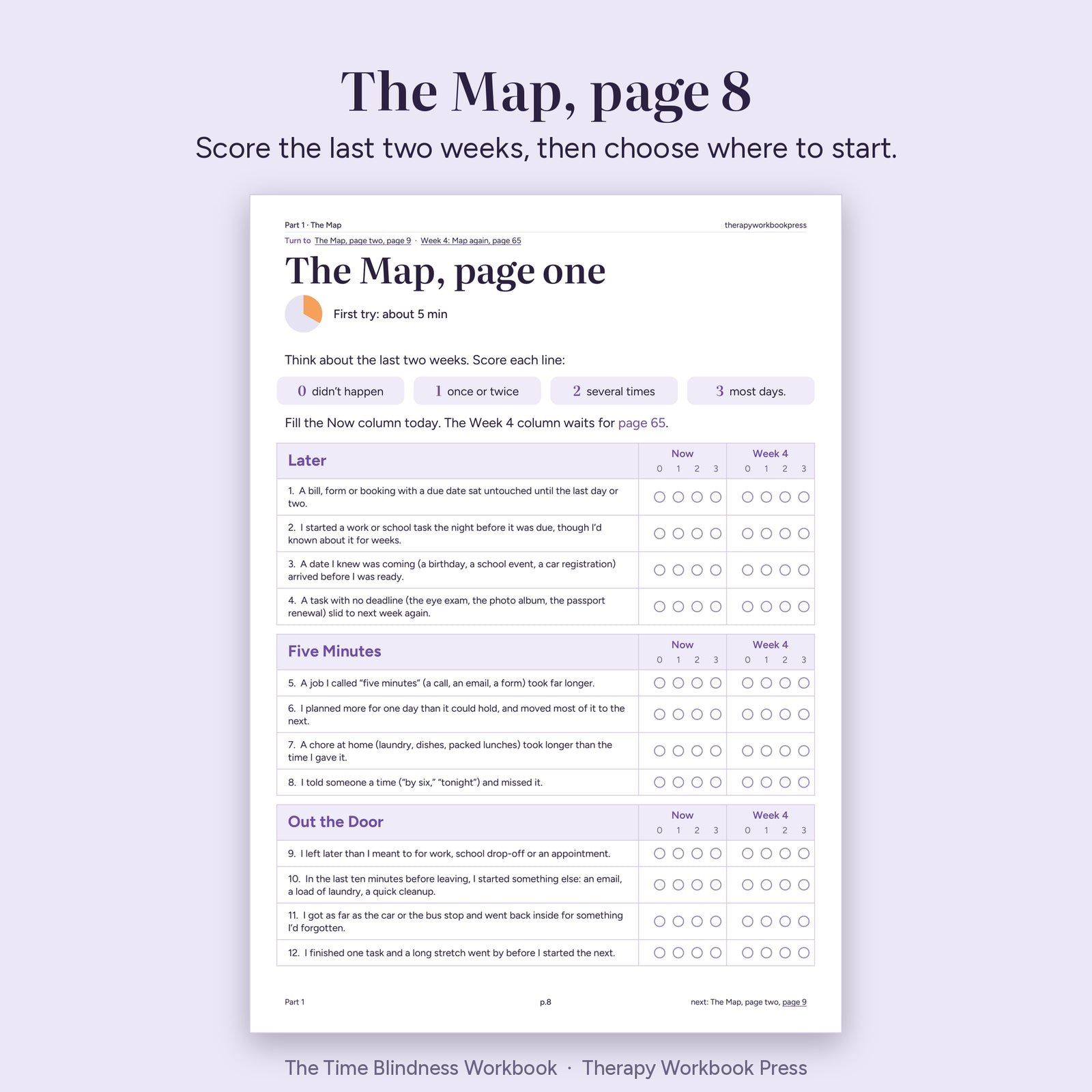
- Map where your time goes (pages 7 to 10). Twenty short lines, each scored 0 to 3 for the last two weeks, about 5 minutes a page. Line 10 reads: “In the last ten minutes before leaving, I started something else: an email, a load of laundry, a quick cleanup.” The scores add up to five totals, one for each way the day disappears: Later, Five Minutes, Out the Door, Waiting and Lost Hours. A cost line counts how often you were late, rushed, missed something or apologized for time. Page 10 then helps you choose where to start. The highest total is a suggestion. If the cost came from a different lane, the book says to start there.
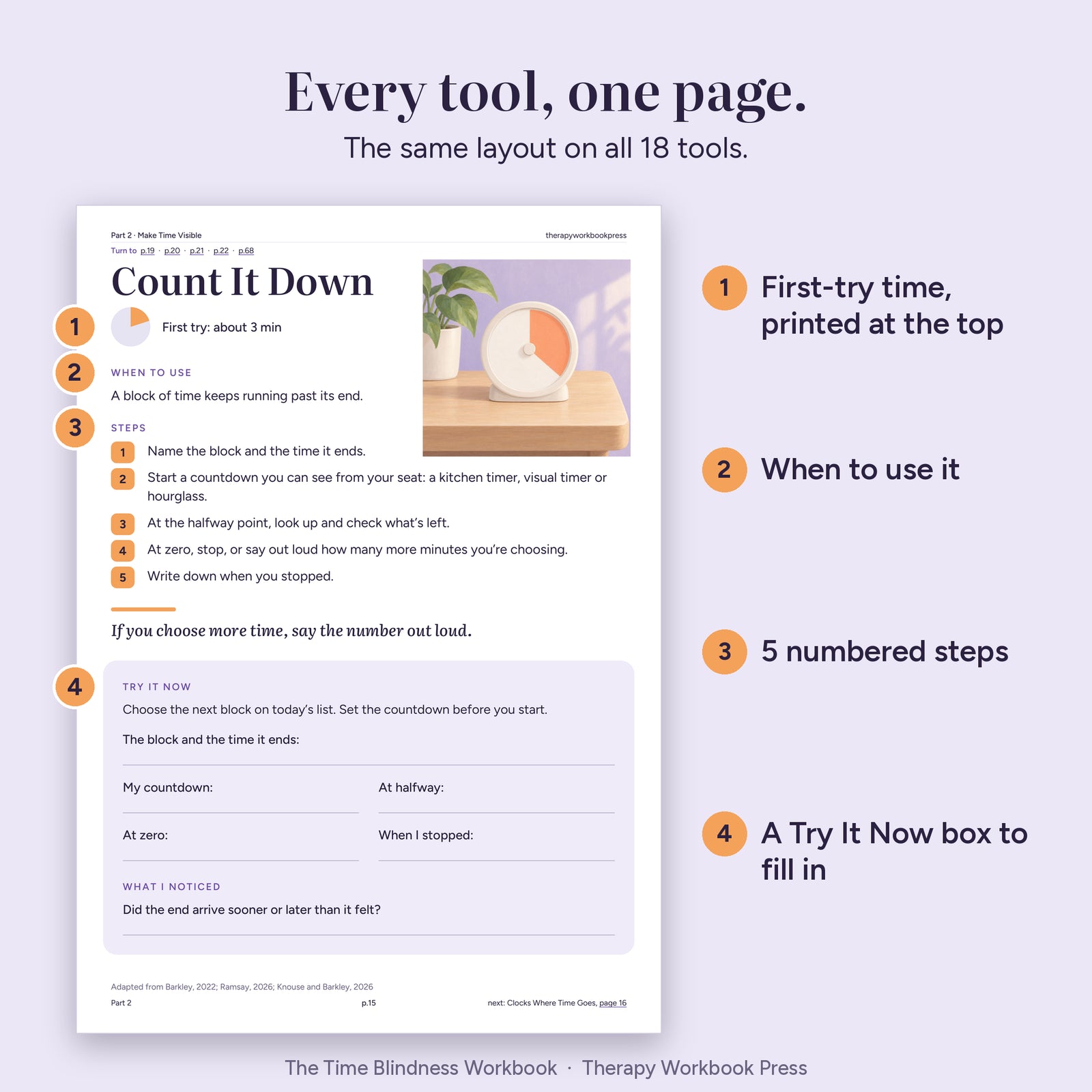
- Use the tool that fits. Every tool page has the same parts: when to use it, 5 numbered steps, a Try It Now box to fill in, and a first-try time printed at the top. Backward from Arrival on page 34 starts from the time you need to be there, ready, then subtracts your door-to-arrival time, your routine and a cushion you choose. What is left is your start time, with one alarm. First try: about 4 minutes. Elena’s version is on page 37: there by 3:25, so she starts at 2:31.
The Map is a mirror, in the book’s own word. No score sends you anywhere, and it doesn’t screen for or diagnose anything. No time for it today? Quick Start on page 2 skips it. Pick the moment that sounds most like yours, and its page has one thing to try today.
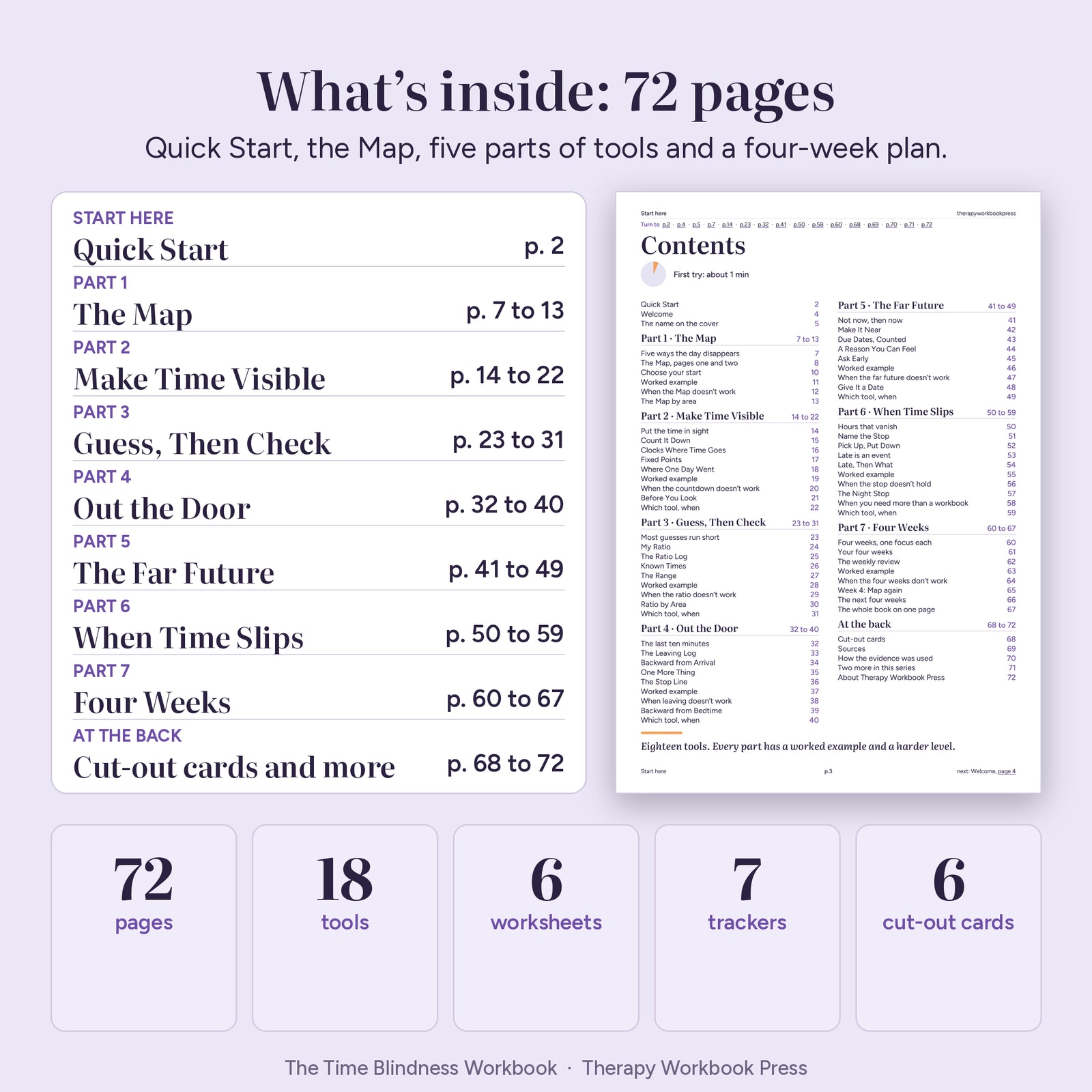
What’s Inside: 18 Tools for Five Ways the Day Disappears
- Part 1, The Map (pages 7 to 13). The five lanes, the 20-line Map, choosing your start, and a Level 2 page that maps where each lane shows up: work deadlines, household, school and kids, appointments, social plans and travel.
- Part 2, Make Time Visible (pages 14 to 22). 4 tools that put a clock where the trouble happens, for any lane: Count It Down, Clocks Where Time Goes, Fixed Points and Before You Look. Plus Where One Day Went, one ordinary day logged in four check-ins.
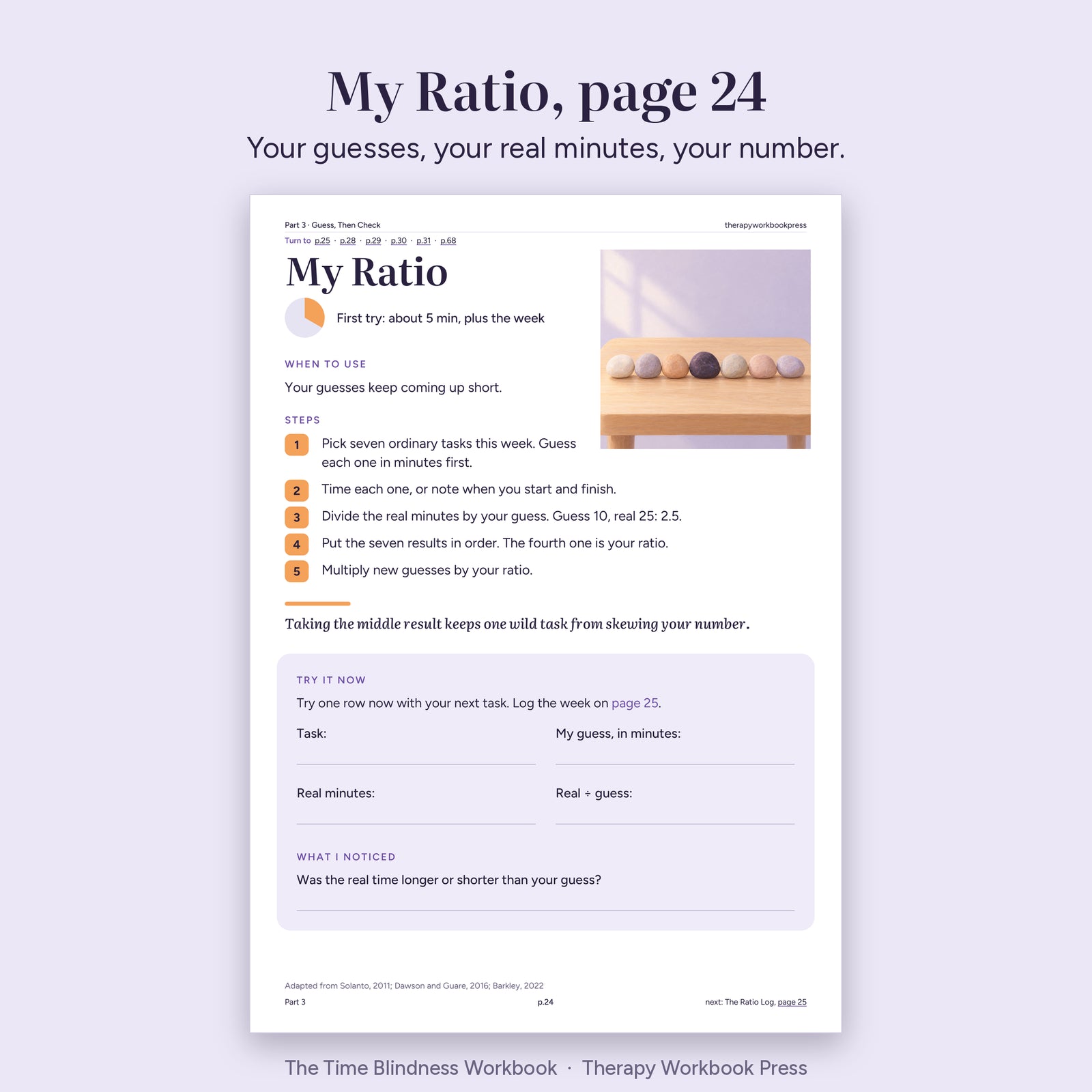
- Part 3, Guess, Then Check (pages 23 to 31). For the five-minute job that takes an hour. My Ratio turns seven timed tasks into one number: real minutes divided by your guess, with the middle result as your ratio. The Range plans the tasks where a short guess will cost you. The Ratio Log, Known Times and Ratio by Area keep the numbers.
- Part 4, Out the Door (pages 32 to 40). The last ten minutes before leaving. The Leaving Log measures your routine and your door-to-arrival time, and Backward from Arrival, One More Thing, The Stop Line and Backward from Bedtime put them to work. The Stop Line is for the 3:00 appointment that eats the whole morning, which some people call waiting mode. That is a name, not a diagnosis.
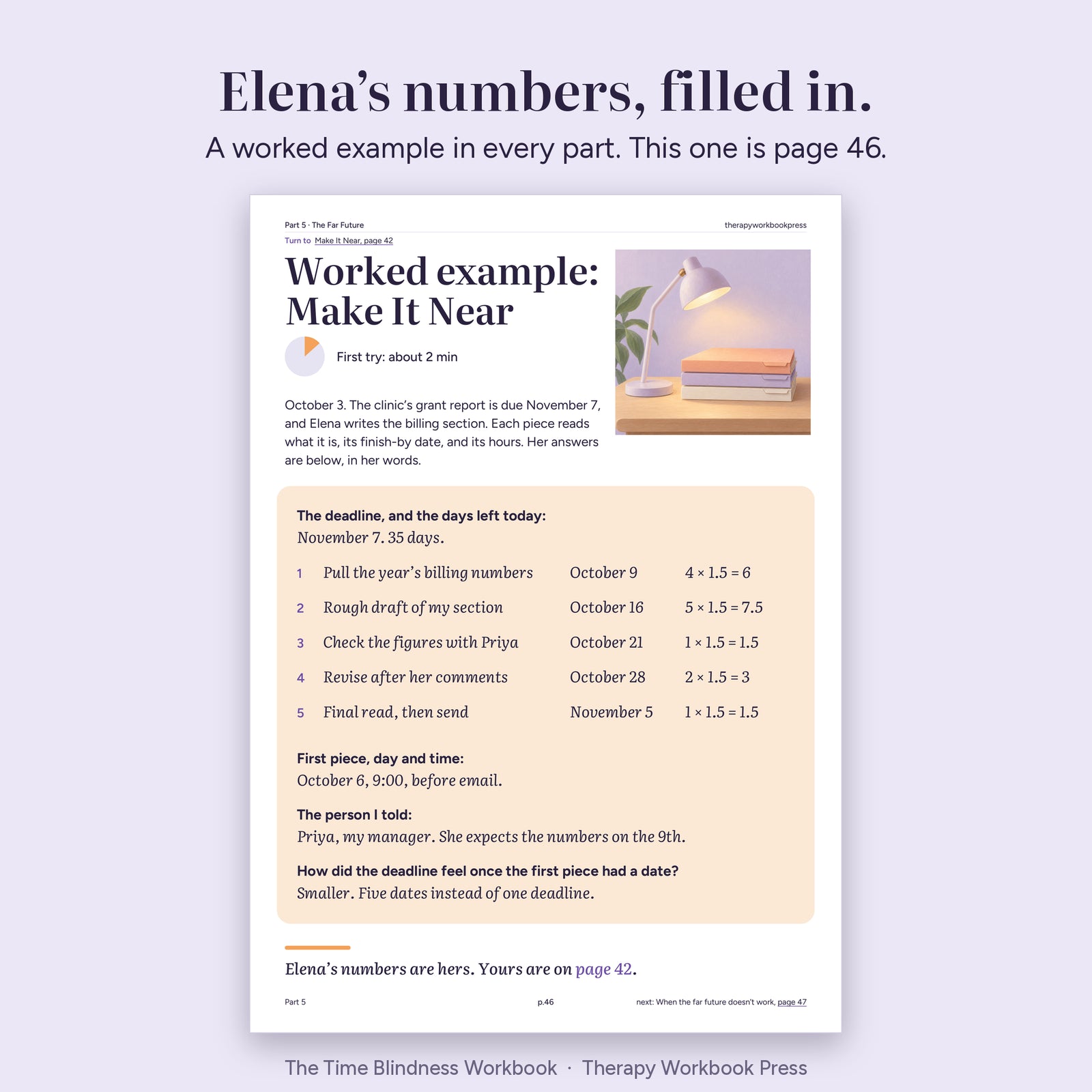
- Part 5, The Far Future (pages 41 to 49). For the deadline that isn’t real until it’s tonight. Make It Near works back from a deadline in pieces of a few days, each priced with your ratio, the last one finishing two days early. A Reason You Can Feel, Ask Early and Give It a Date cover the far task that feels like nothing today, the date that won’t hold, and the task with no deadline at all. Due Dates, Counted puts every deadline in the next eight weeks on one page.
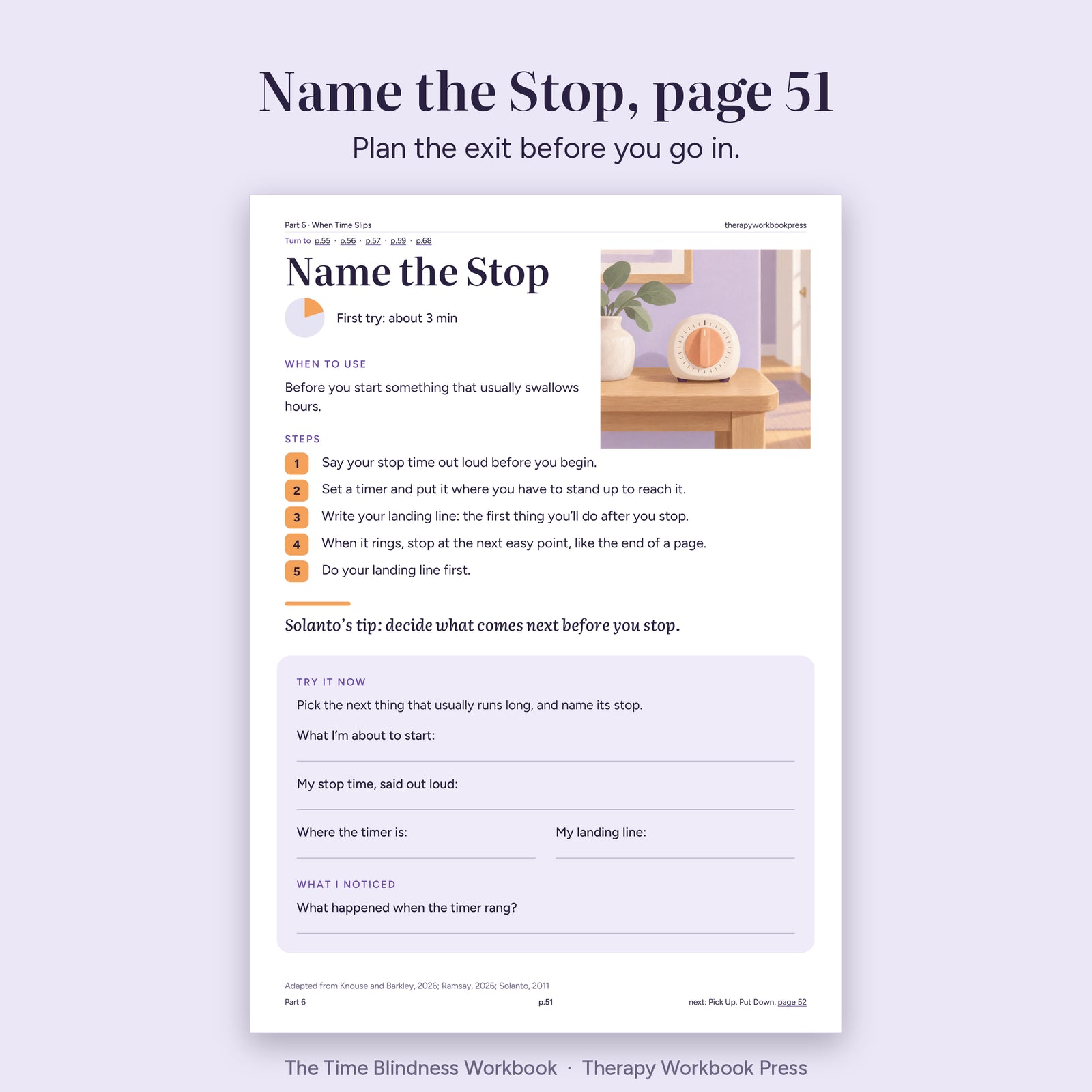
- Part 6, When Time Slips (pages 50 to 59). For the hour that vanishes into a show, a task or a phone. Some call that hyperfocus, also a name, not a diagnosis. Name the Stop, Pick Up, Put Down and The Night Stop plan the exit before you go in. Late, Then What is for after you are late: one line with the time you’ll arrive (never while driving), a thank-you for waiting, and one sorry, which the page calls plenty.
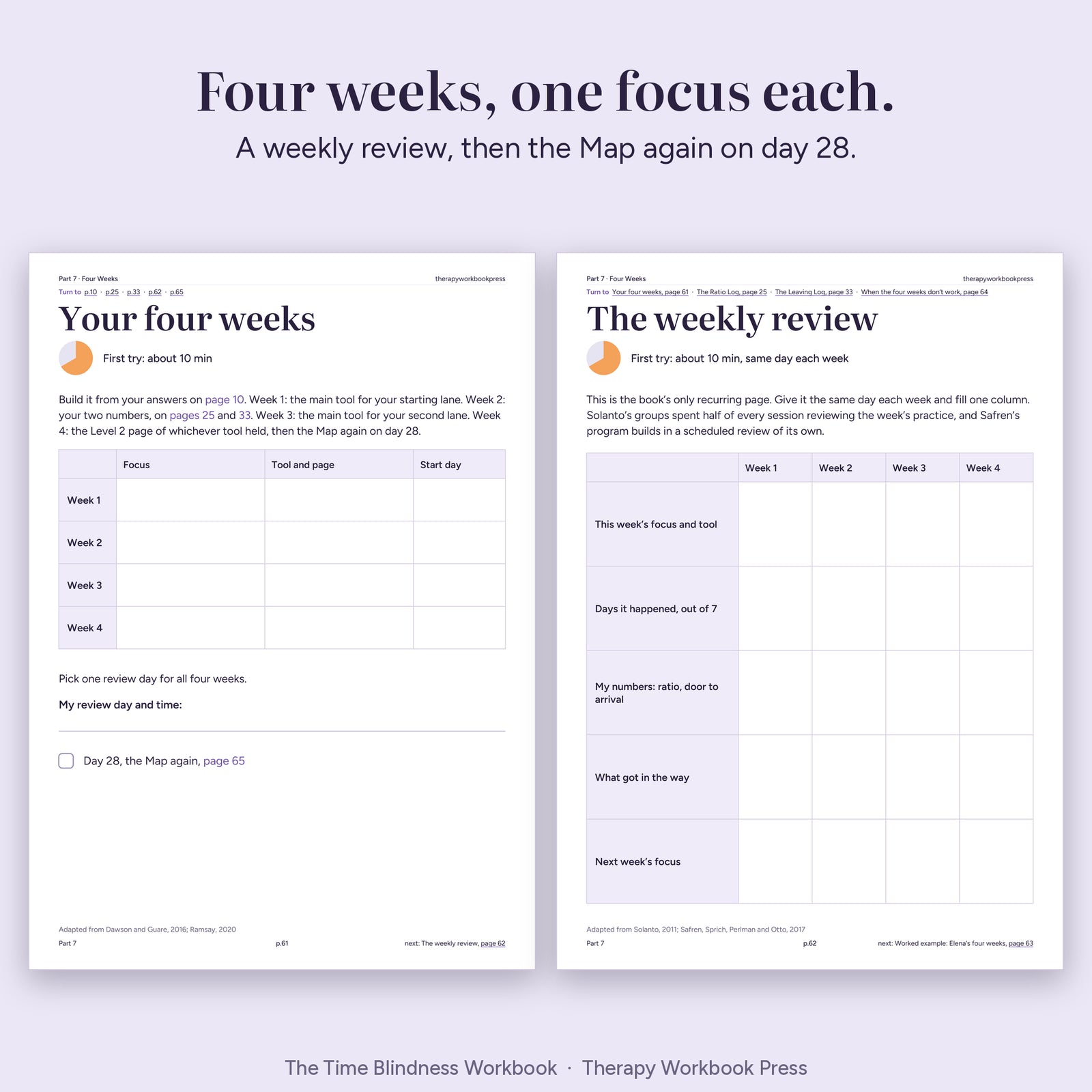
- Part 7, Four Weeks (pages 60 to 67). One focus a week, built from your Map, with week 2 set aside to measure your two numbers. A weekly review on page 62, the Map again on day 28, and the whole book on one page.
- At the back (pages 68 to 72). 6 cut-out cards, the Sources page, a page on how the evidence was used, and the two other books in this series.
Every part has a worked example and a harder Level 2 page. The worked examples follow one woman, Elena, who works in billing three days a week and has two kids, so you see each tool filled in before you fill in your own. Every part also has a page for when a tool doesn’t work: three snags, and what to try.
Counted from the file: 72 pages, 18 tools, 6 worksheets, 7 trackers, 7 worked examples, 479 fillable fields and 6 cut-out cards.
Who It Is For, and Who It Is Not For
For: adults with ADHD, and anyone who knows these days without a diagnosis. That is how page 4 puts it. It suits the person whose 9:00 start became 9:40 again, in a week that holds a job, a household and other people’s schedules on top. Most of the examples come from a woman’s week.
Not for: anyone who needs a diagnosis, since a workbook can’t give one. Anyone looking for treatment, or for something to replace medication or care from a clinician. And anyone shopping for a planner: page 4 says this isn’t one, and only one page repeats, the weekly review on page 62.
What it does not do: promise you will never be late again. Page 4 makes two promises instead. Every tool is a procedure you can try today. And the only numbers about you in it are the ones you write. Page 32 adds Knouse and Barkley’s point: being late sometimes is human, and it doesn’t make you a bad person.
If what you are carrying is heavier than lost time, page 58 comes first. It lists the signs that it’s time to talk to a clinician. If you’re thinking about ending your life or you’re not safe right now, call or text 988 in the US, 9-8-8 in Canada, or your local emergency number anywhere else. Do it now.
The Evidence, at Its Honest Size
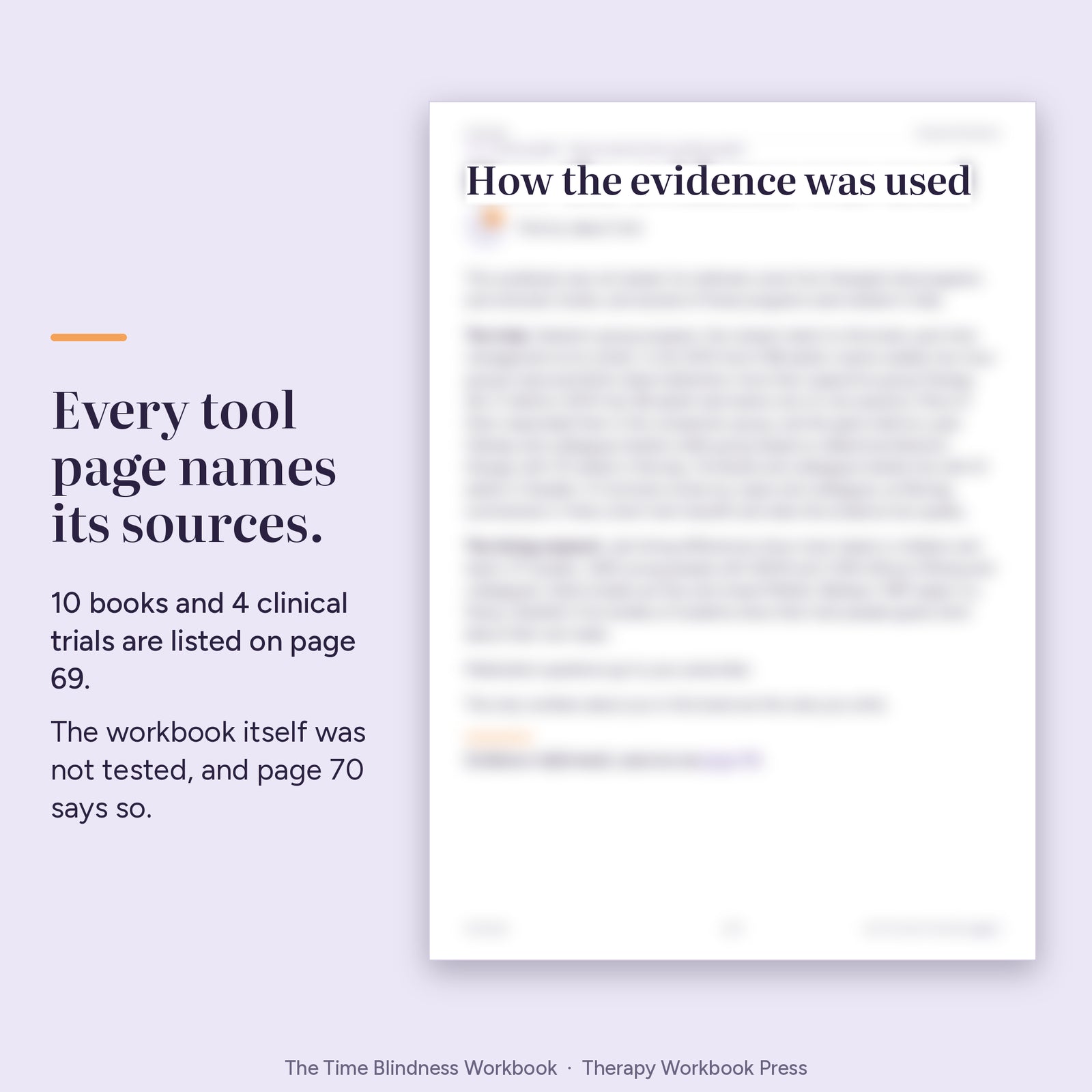
Every tool page names its sources in small print at the foot. Page 69 lists all of them: 10 books, 4 clinical trials and 6 further references. Page 70 explains how each one was used.
The closest match is Solanto’s group program, which puts time management at its center. In her trial of 88 adults, twelve weekly two-hour groups improved blind-rated inattention more than supportive group therapy did (Solanto and colleagues, American Journal of Psychiatry, 2010). In Safren’s trial, 86 adults had twelve one-to-one sessions. More of them responded than in the comparison group, and the gains held at a year.
This workbook turns the methods those programs tested into one-page tools you can use on your own. A Cochrane review, as Ramsay summarizes it, finds a short-term benefit for programs of this kind and rates the evidence low quality. On timing itself, lab differences show most clearly in children and teens, across 27 studies, and adult studies are few and mixed. That is why the book has you measure your own numbers instead of assuming them.
Built on the CBT time-management methods tested in clinical trials with adults with ADHD. Sources on page 69. Names here are for attribution only, and no author named on this page is affiliated with this workbook. Step 4 of The Stop Line on page 36 is DBT-informed: Linehan’s practice of doing one thing at a time. Dialectical Behavior Therapy (DBT) was developed by Marsha M. Linehan. The DBT-informed step is an adaptation, and this workbook is not affiliated with her.
Format, Delivery and License
- Two fillable PDFs, A4 and US Letter, 72 pages each. Use the one that matches your paper.
- Fillable. 479 fields to type or tap into, in a PDF reader such as the free Adobe Acrobat Reader. Or print it and use a pen.
- 6 cut-out cards on page 68: Count It Down, My Ratio, Backward from Arrival, The Stop Line, Make It Near and Name the Stop, each with its page number, for a pocket, a bag or the fridge door.
- Instant download. The link arrives by email within minutes of purchase.
- Personal license. Your purchase covers one person. Print the pages as often as you like for your own use. Clinician and group licenses: contact@therapyworkbookpress.com.
- One payment. No subscription and no app.
The 60-day guarantee. Print it. Fill it in. Give a tool its week. If the workbook isn’t right for you, email contact@therapyworkbookpress.com within 60 days of your order, with your order number, and you get a full refund. Using it doesn’t void the guarantee, and no reason is needed. If no tool earns a second week, that is reason enough.
Questions
I have started planners and workbooks before and never finished them. Will I finish this one? You don’t have to. Quick Start on page 2 picks one moment and one page, and its last line says one tool, tried once today, is a real start. Part 7 gives each week a single focus. And if a week gets skipped, page 64 says to restart the same week, with no catching up.
Do I need an ADHD diagnosis? No. Page 4 says the book is for adults with ADHD and for anyone who knows these days without a diagnosis. Time blindness is Barkley’s name for days like these. It is a name, not a diagnosis, and the workbook can’t diagnose anything.
Is this another planner? No, and page 4 says so in plain words. These pages are procedures. My Ratio, for one, has you guess seven ordinary tasks, time them, and divide the real minutes by your guess. Elena’s works out to 1.5 on page 28. Only one page repeats: the weekly review on page 62.
How long does it take? About a minute for Quick Start and about 5 minutes a page for the Map. Every tool prints its first-try time, from about 1 minute to about 10. After that, page 4’s advice: give a tool a week, then keep it or drop it. Part 7 lays out four weeks.
What exactly do I get? Two fillable PDFs, A4 and US Letter, 72 pages each, by email right after checkout. Nothing ships.
Can I print it on US Letter? Yes. A US Letter edition comes with the A4 one, so you print the file that fits your paper.
What if a page feels heavy? Page 4 answers that: if a page makes the day feel heavier, close the book and turn to page 58.
Is it only for women? No. Most of the examples come from a woman’s week, and the tools are the same for anyone.
Is this therapy, or a replacement for medication? No. Page 6 calls it practice pages for adults, not medical or psychological advice. Page 70 sends medication questions to your prescriber.
I already have The ADHD Executive Dysfunction Workbook. Is this the same book? No. Page 71 explains: that book covers starting, holding things in mind, planning, feelings that flood and running on empty, and its four time pages are where this book began. This one gives all 72 pages to time. Nothing in it depends on the other.
What about the sting after I’m late? Page 53 treats being late as an event: it happened at a time, it cost something, and it has a next step, on page 54. If the sting lasts past the evening, page 71 points to a companion, The Rejection Sensitivity Workbook.
Can I use it with my clients or my group? The standard license covers one person. For a clinician or group license, email contact@therapyworkbookpress.com.
Start on page 2. Its last line: one tool, tried once today, is a real start.