
Last day: sale + free bonuses end midnight. 60-day money-back guarantee.

0

Your Cart is Empty

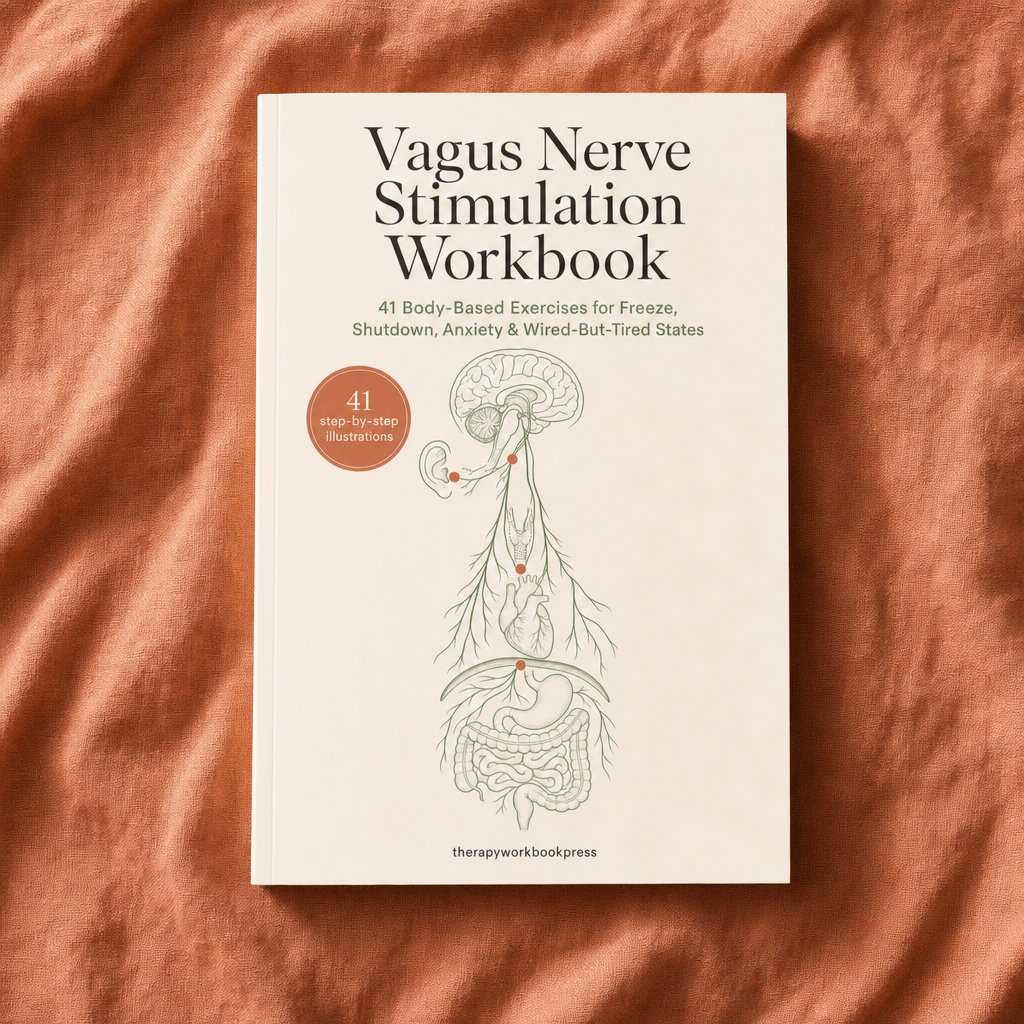
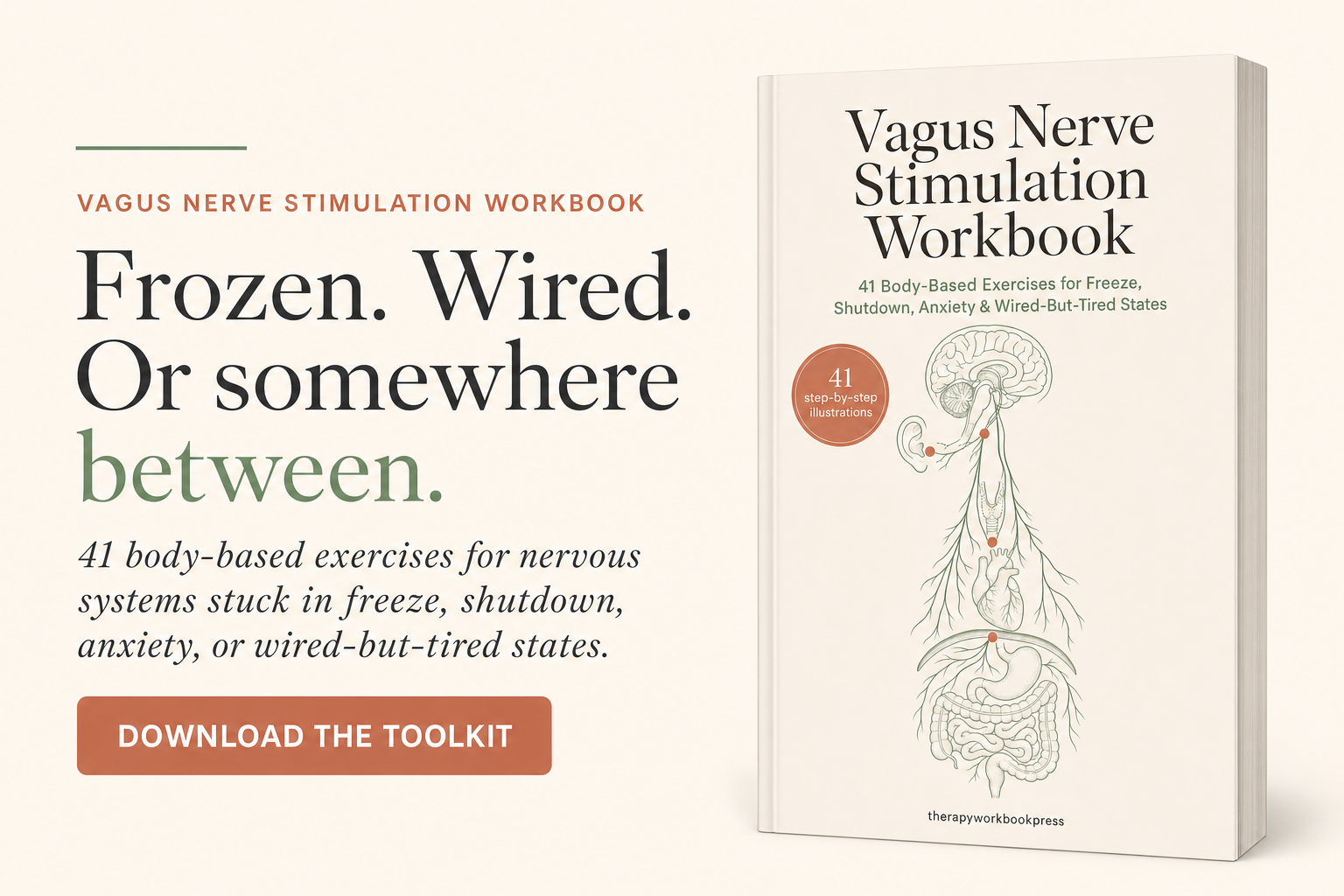
Vagus Nerve Stimulation Workbook: 41 Body-Based Exercises for Freeze, Shutdown, Anxiety & Wired-But-Tired States

  • American Express
  • Apple Pay
  • Google Pay
  • Klarna
  • Mastercard
  • PayPal
  • Visa

Instant download. Your link arrives by email within minutes and also shows on your order page. Open it on any phone, tablet or computer, or print it at home.

60-Day Write-In-It Guarantee. Use every page. If it isn't worth it to you, email us within 60 days for a full refund. Writing in it never voids it.

If your nervous system has been stuck somewhere it shouldn't be — frozen, wired-but-exhausted, anxious, hollow, dissociated, hypervigilant, or just not where you left it — this workbook hands you 41 ways back, anchored to the one nerve that controls all of them.

The mechanism most self-help skips

Your vagus nerve is the master switch between "fight or flight" and "rest and digest." It runs from your brainstem down through your face, throat, heart, lungs, and gut — and it processes danger and safety signals roughly 0.3 seconds before your thinking brain knows what's happening.

This is why insight alone rarely shifts a stuck nervous system. The brainstem decides first. The cortex catches up. By the time you're trying to "calm down" with thoughts, the body has already chosen a state.

The 41 practices in this workbook bypass that lag. Each one is a direct, body-based input to the vagal pathway — breath, sound, movement, temperature, pressure, eye position — that the nervous system reads as a safety cue and responds to in seconds.

Start with the map, not the technique

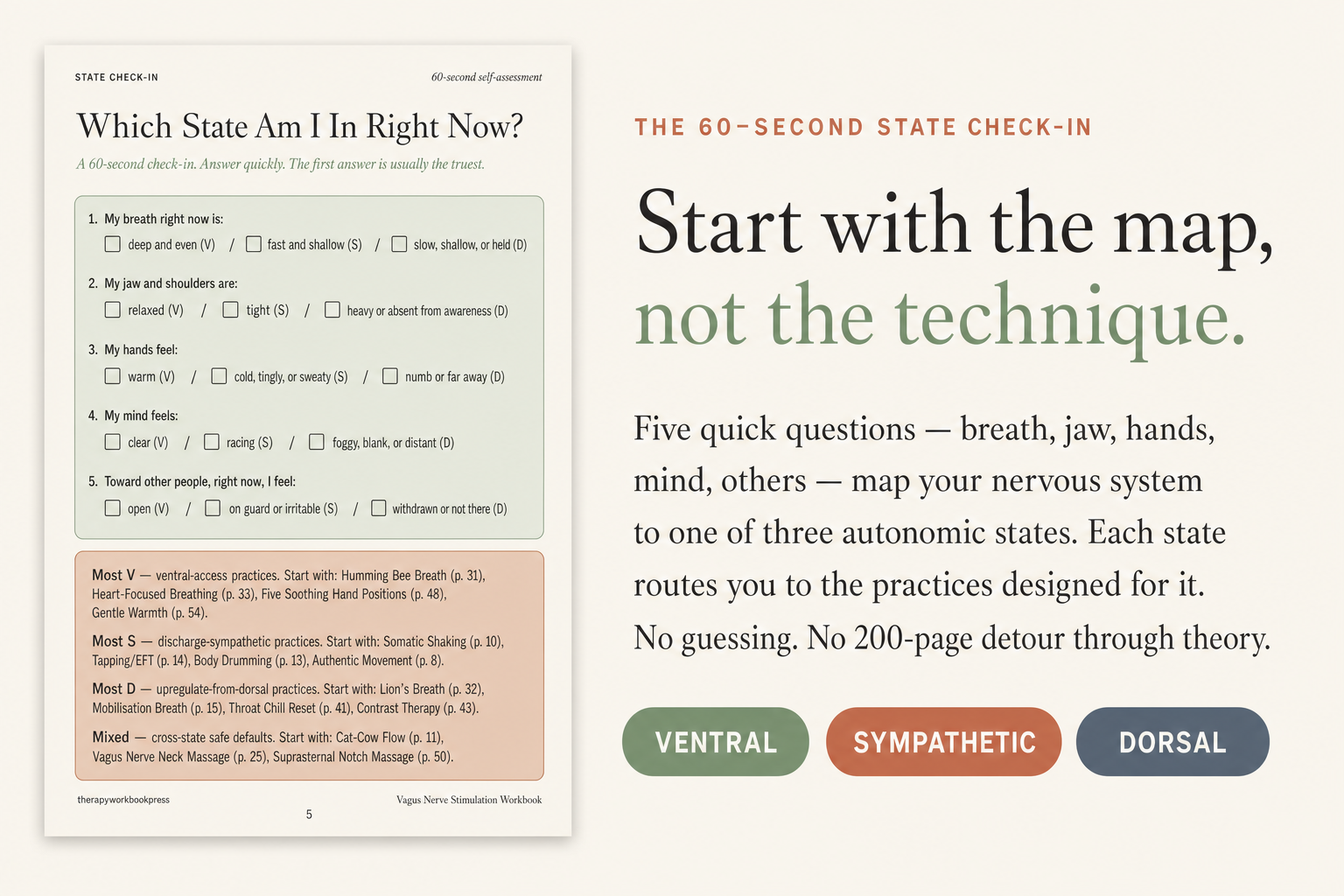
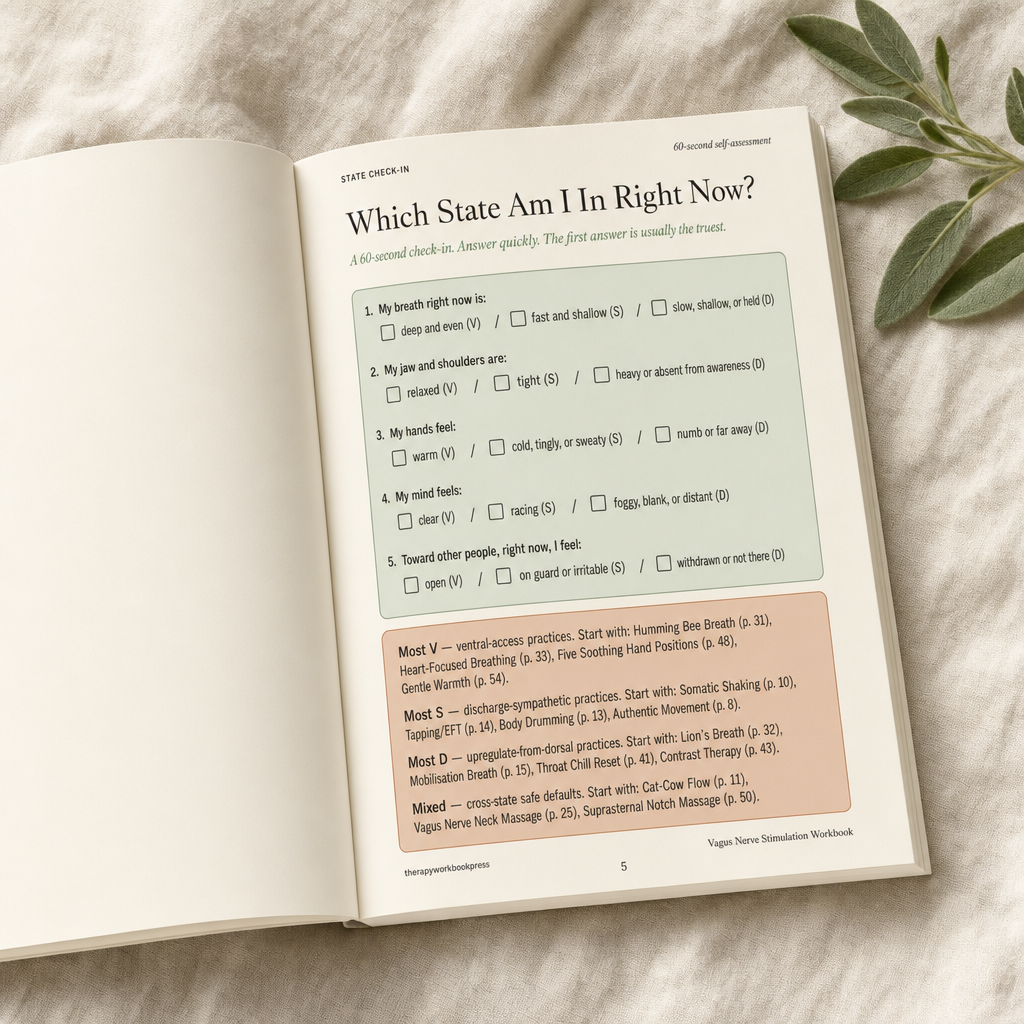
Most somatic resources hand you 50 exercises and let you guess. This workbook opens with a 60-second state check-in — five quick questions about your breath, jaw, hands, mind, and orientation to people — that maps your current state to one of three autonomic positions:

  • Ventral — connected, calm, capable. Practices here deepen and stabilise the state.
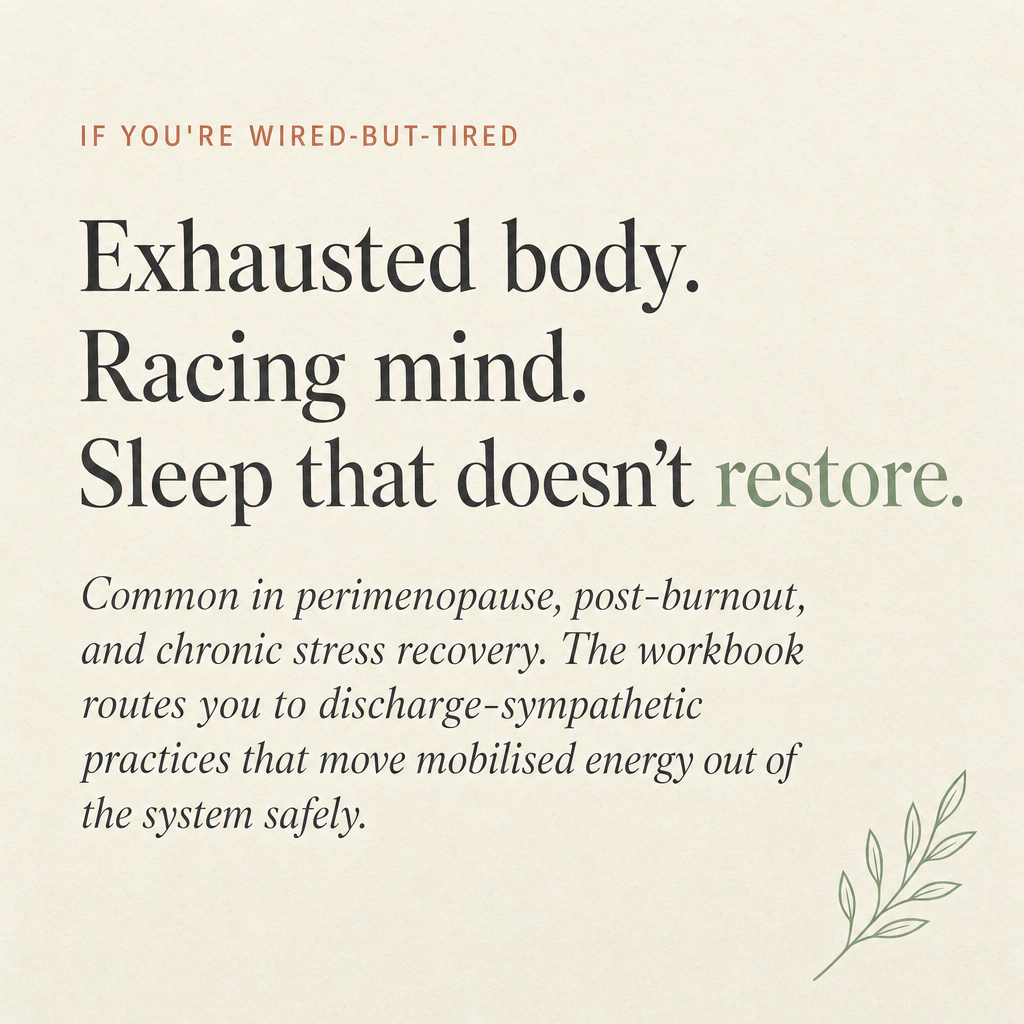
  • Sympathetic — wired, anxious, irritable, racing. Practices here discharge mobilised energy safely.
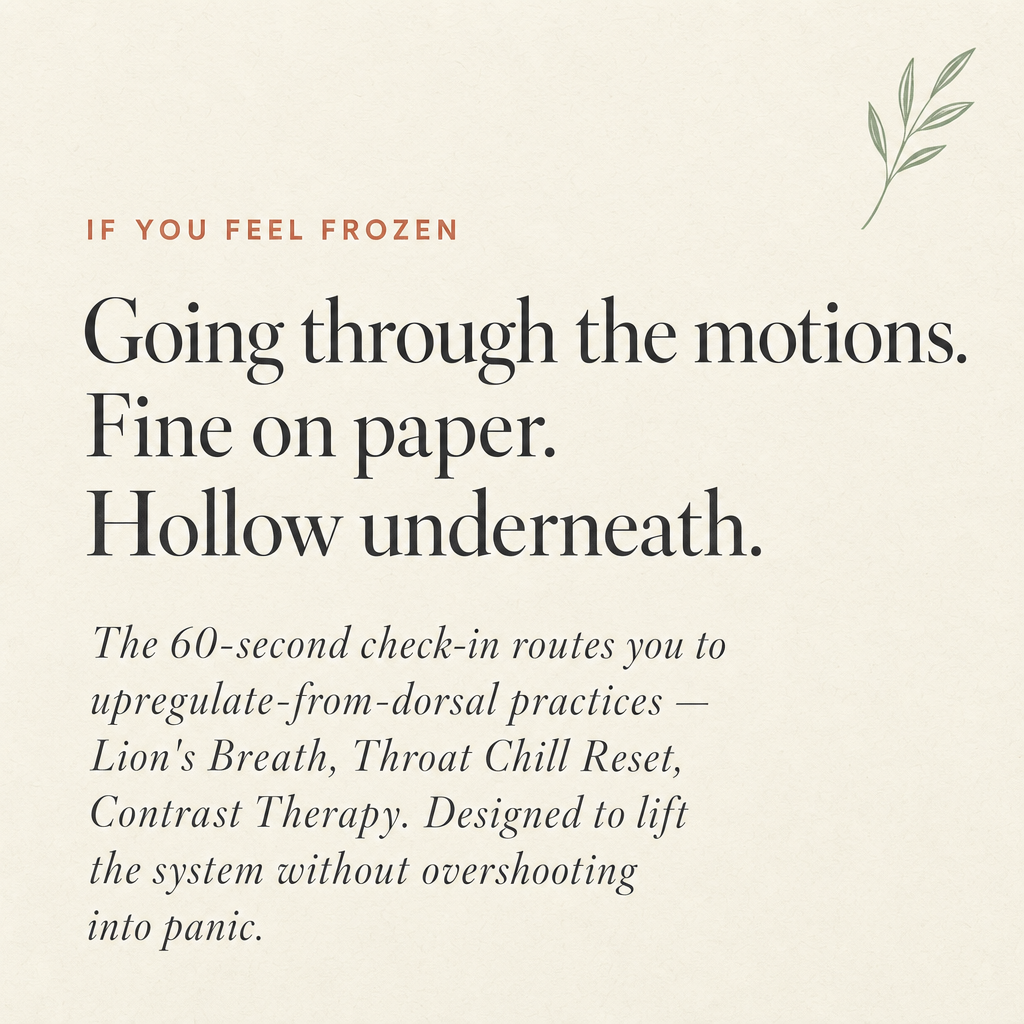
  • Dorsal — shut down, foggy, withdrawn, numb. Practices here gently upregulate without overshooting.

The check-in routes you straight to the four or five practices that fit your nervous system in this moment. No trial-and-error. No 200-page detour through theory. The map is on page 5.

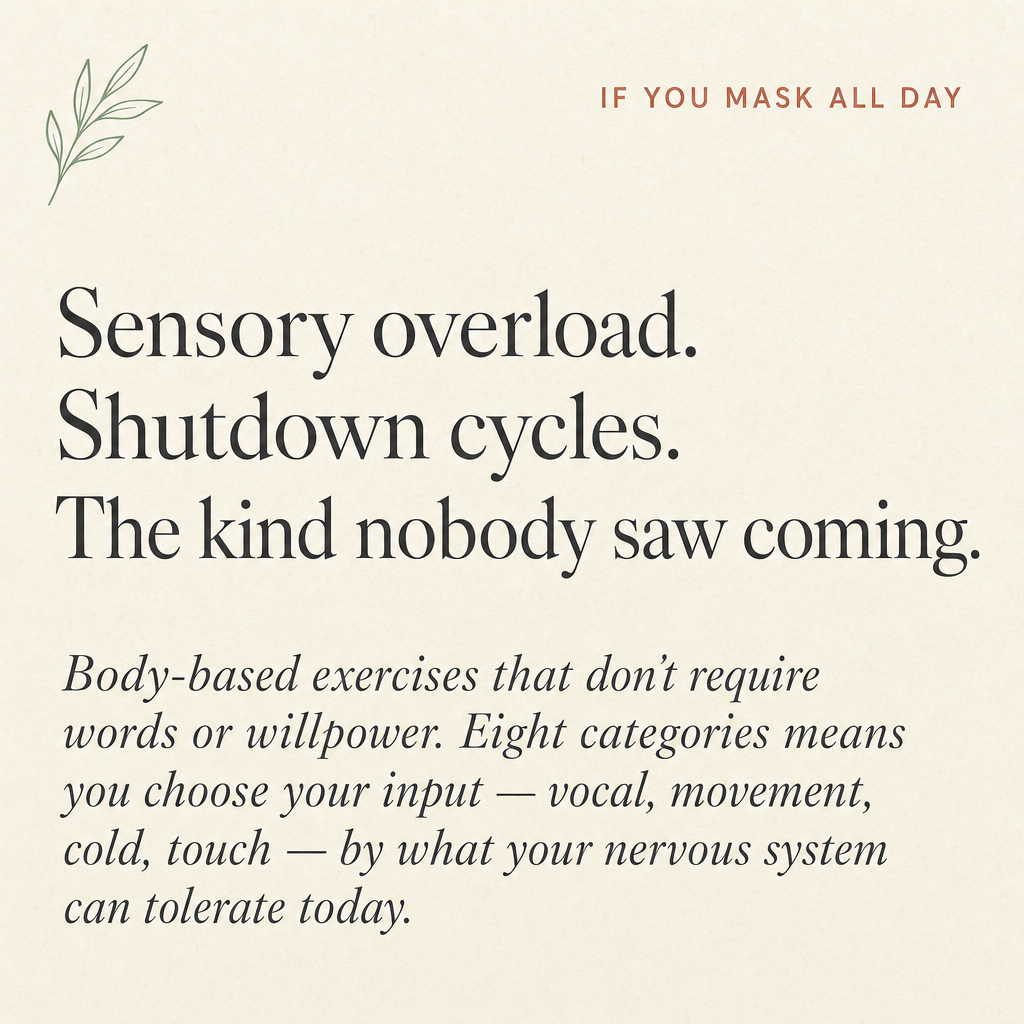
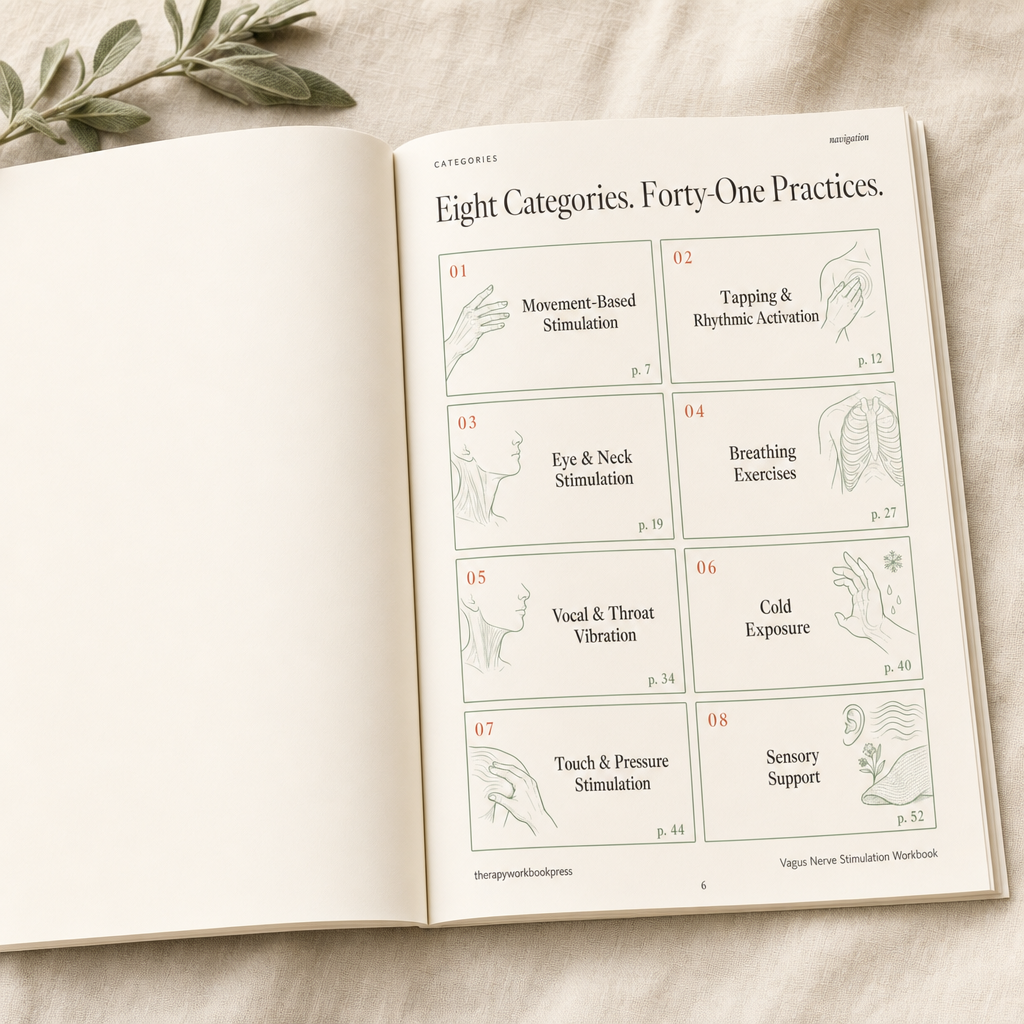
Eight categories. Forty-one practices. One page each.

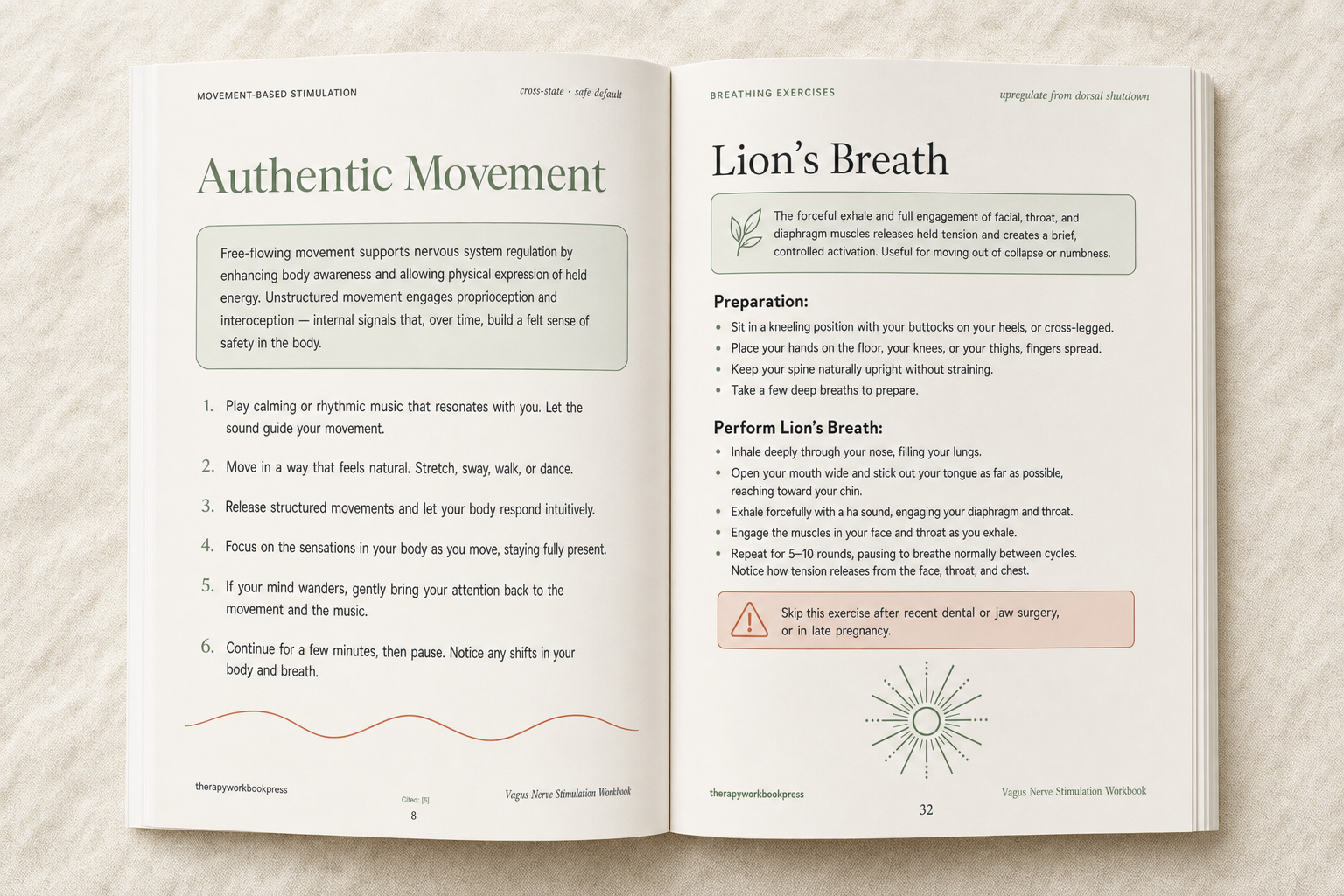
Every practice is on a single page, with the mechanism, the instructions, and the safety considerations together. Flip to whichever fits the moment. No required order.

  • 01 — Movement-Based Stimulation: Authentic Movement, Somatic Shaking, Cat-Cow Flow, Body Drumming, and others. For energy that's stuck or stored and needs to move.
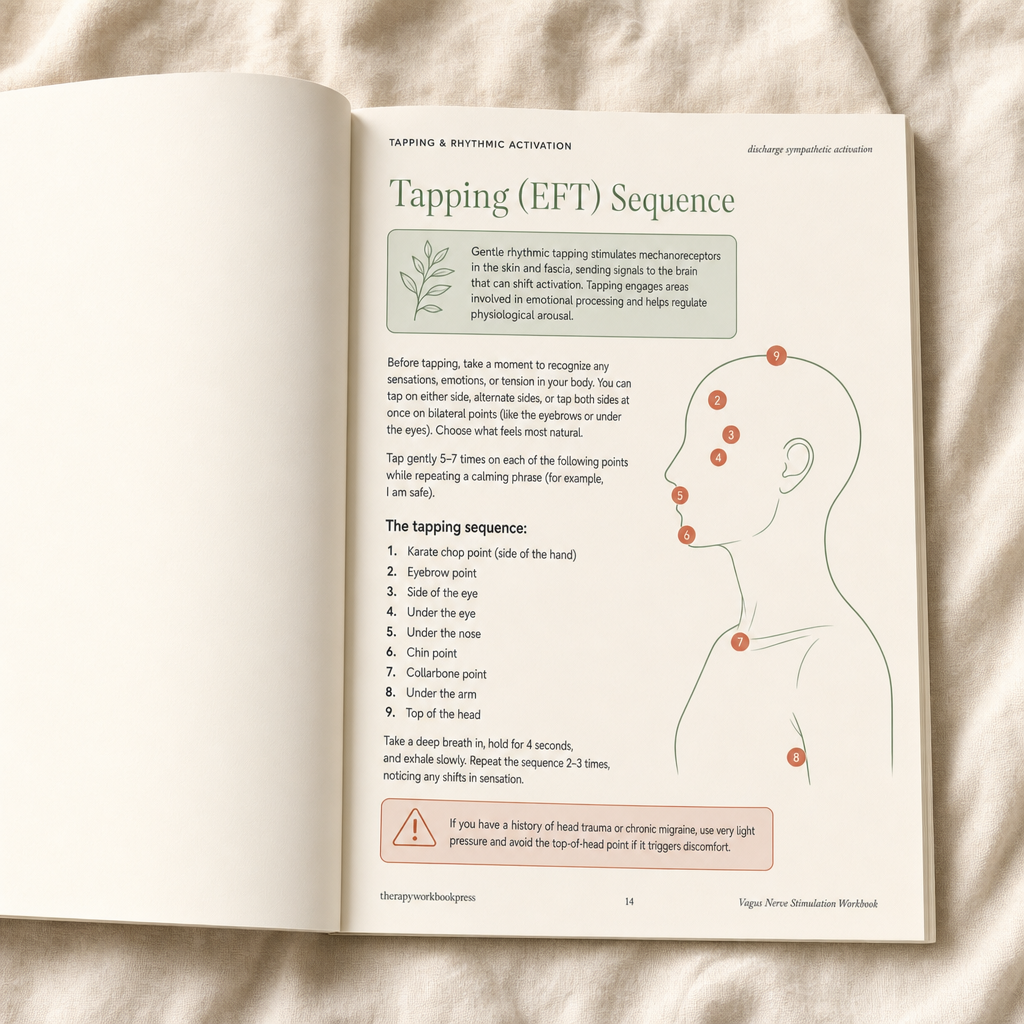
  • 02 — Tapping & Rhythmic Activation: EFT-Style Tapping, Bilateral Hand Tapping, Pendulum Self-Hug. Right-left rhythmic input for systems caught in alarm.
  • 03 — Eye & Neck Stimulation: Basic Exercise (Stanley Rosenberg), Vagus Nerve Neck Massage, Suprasternal Notch Release. Direct input to the cervical branches of the vagus.
  • 04 — Breathing Exercises: 4-4-6-2 Breath, Buteyko, Alternate Nostril, Lion's Breath, Mobilisation Breath, Humming Bee Breath. Different breaths for different states — not "just breathe."
  • 05 — Vocal & Throat Vibration: "Vooo" Toning, Humming, Throat Chill Reset. Internal vibration that engages the recurrent laryngeal branch and softens the amygdala.
  • 06 — Cold Exposure: Cold Water Reset, Contrast Therapy, structured protocols for using temperature as a controlled nervous-system stimulus — not a shock.
  • 07 — Touch & Pressure Stimulation: Five Soothing Hand Positions, Heart-Focused Holding, weighted and pressure-based interoceptive cues.
  • 08 — Sensory Support: Texture Exploration, Sound Mapping, Aroma Anchors. Practices to interrupt dissociation loops and rebuild felt safety.

Built on the canon — not the algorithm

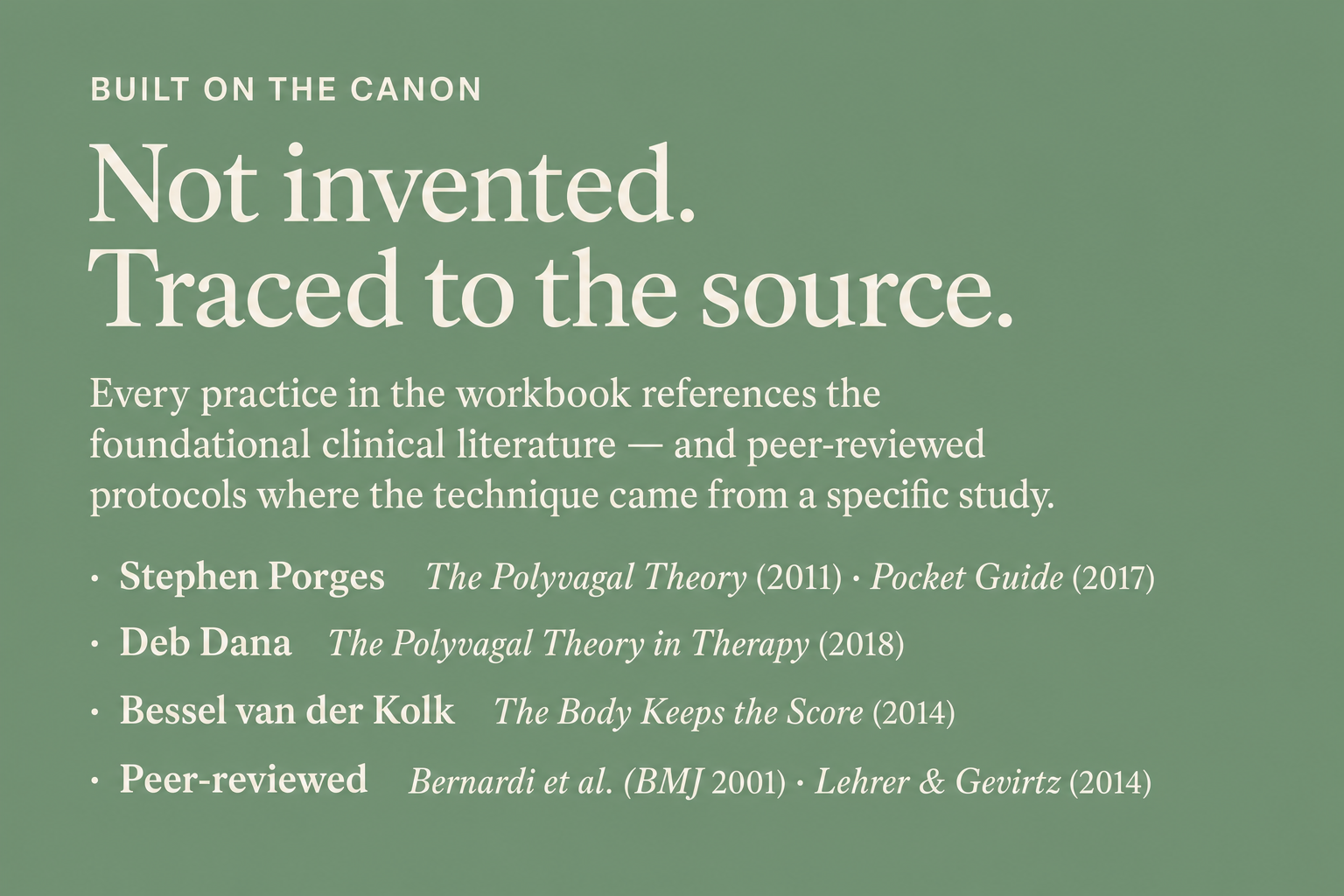
The framework draws on the foundational clinical literature: Stephen Porges (The Polyvagal Theory, 2011; The Pocket Guide to Polyvagal Theory, 2017), Deb Dana (The Polyvagal Theory in Therapy, 2018), and Bessel van der Kolk (The Body Keeps the Score, 2014). Specific protocols cite peer-reviewed sources including Bernardi et al. (BMJ, 2001) on respiratory rhythms, Lehrer & Gevirtz (Frontiers in Psychology, 2014) on heart rate variability, and Schauer & Elbert (2010) on dissociation. Every practice has a traceable mechanism. Nothing here is invented.

Who this workbook is for

This is a map-before-technique resource. It's not a symptom-specific protocol — it's a state-specific one. That makes it useful for anyone whose nervous system runs hotter, colder, or more erratically than they'd like:

  • People in functional freeze — going through the motions, fine on paper, hollow underneath.
  • People in wired-but-tired states — exhausted body, racing mind, sleep that doesn't restore. Common in perimenopause, post-burnout, and chronic stress recovery.
  • Late-diagnosed neurodivergent adults processing sensory overload, masking exhaustion, and shutdown cycles.
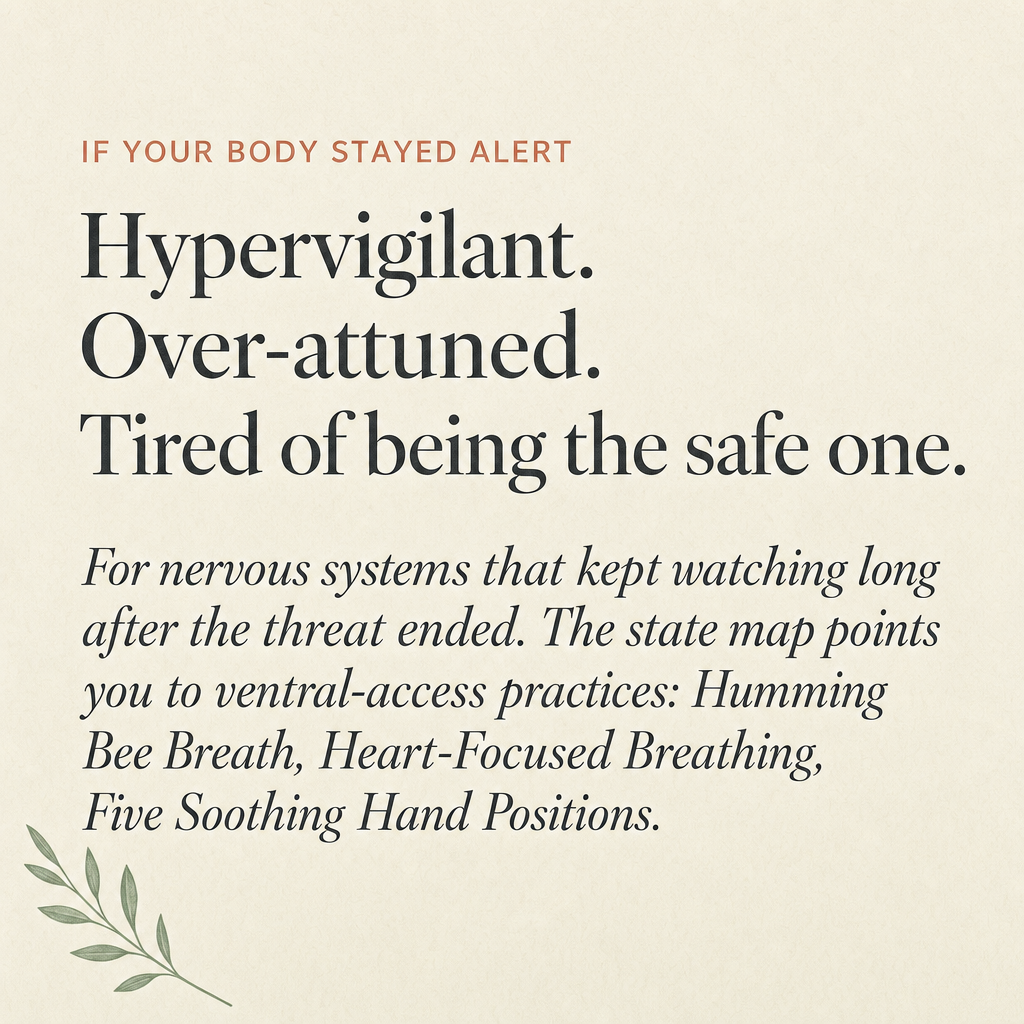
  • People recovering from complex or developmental trauma, including fawn-response and people-pleasing patterns where the body stayed alert long after the threat ended.
  • Parents learning co-regulation — practices you can use alongside a child, not at them.
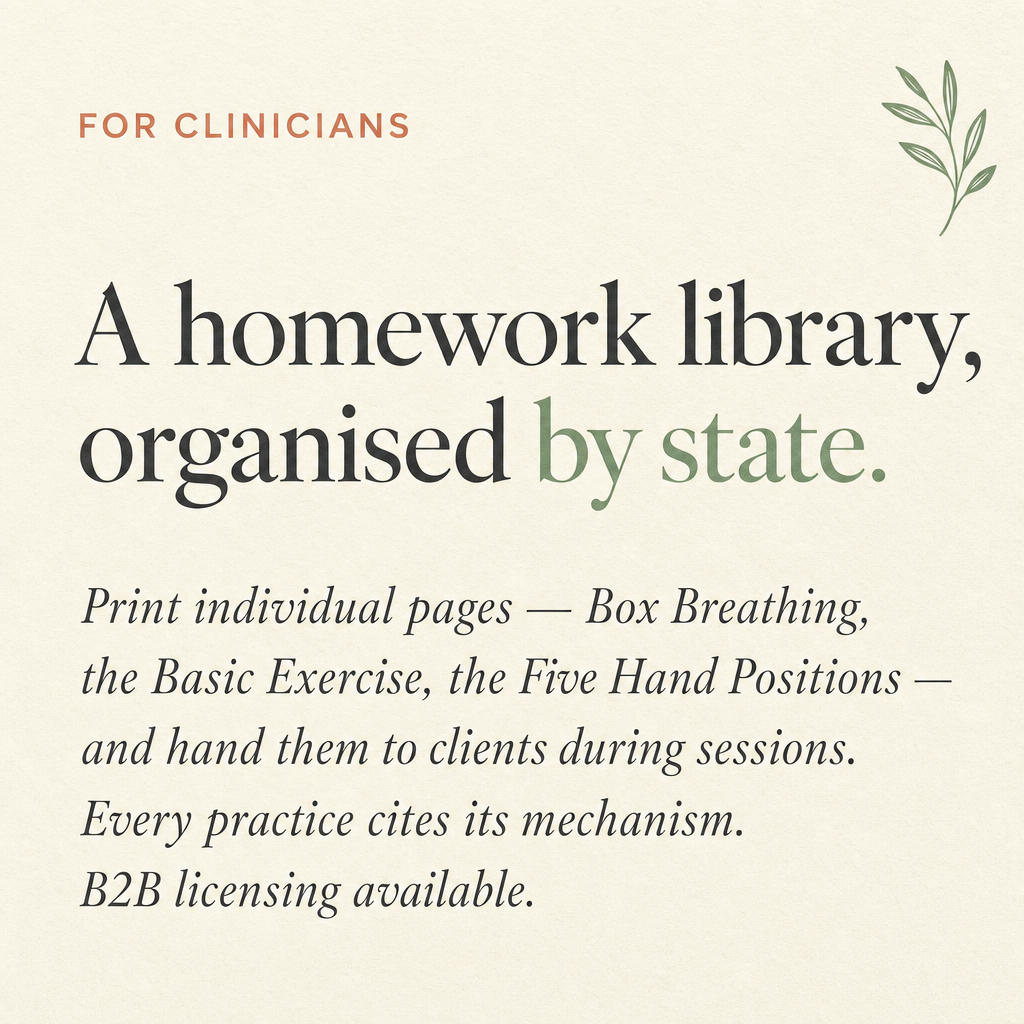
  • Clinicians — a library of homework assignments organised by state. Print individual pages (Box Breathing, the Basic Exercise, Five Soothing Hand Positions) and hand them to clients during sessions. B2B licensing available on request.

What you receive

  • 60-page digital PDF workbook — A4 and US Letter format. Printable, tablet-friendly, returnable to often.
  • 41 step-by-step illustrated practices, each on a single page with mechanism and safety notes.
  • The 60-second State Check-In — your routing tool, used as often as needed.
  • Lifetime access and free future updates — buy once, own forever. Every revised edition and new release in this series is delivered straight to your inbox at no additional cost.
  • Instant download — delivery link arrives on your confirmation page and by email within seconds of checkout.

Format: Digital PDF Workbook (A4 & US Letter). 60 pages. Printable and tablet-friendly. No physical item shipped.


  • 5 stars: 146 (94%)
  • 4 stars: 9 (6%)
  • 3 stars: 0 (0%)
  • 2 stars: 0 (0%)
  • 1 star: 0 (0%)
Some of the reviews shown are from related products the merchant grouped with this one.
K
Karen

Unable to access any of the purchases from this company.

I'm sorry for the trouble. Your files are always available from your order email. Open the email we sent to the address you used at checkout and use the link in it. It opens your order page, and every file you bought is there to download. If you can't find the email, check your spam folder. If it still won't open, message us through the Contact page on our site and we will send the files to you directly.

K
Kirk

Cool beans

T
Trish

Fabulous workbook! Very useful in my own life, with my children, and in my work as a life coach. Thank you for educationg me in ways to make a real difference in someone’s pain.

A
Anonymous

It’s great resource for people with trauma

J
Jennifer Boyd
Helped my chronic tension

I've held tension in my shoulders for years. The exercises targeting the neck and shoulders have made a noticeable difference. Physical relief I didn't think was possible.

V
Vincent Howard
My daughter uses these at school

My 12-year-old keeps these in her pencil case. When she feels overwhelmed at school, she has tools right there. Her teachers have noticed the difference.

K
Kenneth Lawrence
Beautifully designed materials

The visual design is calming and professional. That matters when working with dysregulated clients. The aesthetics match the content quality.

S
Sarah Martin LPCC
Keep a set everywhere

I have these on my desk, in my bag, by my bed, and in my car. Different situations call for different exercises and having them accessible makes all the difference.

R
Ruth Wright
Worth every penny

I hesitated at first but this toolkit has saved me hours of creating my own materials. The quality is professional and the content is clinically sound.

J
Jane Reed
Evidence-based and practical

This isn't woo-woo wellness content. It's grounded in neuroscience and trauma research. As a skeptic, I appreciate the scientific foundation. And it works.

B
Betty Allen
My entire book club worked through this

My women's group decided to work through this together. The discussions were incredibly rich. We all experienced breakthroughs. Highly recommend as a group resource.

T
Theresa Foster NCC
Great addition to therapy homework

I assign these as homework and clients actually use them! The cards are engaging enough that they don't feel like a chore. Compliance is way up.

J
Janice Kelly
Changed how I parent

Understanding my own nervous system has made me a better parent. I can now recognize when I'm dysregulated and model regulation for my kids. The ripple effects are profound.

A
Andrew Price
Wish there were more cards

I love what's included and use them constantly. I'd happily pay for an expansion pack with additional exercises. The quality is so good I want more of the same.

J
Janice Howard
Clear explanations, practical exercises

The balance between explaining why and showing how is perfect. Clients understand what's happening in their bodies AND have tools to shift their state.

G
Gregory Johnson LMFT
Perfect for on-the-go regulation

I printed these on cardstock and gave a set to each of my therapy clients. They keep them in their bags and actually use them during panic attacks. The body-based focus means they work even when thoughts are spiraling.

A
Anthony Jackson
Excellent for clinicians and clients

I'm a social worker and I use this for my own regulation AND with clients. The language is accessible enough for personal use but clinically sound. Really well done.

J
Jennifer Hall LMFT
Worth printing and binding

I printed this professionally and had it spiral-bound. It sits on my desk as a reference. The quality of content justified the investment in making it a permanent resource. Highly recommend.

K
Keith Ford
Reduced my appointment anxiety

I used to dread appointments because I'd forget everything I wanted to say. With this binder prepped, I feel confident walking in. I get the care I need.

D
Dennis Ramirez PhD
100+ pages of pure value

Every page offers something useful. No filler, no fluff. The exercises build on each other and the theory sections are engaging rather than dry. This is what a workbook should be.

A
Adam Perry PsyD
Love the variety

What sets this apart is the sheer number of exercises. If one doesn't resonate, there are 40+ more to try. I found my personal toolkit of about 8 favorites that work for different situations. Excellent resource.

J
Judith Vasquez LCPC
Something for every situation

High anxiety? There's an exercise. Trouble sleeping? There's an exercise. Need a quick reset? There's an exercise. The variety means I'm never without tools.

E
Emma Stephens PhD
Simplified without being simplistic

Polyvagal theory can be complex. This toolkit makes it accessible without dumbing it down. Clients feel respected while learning.

C
Christina Baker
My go-to trauma resource now

The 6 trauma response stages are explained so clearly. I use the handouts in every intake session now. Clients feel validated when they can identify where they are on the ladder. Brilliant clinical tool.

E
Elizabeth Ferguson LMFT
Clear instructions, real results

Each exercise is explained clearly with illustrations. I never wondered if I was doing it right. The results have been tangible - less tension, better sleep, more resilience to stress. Highly recommend.

J
Joseph Torres MA
Finally understand polyvagal theory!

I've read Stephen Porges' work but struggled to apply it with clients. This toolkit breaks it down perfectly. The Safety Ladder visual is something my clients actually remember and reference. Exactly what I was looking for.

R
Rachel Stone
Exercises I actually do

I've bought workbooks before that I never complete. This one I actually work through. The exercises feel meaningful and the results keep me motivated.

K
Kenneth Roberts
My nervous system finally feels regulated

For the first time in my life, I understand what a regulated nervous system feels like. These exercises taught me how to get there and stay there. Transformative.

J
Jack Hayes MA
Comprehensive without being overwhelming

100+ pages sounds like a lot but it's organized so well that it never feels overwhelming. Each section builds logically on the last. Thoughtful design.

J
Jason Gray LPCC
Essential for my EMDR practice

I integrate this with EMDR therapy and it's a perfect complement. Clients understand why we're working with the body, not just cognitions.

K
Karen Flores
40+ options means no boredom

With so many exercises, I never get bored. I rotate through favorites and try new ones when I need variety. The quantity doesn't sacrifice quality.