
60 days. No shift, full refund. You keep the files.

Emotional Dysregulation in Adults: Nine Questions People Ask After the Reaction Has Already Happened
September 06, 2026 8 min read
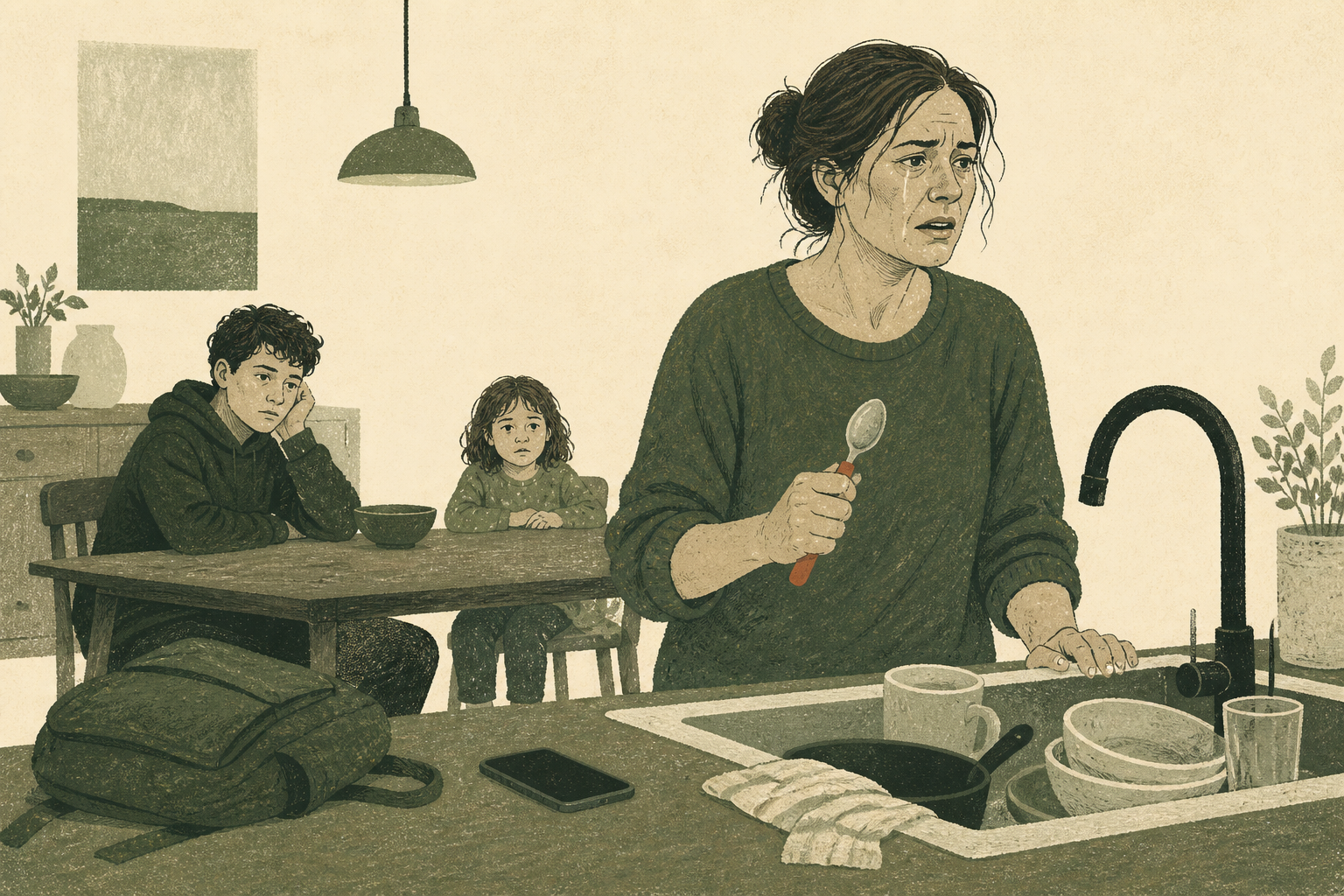
The reaction has already happened. That is the state most people are in when they search this phrase: the spoon has gone into the sink harder than a spoon should, the children have gone quiet, and the part of you that was watching from the ceiling is now back in your body, asking what on earth that was.
Our main piece on emotional dysregulation explains the mechanism, the reaction outsizing the trigger. This page answers the questions that come after, in the order people tend to ask them, with the research where there is research and a plain "we do not know" where there is not.
1. Is emotional dysregulation a disorder?
No. There is no diagnosis by that name in the DSM-5-TR. Emotional dysregulation is a feature, and it runs through a long list of conditions: ADHD, post-traumatic stress and its complex form, borderline personality disorder, depression, bipolar disorder, and some autistic profiles. It also runs through exhausted, overloaded adults with no diagnosis at all.
The closest thing to an official definition comes from a 2004 paper by Kim Gratz and Lizabeth Roemer, who built the most widely used questionnaire for it, the Difficulties in Emotion Regulation Scale. They broke it into six parts: not accepting your own emotional reactions, losing the thread of what you were doing when upset, losing control of impulses, not noticing emotions as they build, believing you have no strategies, and not being clear what you are feeling. You will notice that none of those is "feeling too much." The scale measures what happens around the feeling, and that is where the work is.
2. Why is this happening now? I was fine before.
Two possibilities, and they are not exclusive.
The first is load. Emotional regulation is a capacity, and capacity gets spent. Five hours of sleep, a parent in decline, a teenager, a job that follows you home, a body in perimenopause, chronic pain: each of these narrows the band in which you can feel something and still choose what to do about it. The spoon did not meet a system that was broken. It met one that had nothing left at six in the evening. We describe this band in the window of tolerance, and how to widen it in a six-week plan.
The second is that it was always there and you were compensating. Many women receive an ADHD diagnosis in their forties after a lifetime of holding it together at considerable cost, and the first thing to go when the cost becomes unpayable is often the emotional lid. If "I was fine before" means "I was working very hard to look fine before," the next question is for you.
3. Is it ADHD?
It might be part of ADHD, and the research has been catching up with what adults have been saying for years. A 2014 review by Philip Shaw and colleagues in the American Journal of Psychiatry argued that emotional dysregulation is a core feature of ADHD for a large share of adults who have it, not an optional extra, even though it does not appear in the official diagnostic criteria. If your reactions come fast, peak hard, and pass quickly, if rejection in particular lands like a blow, and if the rest of your life has the texture of someone managing attention by force, an assessment is worth having. We wrote about the rejection piece specifically in ADHD and rejection sensitivity. We are not the people to diagnose you, and neither is a questionnaire.
4. Is it my childhood?
It may be, and the most careful model of how that works is Marsha Linehan's biosocial theory, developed in the 1990s for people with the most severe form of this pattern. Her proposal was that dysregulation grows where two things meet: a nervous system that was emotionally sensitive from the start, and an environment that repeatedly treated the child's emotions as wrong, excessive, or inconvenient. A sensitive child in an invalidating house learns neither how to name feelings nor that feelings are allowed, and arrives in adulthood with a powerful engine and no dashboard.
Notice what the model does not say. It does not say sensitive children are doomed, or that every dysregulated adult had a bad childhood. It says the combination matters, and it puts the fault in the fit rather than in the child. If you recognise the house, that recognition is information, not a sentence.
5. What is actually happening when the reaction is bigger than the trigger?
James Gross, whose process model has organised the research on emotion regulation since 1998, describes regulation as something that can happen at five points along a chain: choosing the situation, changing the situation, shifting attention, changing how you interpret what is happening, and, last, clamping down on the response once it has started.
The important finding is that the earlier in the chain you intervene, the cheaper it is. Most exhausted adults regulate at the very last point, by suppression, which is the most expensive strategy there is: it costs energy, it leaves the feeling intact underneath, and when the reserve runs out it fails suddenly and completely. That is the spoon. It is not that you have no regulation. It is that all of it was stacked on the one point in the chain that gives out first.
6. What helps, according to the evidence?
Three things have evidence behind them, and one has common sense.
Skills, practised. Dialectical behaviour therapy, Linehan's treatment, teaches a specific set of emotion regulation and distress tolerance skills, and research from her group found that the amount people used the skills predicted how much they improved. The skills are learnable outside a full programme, and they mostly involve moving your regulation earlier in Gross's chain: naming the feeling while it is still small, changing the situation before it peaks, shifting attention on purpose.
The body, daily. Slow breathing at about six breaths a minute reliably settles the body while you do it, and a daily five-minute practice has been shown in a randomised trial to improve mood over a month. This is not a trick for the moment of the spoon. It is a baseline practice that gives the reaction less to work with.
Sleep, treated as a regulation tool rather than a luxury. No skill survives chronic sleep debt, and the most dysregulated week most people ever have is a week of bad nights.
And the common sense: earlier. Every strategy works better at the first flicker than at the peak. The whole art is noticing the flicker, which is why the practice in the next question starts with a name.
7. Why does it happen most with the people I love?
Because they are safe, which is the cruel part. A body that holds it together at work all day discharges where the consequences are lowest, and that is home. This is not a moral failing and it is not a hidden hatred of your family. It is where the suppression runs out.
There is a second mechanism. Two nervous systems in the same kitchen regulate each other, and they can also escalate each other, which is the loop we describe in co-regulation in relationships. Your spike meets your partner's spike, the children read both, and the room climbs. If the loudest version of this for you is with your children, mom rage is the specific page, and it is the most read thing we have published, which tells you how alone you are not.
8. What do I do in the moment?
A ninety-second sequence, practised in advance so it is available when you have no capacity to think.
Name it, in two words, out loud if you can: "I'm flooding." Naming moves regulation one step earlier in the chain and tells the people in the room what is happening without blaming them for it.
Move away. Not storming out, stepping out. "I'm going to the hall for a minute." Distance is the cheapest regulation there is, and it is the one most people skip because it feels like losing.
Exhale longer than you inhale, five times. Then press your hands flat against a wall, hard, for ten seconds, and let go. The body has been loading for a fight it is not going to have; give it somewhere to put the charge.
Look at three things in the hall and name them. This is orienting, and it tells the system the hall is an ordinary hall.
Come back. The coming back is not optional and it is the part that changes the house, which is the last question.
9. How do I repair afterwards?
The developmental psychologist Ed Tronick spent decades filming parents and infants and found that even attuned parents are out of sync with their babies a large share of the time. What predicted secure, resilient children was not the absence of rupture. It was repair: the reliable return. The same finding holds, as far as anyone can tell, for partners and for teenagers.
Repair is short. It is not an essay and it is not a confession. "I shouted about the spoon. That was too big for what happened, and it was not your fault. I'm sorry. I'm back." Then you are back, which means you do the next ordinary thing with them rather than withdrawing into guilt, because guilt that keeps you out of the room is a second rupture dressed as remorse.
Children who see repair learn that feelings are survivable and relationships are durable. That lesson is worth more than a childhood with no spoons in it, and no such childhood exists anyway.
Assess first, then choose the tool
If the pattern is mostly load, a narrowed capacity in an otherwise steady person, the work is sleep, daily body practice, and moving regulation earlier in the chain, and the Nervous System Regulation Workbook is the structured version: map which state the reaction came from, wired or flat, then use the tool that matches. If the pattern runs through a whole household, with two adults escalating each other and children reading both, the Co-Regulation Workbook is built for doing the work in pairs. If the reactions are fast, intense, and lifelong, and rejection lands like a physical blow, get an assessment before choosing anything, because the ADHD question changes the plan. And if there is a house in your history that treated your feelings as wrong, the skills above help, and a therapist trained in dialectical behaviour therapy or in trauma work helps more.
Sources
- Gratz, K. L., and Roemer, L. (2004). Multidimensional assessment of emotion regulation and dysregulation: development, factor structure, and initial validation of the Difficulties in Emotion Regulation Scale. Journal of Psychopathology and Behavioral Assessment, 26(1), 41-54. doi.org/10.1023/B:JOBA.0000007455.08539.94
- Gross, J. J. (1998). The emerging field of emotion regulation: an integrative review. Review of General Psychology, 2(3), 271-299.
- Shaw, P., Stringaris, A., Nigg, J., and Leibenluft, E. (2014). Emotion dysregulation in attention deficit hyperactivity disorder. American Journal of Psychiatry, 171(3), 276-293.
- Linehan, M. M. (1993). Cognitive-Behavioral Treatment of Borderline Personality Disorder. Guilford Press.
- Neacsiu, A. D., Rizvi, S. L., and Linehan, M. M. (2010). Dialectical behavior therapy skills use as a mediator and outcome of treatment for borderline personality disorder. Behaviour Research and Therapy, 48(9), 832-839.
- Tronick, E. Z. (1989). Emotions and emotional communication in infants. American Psychologist, 44(2), 112-119.
- Balban, M. Y., and colleagues (2023). Brief structured respiration practices enhance mood and reduce physiological arousal. Cell Reports Medicine, 4(1), 100895. doi.org/10.1016/j.xcrm.2022.100895
This article is educational and not a diagnosis or treatment. If reactions are frightening you or the people around you, or if the pattern is lifelong and intense, an assessment with a clinician is the right next step, and nothing here is meant to delay it.