


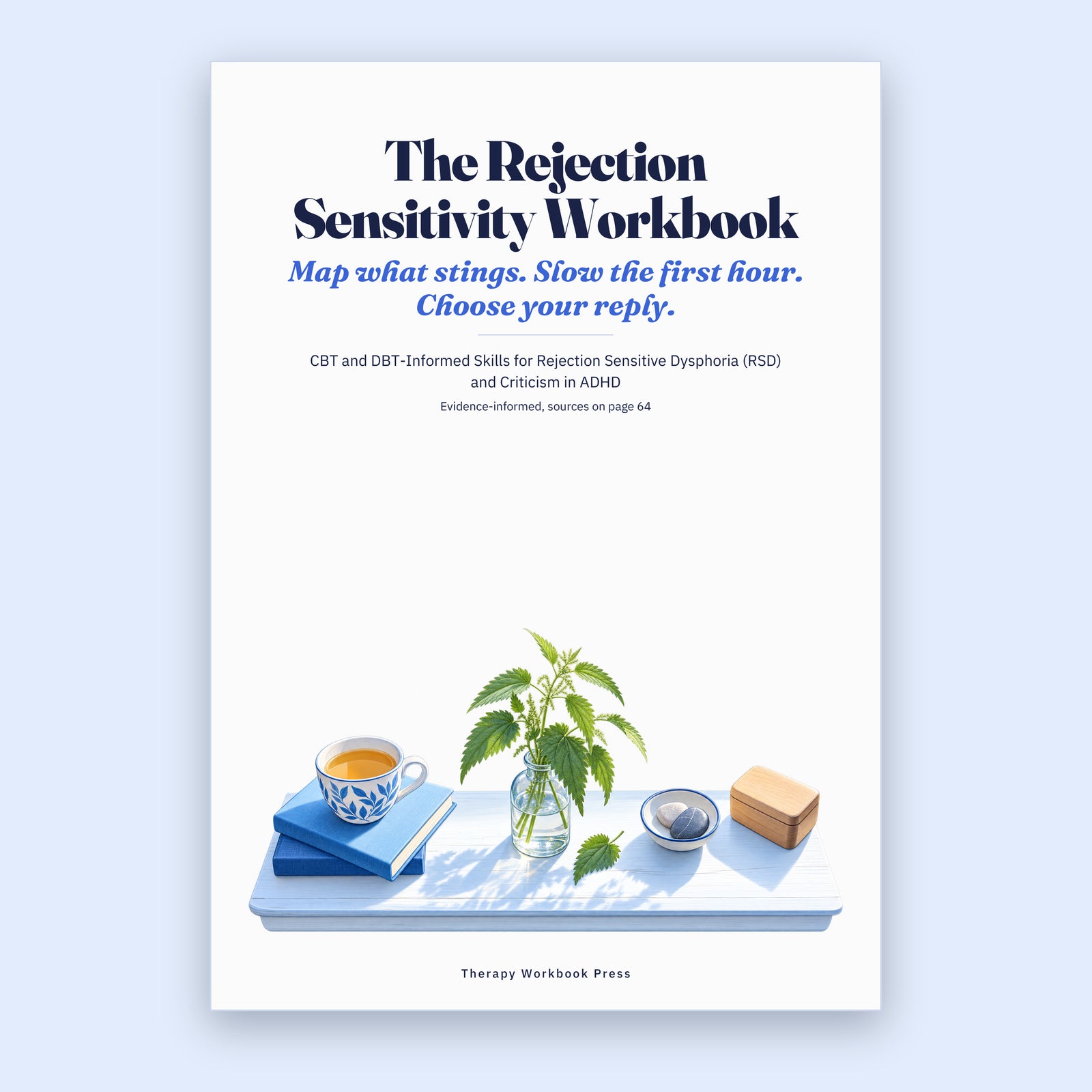








The Rejection Sensitivity Workbook: Map What Stings, Slow the First Hour, Choose Your Reply (68 Pages, PDF)
$21.49
Instant download. Your link arrives by email within minutes and also shows on your order page. Open it on any phone, tablet or computer, or print it at home.
60-Day Write-In-It Guarantee. Use every page. If it isn't worth it to you, email us within 60 days for a full refund. Writing in it never voids it.
“The message came ten minutes ago and I can’t think about anything else.”
That sentence is printed on page 2 of this workbook. Under it sits a page number: Back in the Room, page 14, then The Hour Test, page 15. Four more lines follow. A reply already typed, with a thumb over Send. A conversation on its ninth replay at 2 a.m. No answer since lunch, and a reason that feels certain. A snap an hour ago, and the urge to apologize six times. Each line points to one page.
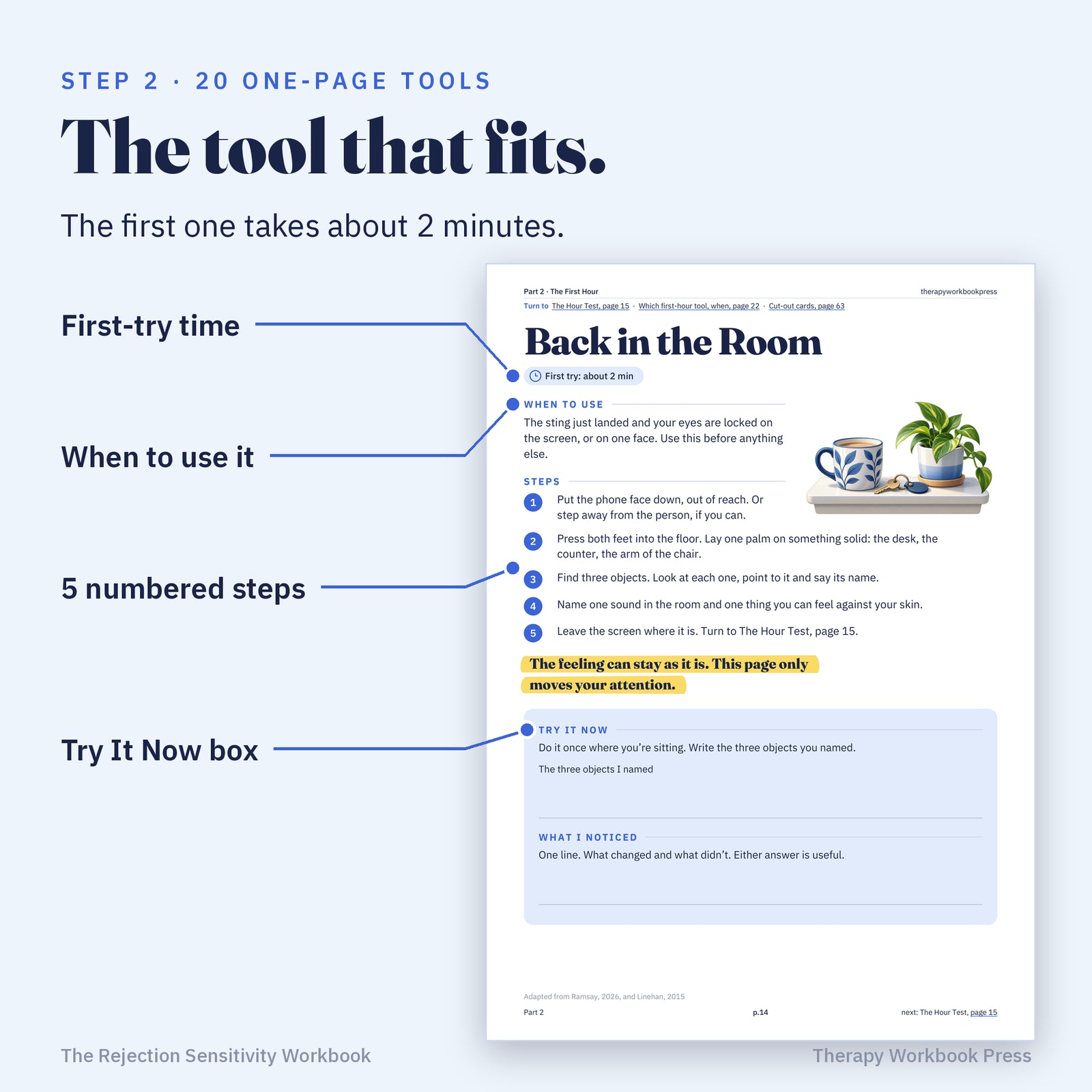
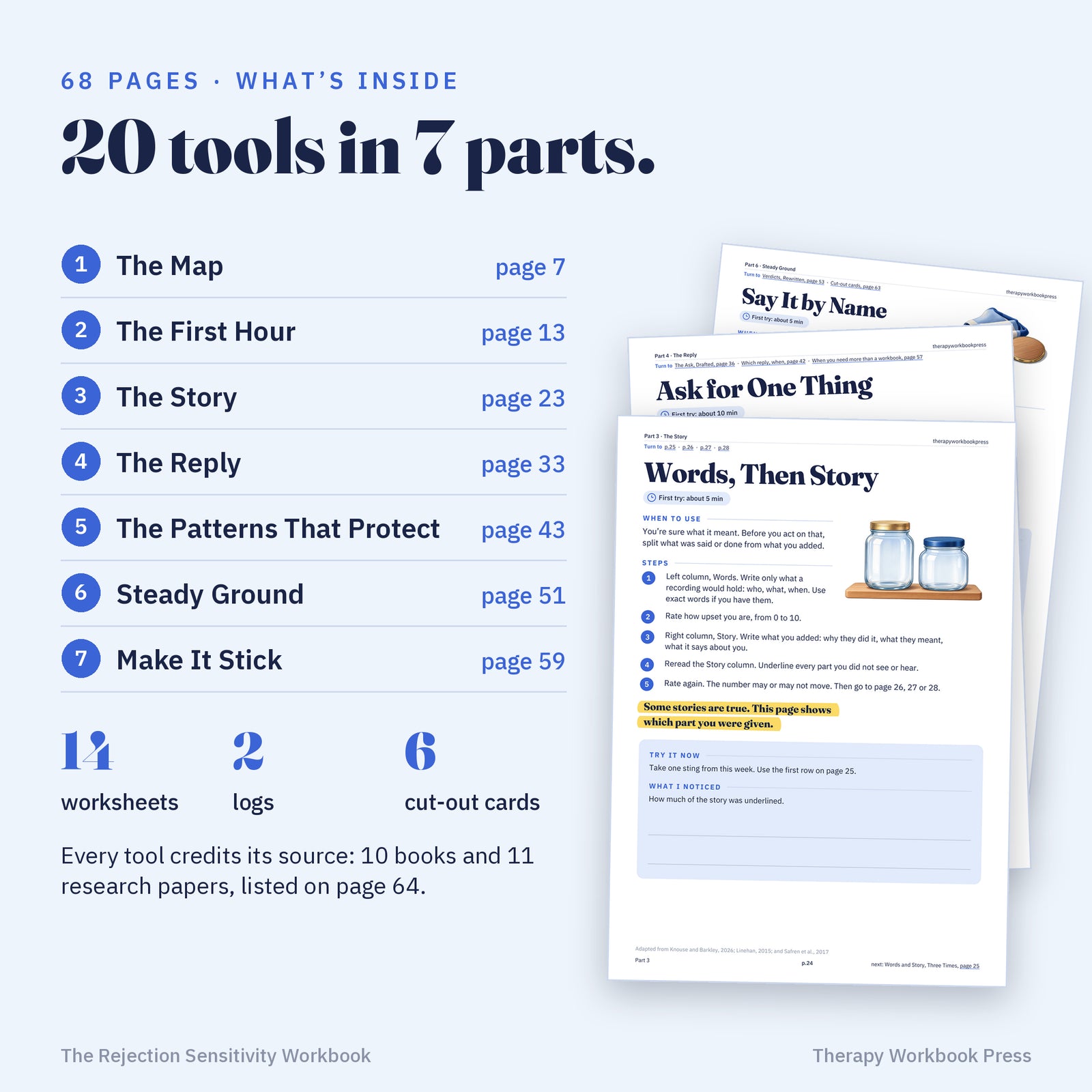
The Rejection Sensitivity Workbook is a 68-page printable PDF for adults that maps what stings first, then gives you the tool that fits that moment. It holds 20 tools, one page each. The shortest, Back in the Room, takes about 2 minutes to try.
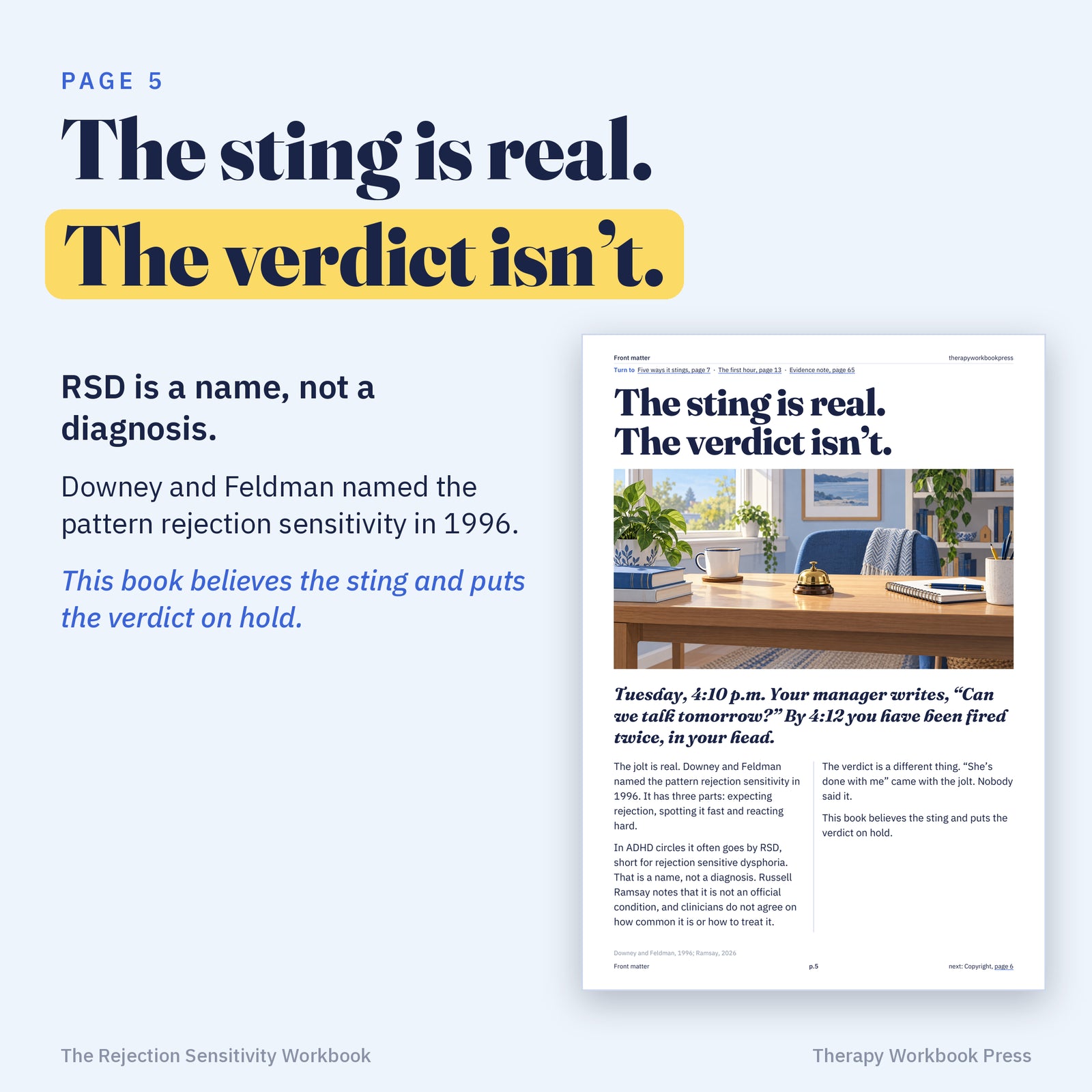
The sting is real. The verdict isn’t.
That is the title of page 5, and the page opens on a weekday afternoon: “Tuesday, 4:10 p.m. Your manager writes, ‘Can we talk tomorrow?’ By 4:12 you have been fired twice, in your head.”
The page takes both halves seriously. The jolt is real. Downey and Feldman named the pattern rejection sensitivity in 1996, and it has three parts: expecting rejection, spotting it fast and reacting hard. In ADHD circles the same jolt often goes by RSD, short for rejection sensitive dysphoria. That is a name, not a diagnosis. Russell Ramsay notes that it is not an official condition, and that clinicians do not agree on how common it is or how to treat it.
The verdict is something else. “She’s done with me” arrived with the jolt, and nobody said it. So the workbook believes the sting and puts the verdict on hold.
That is also why it makes no promise about the feeling itself. Psychologist Thomas Brown hears it from his patients, and Knouse and Barkley write it plainly: in adult ADHD, feelings often arrive fast and take over. Russell Ramsay is clear that skills may not touch that first flash. They work on what you do next. So the aim for the first hour, set out on page 13, is small and exact: send nothing, quit nothing, decide nothing about yourself.
How It Works: Map What Stings, Then Use the Tool That Fits
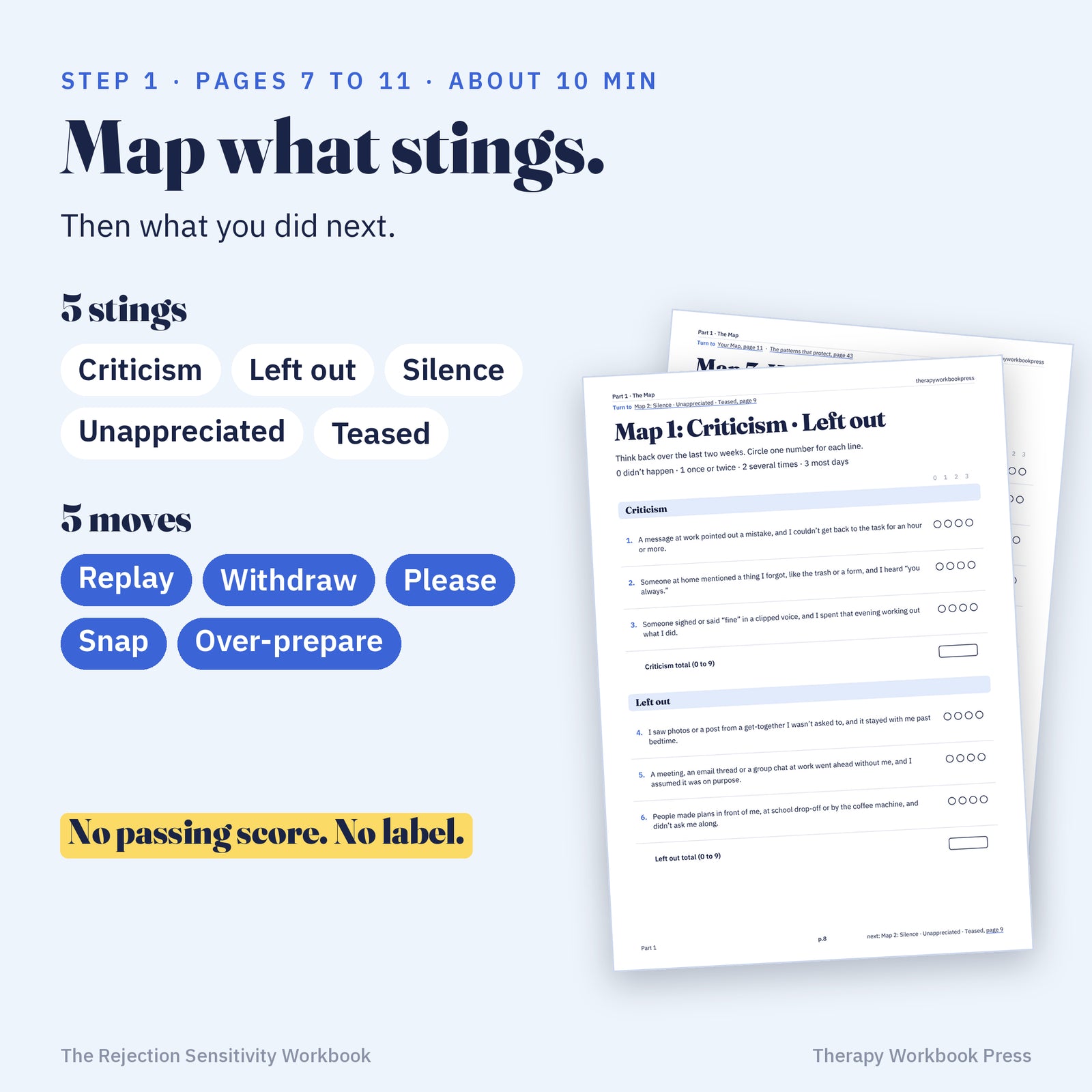
- Map what stings (pages 7 to 11, about 10 minutes). Think back over the last 2 weeks and circle 0 to 3 beside 15 short lines, 3 for each kind of sting: criticism, being left out, silence, being unappreciated and being teased. Line 8 reads: “My boss or a client hadn’t replied by the end of the day, and I decided it was bad news.” Then 5 more lines ask what you did next: replay, withdraw, please, snap or over-prepare. Last, you circle the sting and the move that cost you most. There is no passing score and no label at the end.
- Use the tool that fits. Page 12, Choose your start, matches each move to a first tool. Snap goes to The Holding Line on page 17. Replay goes to Words, Then Story on page 24. Withdraw goes to The Short Visit on page 45. Please goes to The Smaller Promise on page 44. Over-prepare goes to One Pass, Then Send on page 46. Each sting gets a reply to practice as well, such as The Follow-Up on page 41 for silence. No number sends you anywhere: the page asks you to start where it cost you most, and page 13 says one tool is enough to begin.
Every tool is one page with the same layout: when to use it, 5 numbered steps, a Try It Now box to write in, and a first-try time printed at the top, from about 2 minutes to about 12.
In a sting right now? Skip the Map. Quick Start on page 2 lists 5 situations, each with the one page to turn to, and tells you the rest of the book can wait.
What’s Inside: 20 Tools in 7 Parts
- Part 1, The Map (pages 7 to 12). The 20 lines across 3 pages, Your Map on page 11, and Choose your start on page 12.
- Part 2, The First Hour (pages 13 to 22). 5 tools for the hour after a sting: Back in the Room, The Hour Test, The Holding Line, The Unsent Draft and Let It Be Loud. Also the Sting Log on page 16, and a page for your own holding lines, written on a calm day.
- Part 3, The Story (pages 23 to 32). What was said, and what got added. 3 tools: Words, Then Story; A Fair Hearing; and Replay, Noted, for the conversation that keeps starting over at night. Plus 4 worksheets, including Three Other Meanings and The Mind-Reading Check, and a page for the times the story turns out to be true.
- Part 4, The Reply (pages 33 to 42). 6 tools for what to say back: Three Aims, Ask for One Thing, Three Answers, Take the Note, The Repair and The Follow-Up.
- Part 5, The Patterns That Protect (pages 43 to 50). Pleasing, pulling back, over-preparing and hiding, each with a smaller version to try: The Smaller Promise, The Short Visit, One Pass, Then Send, and One Person, One Fact.
- Part 6, Steady Ground (pages 51 to 58). How you talk to yourself after a sting: Say It by Name and Pick a Role, Do One Thing, plus What I bring and What Was Already Low, a check of sleep, meals and long days of people.
- Part 7, Make It Stick (pages 59 to 62). A 10-minute Weekly Review, a page for after a hard week, and the Map again at week 4.
- At the back (pages 63 to 68). 6 cut-out cards, the Sources page, an Evidence note and room for notes.
Every part ends on a single page that says which tool fits when, and page 62 puts the whole book on one page.
Counted from the file: 68 pages, 20 tools, 14 worksheets, 2 logs, 391 fillable fields and 6 cut-out cards.
Who It Is For, and Who It Is Not For
For: adults for whom a comment, a silence or a missing invitation lands harder than anyone can see, and who then replay it, pull back, say yes too fast, snap or recheck everything. The workbook was written from adult ADHD research and clinical books, and its examples come from ordinary weeks: a manager’s short email, a group chat gone quiet after your message, a family joke at the table.
Not for: anyone who needs a diagnosis or a treatment, because a workbook gives neither. Anyone looking for something to replace therapy or medication. And anyone who is afraid of someone at home: page 2 sends you to page 57 first, before any tool.
What it does not do: promise the sting will shrink. Page 4 says what it does instead: it gives you something to do while the feeling is loud.
If you need more than a workbook right now: If you’re thinking about ending your life or you’re not safe right now, call or text 988 in the US, 9-8-8 in Canada, or your local emergency number anywhere else. Do it now. In the US you can also chat at 988lifeline.org.
If you’re afraid of someone at home: in the US, call the National Domestic Violence Hotline at 1-800-799-7233 or text START to 88788. Anywhere else, call your local emergency number.
The Evidence, at Its Honest Size
Every tool page names its sources in a line at the foot of the page. Page 64 lists them all: 10 books and 11 research papers, each paper checked against its DOI record in October 2026.
What is known. Rejection sensitivity is a studied pattern. Downey and Feldman described it in 1996. In 2017, a review pooled 75 studies: higher rejection sensitivity went with more depression, anxiety and loneliness. Two studies of young people, 1,235 aged 10 to 19 and 391 aged 10 to 15, found that more ADHD symptoms went with more rejection sensitivity.
What is not known. Adults with ADHD have barely been studied on rejection sensitivity itself. The nearest work, a 2020 survey of 1,203 adults, found that those reporting an ADHD diagnosis described more criticism and less self-compassion.
Where the methods come from. The tools adapt four programs that were tested with therapists leading them, with 51 to 121 adults each. None of the four trials measured rejection sensitivity. In the largest, scores for managing emotions did not differ between the groups at 14 weeks. That is why no page promises a smaller sting. Every tool in the workbook is built on the methods those programs used.
Built on four CBT and DBT-informed programs tested in clinical trials with adults with ADHD. Sources on page 64. This workbook is not affiliated with or endorsed by any author it cites. Dialectical Behavior Therapy (DBT) was developed by Marsha M. Linehan. The DBT-informed pages are adaptations, and this workbook is not affiliated with her.
Format, Delivery and License
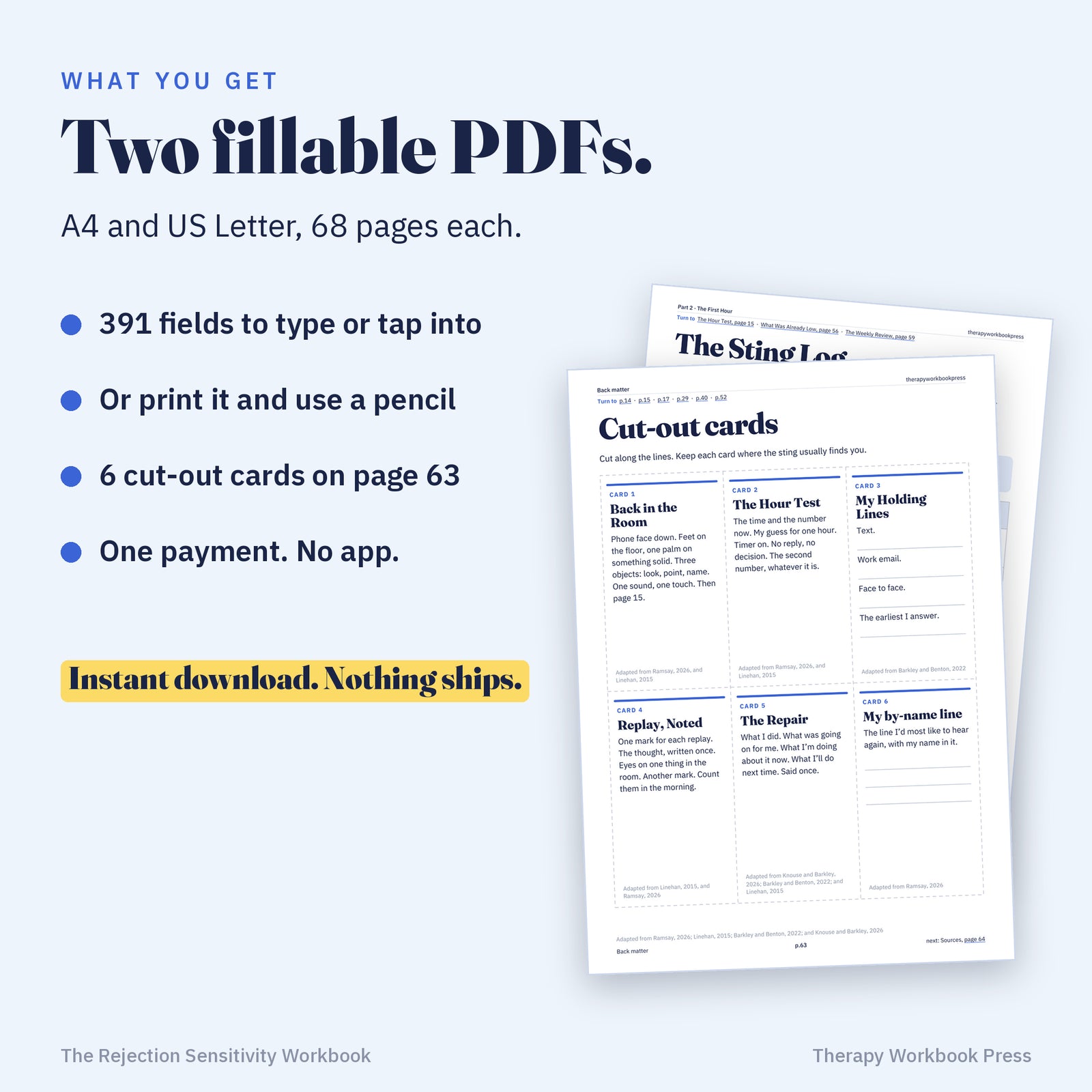
- Two fillable PDFs, 68 pages each: A4 and US Letter. Print the one that matches your paper.
- Fillable. 391 fields to type or tap into, from the Map’s circles to the Sting Log, in a PDF reader such as the free Adobe Acrobat Reader. Or print it and use a pencil, as page 4 suggests.
- 6 cut-out cards on page 63, for wherever a sting usually finds you: by the laptop, in the phone case.
- Instant download. The link arrives by email within minutes of purchase.
- Personal-use license. Print what you need for your own use. Clinician and group licenses: contact@therapyworkbookpress.com.
- One payment. No subscription and no app.
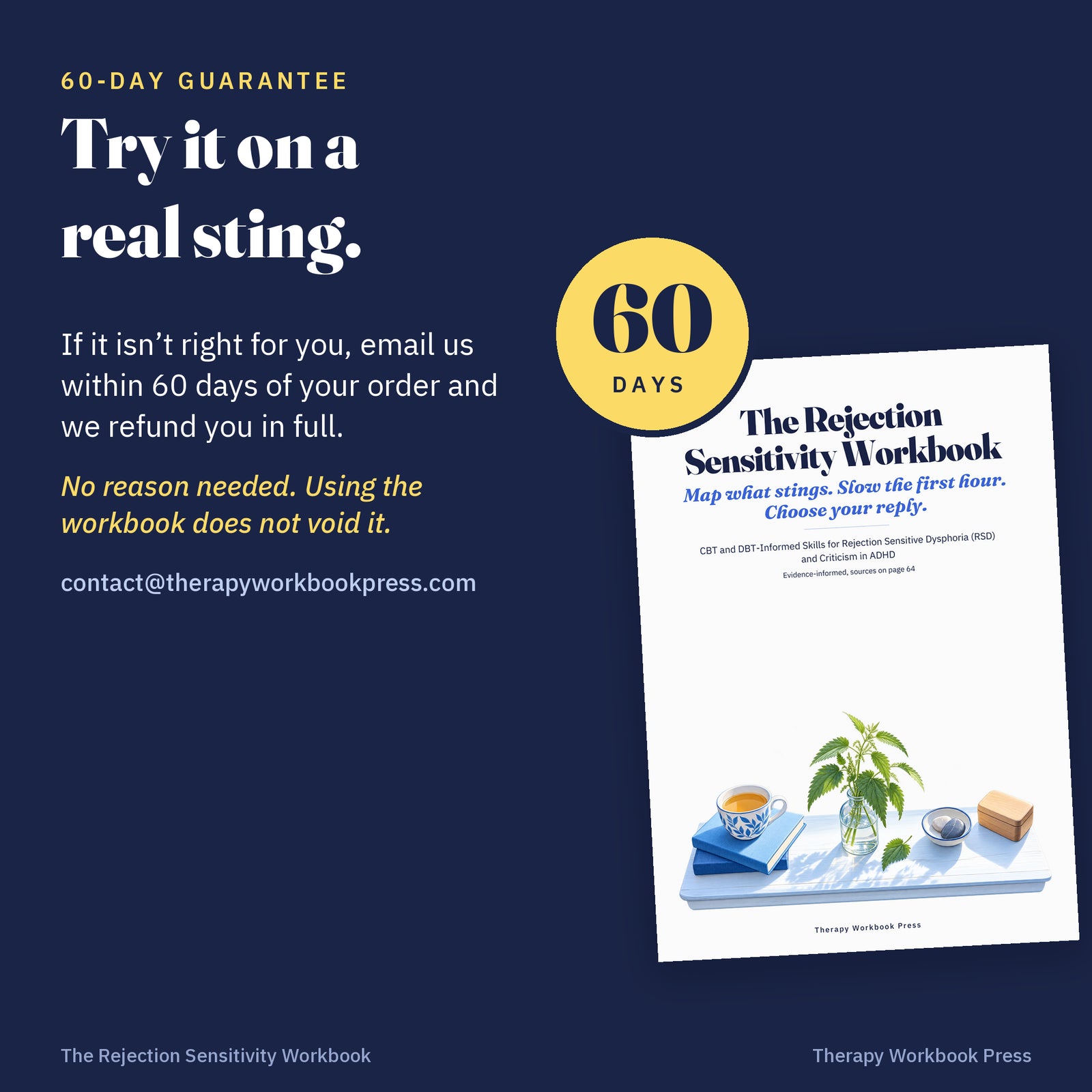
The 60-day guarantee. Fill in the Map. Try a first-hour tool on a real sting. Write on every page if you like. If the workbook isn’t right for you, email contact@therapyworkbookpress.com within 60 days of your order, include your order number, and we will refund you in full. No reason needed, and using the workbook does not void it.
Questions
Will working through this make me feel worse? The book plans for that. Page 4 says that if a page makes things feel worse, turn to page 57. Page 31, which asks where a verdict started, tells you to stop if it brings up more than you want to hold alone. And the Map gives no score and no label: page 12 calls each number two weeks of a life, not a grade.
Is RSD even real? The pattern is. Rejection sensitivity has been studied since Downey and Feldman named it in 1996. The name RSD is not an official diagnosis, and the workbook says so on pages 2 and 5. It treats the sting as real and the verdict that comes with it as something to check.
Do I need an ADHD diagnosis? No. The workbook does not ask for one and cannot give one. It was written from adult ADHD research, and the Map is a look at two weeks of your life, not a test.
Will the feeling go away? The workbook makes no promise about that. The tools work on what you do in the hour after a sting. Russell Ramsay points out that people tend to guess a bad feeling will last longer than it does. Yours may or may not, and The Hour Test on page 15 lets you find out: you write your guess for one hour later, then the real number, whatever it is.
How long does it take? About 10 minutes for the Map. Each tool prints its first-try time, from about 2 minutes to about 12. After that, the Weekly Review takes 10 minutes once a week, and page 61 asks you to score the Map again at week 4.
I’m in a sting right now. Where do I start? Page 2. Find the line closest to what is happening and turn to that page.
I’ve started workbooks before and stopped. Is this one different? No page needs the one before it. Quick Start sends you straight to one tool, and page 60, After a hard week, is written for the weeks you snapped, canceled and opened none of these pages.
What exactly do I receive? Two fillable PDFs, A4 and US Letter, 68 pages each, by email after checkout. Nothing ships.
Can I print it on US Letter? Yes. You get a US Letter edition as well as the A4 one.
Is this therapy? No. It is a place to practice skills. Page 57 lists the signs that it is time to talk to a clinician, and medication questions go to your prescriber.
Can I use it with my clients or my group? The standard license is for personal use. For a clinician or group license, email contact@therapyworkbookpress.com.
How does it fit with The ADHD Executive Dysfunction Workbook? This book grew out of one page in that one, The Sting. If the sting is one part of a bigger picture (starting, remembering, time, running on empty), page 66 points you there: The ADHD Executive Dysfunction Workbook.
Start with page 2. Find your line. The rest of the book can wait.