

Seasonal Depression Test: A Six-Question Check, Then a Two-Week Map
Key takeaways
- Seasonal affective disorder is a pattern, not a mood: a low that arrives in the same weeks each autumn and lifts by spring. In one trial a lamp did as well as an antidepressant for it.
- Three winter states look alike from the inside. A seasonal low. An end-of-year burnout. A shutdown that only happens to start in November. They want different tools.
- A quiz can't tell them apart. Two weeks of logging wake time, morning light, 3pm energy and evening pull usually can.
- Light and CBT for seasonal depression have the strongest trials for the seasonal pattern, and CBT held up better two winters later. None of it replaces a clinician if the low lasts.
It is 3pm in November and the toast is winning.
The second slice, not the first. The limbs have a wet-sand feeling they did not have in August. The lamp has been sitting in an online basket since Tuesday, and every seasonal depression test on the first page of Google asks the same question six different ways, then says to see a professional.
Fair enough. But it skips the thing that decides whether the lamp is money well spent. Three different winter states send people to that search box, and all three answer a quiz the same way. Only one of them is what the lamp was built for.
So this is a test in two parts. A six-question first pass, which takes a minute. Then a two-week map, which takes a minute a day and does what the quiz cannot.
What a seasonal depression test can tell you, and what it can't
Seasonal affective disorder is depression that comes back with the season. Most often it starts in late autumn and lifts in spring. Norman Rosenthal's group named it in 1984, in the same paper that tried the first light therapy on it. The manual clinicians use treats it as a "seasonal pattern" attached to a depression diagnosis, not a condition of its own. Somewhere between 1.5 and 9 people in every 100 fit the pattern, depending on how far from the equator they live.
The winter version has a shape people recognize once it is named. Sleeping more and waking tired anyway. A pull toward bread, pasta and sugar that summer did not have. A few pounds. Limbs that feel heavier than they are. Canceling things, then canceling the make-up plans.
Every seasonal affective disorder quiz online works from that list, and the careful ones do it well. What none of them can do is separate the seasonal pattern from its two lookalikes. Burnout answers "sleeping more than usual?" with a yes in December. So does a nervous system that powered down in July and has been coasting since. A quiz sorts. It does not see. For that, two weeks of your own numbers beat any score.
The six-question first pass
Answer in a minute. Keep count of the yeses.
- Does the low start in the same few weeks each autumn and lift by spring?
- Has that happened at least two years running?
- Sleeping more than usual, and still tired in the morning?
- Reaching for bread, pasta or sweets more than in summer?
- Does the dip follow the daylight (worse after the clocks go back) rather than a deadline, a loss, or a change at home?
- Does a bright morning outdoors make the afternoon noticeably better?
Five or six yeses: the pattern is closest to the seasonal one. Run the map anyway, and talk to a clinician, because that is the branch where the strongest tools are also the ones a prescriber should know about.
No to the first two, and the nights are wired rather than heavy: closer to burnout.
No to the last one, and the honest word for most days is flat or numb rather than sad: closer to a shutdown.
Mixed: the map decides. A first pass sorts. It does not diagnose, and neither does the rest of this page.
Three winter states that look the same from the inside
All three of these arrive with the dark, all three make mornings hard, and from inside any one of them the other two are invisible. They are also, not by accident, the three states our workbooks are sorted by.
| The seasonal low (the SAD pattern) | End-of-year burnout | A shutdown that started before the clocks went back | |
|---|---|---|---|
| When it started | Same weeks each autumn; lifts in spring | Builds with the workload; the date tracks deadlines, not daylight | Often before autumn; may follow a hard spring or summer |
| Sleep | More than usual, hard to wake, still tired | Short and wired; awake at 3am with a busy mind | Long or broken; unreachable either way |
| Appetite | Bread, pasta, sweets; a few pounds | Skipped meals, caffeine, lunch at the desk | Not much interest, or eating without noticing |
| Energy shape | Low mornings, a lift around midday, an early evening drop | Runs on adrenaline until it doesn't; crashes on weekends | Flat all day; small tasks feel enormous; numb more than sad |
| What helps | Bright morning light, a protected wake time, outside before 10am | Fewer inputs, rest that is not a screen, a hard stop on the day | Warmth, one safe person nearby, tiny movement, light with no task attached |
| What makes it worse | Dark mornings, sleeping in, staying in | More hours, pushing through | Being pushed; pressure to snap out of it; too much at once |
| What to call it | A recognized pattern (Rosenthal 1984; the DSM's seasonal pattern) | The WHO's word for work exhaustion (ICD-11). Not a diagnosis. | A polyvagal-informed description of a low-energy protective state. Not a diagnosis. |

The middle column is the one people miss, because burnout in December has a perfect alibi. Of course it is dark. Of course everyone is tired. Then the light comes back in March and the tiredness does not, because it was never about the light. If the burnout has an ADHD shape to it, that is its own article.
How do you tell if you have seasonal depression? Two weeks of your own data
Fourteen days. Five fields. Under a minute, ideally before the day forms an opinion.
- Wake time. The real one, not the alarm.
- Daylight before 10am. None, under 10 minutes, 10 to 30, or 30 and up. A window counts for a little. Outside counts for a lot.
- 3pm energy. One to five.
- Evening pull. Toward bed, toward a screen, or toward nothing at all.
- One word for the day. Whatever comes. Heavy. Wired. Fine. Nothing.
Print a page for it, use the back of an envelope, or use the tracker we built for exactly this. The columns matter more than the stationery.

At the end of two weeks, three shapes tend to show up.
The daylight line. Energy climbs on the mornings with 30 minutes of light and sinks on the ones with none. Wake time drifts later as the two weeks go on. The evening pull is toward bed. The words run heavy, slow, hungry. This is the shape closest to the seasonal pattern, and it is the one branch where the two best-studied tools, morning light and CBT for seasonal depression, have real trials behind them. If the first pass was mostly yeses, the log is worth more to a clinician than any quiz score.
The deadline line. Energy follows the calendar, not the light column. Sleep is short and ends with an alarm. The evening pull is toward a screen. The words run wired, behind, irritable, and the weekend crashes. This is closest to burnout. The tools are fewer inputs, a hard stop, and a minimum day (below). A workbook will not fix a job, and we would rather say that here than in a refund email.
The flat line. Energy sits at one or two no matter what the light or the workload did. Wake time is all over the place. The evening pull is toward nothing. The words run numb, far away, nothing. And it started before the clocks went back. This is closest to the shutdown branch, and if it has lasted more than a couple of weeks it deserves a clinician's eye, not a lamp.

This is educational self-reflection, not medical care, and it is not a reason to stop anything that is working for you.
Do SAD lamps work? What the trials found
For the seasonal pattern, yes, and better than most people expect. For the other two states there is no evidence at all, which is a different kind of answer.
A 2005 review pooled the light-therapy trials and found an effect in the range seen for antidepressants. Then a Canadian team tested it head to head. Ninety-six people with the winter pattern, eight weeks, a 10,000-lux box for 30 minutes on waking against 20mg of fluoxetine. Two thirds responded in both groups, 67 and 67. The light group was ahead after one week, then the two ran level.
The more interesting trial came from Vermont. Kelly Rohan's group took 177 people and gave half of them six weeks of a CBT built for winter and half the standard lamp. At six weeks they tied. Two winters later, 46 in 100 of the lamp group had had another episode. In the CBT group it was 27. Only three in ten of the lamp group were still switching it on. The lamp works while it is used. The skills stayed.
On prevention, the honest answer is a shrug. The Cochrane review of starting a lamp early to head off an episode found one trial, 46 people, and evidence too thin to lean on. Nobody has shown that switching on in October prevents anything.
What the trials actually did, since "get a lamp" leaves most of it out: 10,000 lux, about 30 minutes, soon after waking, at eye level, eyes open. Side effects were mild, mostly headache, eye strain, feeling wired. The trials screened for bipolar disorder and eye disease first. If either applies, or a medication raises light sensitivity, a prescriber comes before a purchase.
And the part the lamp box does not print: light does not remove a workload, and it does not reach a body that has powered down. It answers the daylight line and nothing else.
Seasonal depression tips that survive a dark morning
Not a list of twenty. Five. Two come from the light trials, two from the winter CBT trials, and one is ours.
A protected wake time, seven days a week. Light in the trials was timed from waking, which only works if waking has a time. Sleeping in on Saturday moves Monday, which is also why some mornings start with dread before anything has happened.
Light before 10am. Outside beats any lamp on a bright day, and even a gray morning outdoors is brighter than a lit kitchen. Twenty minutes, hands around a coffee, counts.
One social contact a week, booked in advance. The winter CBT trials scheduled activities, social ones included, on purpose, because withdrawal is the part of the pattern that grows when nobody interrupts it. On the calendar before the mood gets a vote. Borrowed steadiness counts.
November is not a verdict. In the follow-up analysis of the Vermont trial, the people who stopped treating winter as a sentence were the ones who stayed well two winters later. That is a change of belief, not a lamp, and it can be learned.
A minimum day. Three things that still count as a day at 20 percent capacity. Written in November, in advance, not chosen at 3pm through the fog. This is the one page of ours we would hand to anyone in any of the three states.


The first two are what the Sleep & Shutdown Workbook calls the 7-night baseline log and the morning-collapse protocol. The last one is the whole point of it.
When the body has already shut down

The flat line needs its own paragraph, because most winter advice makes it worse.
Deb Dana, whose clinical framework our somatic workbooks follow, describes this as a state of conservation: not enough energy moving through the system to run the usual regulation. Her guidance for it is the opposite of a pep talk. A gentle return of energy, not a big one, because too big a shift feels dangerous and pushes the system further away. Movement that can be tiny, or only imagined. Warmth. A real or imagined hand on the back. Her word for the small moments of okay, a patch of sun on the floor, the kettle, is glimmers, and the practice is to notice them rather than manufacture them.
That is polyvagal-informed language: a description, not a mechanism. What it gets right, in our experience, is the order of things. Light without a task attached. One safe person in the room. A step before a plan. Pressure reliably fails, and on the flat, foggy days people call functional freeze it fails hardest. The flat line sits below what Dan Siegel called the window of tolerance, the band where thinking and feeling both still work.

And the sentence that matters most: a shutdown that began in June is not seasonal. The map will show it, usually by day five. It deserves a clinician's eye, and the Nervous System Regulation Workbook's state check and low-state tools were built for the stretch between now and that appointment.
When to see someone
A low that has lasted more than two weeks. Hopelessness. Not managing the basics of a day. Any thoughts of self-harm. Any one of those means a clinician or a crisis line now, not a lamp and not a log. In the US, call or text 988. Elsewhere, the local emergency number or a national crisis line.
Workbooks for this state

We publish workbooks, not lamps, so here is where ours fit and where they don't.
- Sleep & Shutdown Workbook, $29.49, 52 pages. The 7-night baseline log, the morning-collapse protocol, and the hypersomnia pages. Built for the daylight line and the deadline line.
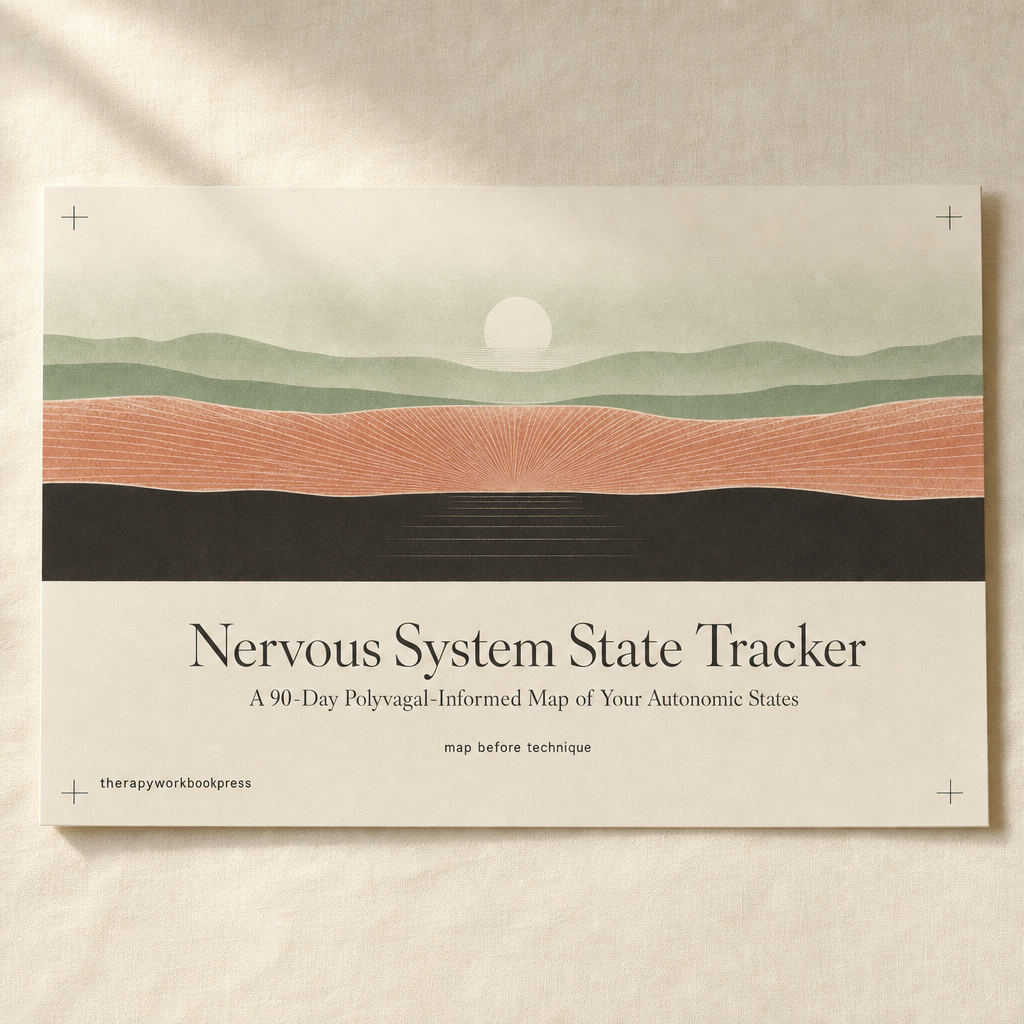
- Nervous System State Tracker, 90 days, $19.49. The two-week map, extended to a whole winter, so the log does not end on day 14.
- Nervous System Regulation Workbook, $29.49. The 60-second state check and the low-state tools for the flat line.
- Somatic Coping Cards, $24. Forty-eight cards sorted by state, for dark-morning starts when a page is too much.
- The Complete Somatic Nervous System Regulation Bundle, $37.49. All of the above in one file.
For the daylight line, the tools with the best trials behind them are morning light and CBT for seasonal depression. We sell neither. The tracker exists to show whether they are working.
Frequently asked questions
How do you tell if you have seasonal depression?
A quiz gives a score. A log gives a shape. Two weeks of wake time, morning light, 3pm energy and evening pull will usually show whether the low follows the daylight, the calendar, or neither. Then the log goes to a clinician, who is the only person who can actually diagnose it.
Is seasonal affective disorder the same as depression, or the winter blues?
Same family, different rules. The seasonal pattern is a full depressive episode that returns in the same season at least two years running and lifts when the season changes. Depression without the pattern has no spring lift and no rhythm. The winter blues is the milder tilt, with daily life still running.
Do SAD lamps work for everyone?
No. The trials behind light therapy were run on people with the winter pattern, where it did as well as an antidepressant. Nothing shows it helps burnout or a shutdown state. Bipolar disorder, eye disease, or light-sensitizing medication means a prescriber first.
Is CBT or a lamp better?
They tied at six weeks in the largest head-to-head trial. Two winters later, 27 percent of the CBT group had had another episode against 46 percent of the lamp group, mostly because people had stopped using the lamp. Light starts faster. The skills last longer. Plenty use both.
Can you have seasonal depression in summer?
Yes, and it is less common. The summer pattern tends to be the mirror image of the winter one: less sleep, less appetite, agitation rather than heaviness. Same rule, though. It returns with the season and lifts when the season ends.
Related on this site
Find your state first: the nervous-system states hub · Fight, flight, freeze, fawn · Window of tolerance · Freeze vs shutdown vs dissociation · Functional freeze · Signs of a dysregulated nervous system · The polyvagal chart · ADHD burnout · ADHD paralysis · Emotional dysregulation · Why do I wake up at 3am · Co-regulation · Chronic pain and the nervous system · Wired but tired · Why do I feel emotionally numb · Glimmers · Morning anxiety · High-functioning anxiety · How to widen your window of tolerance · Is polyvagal theory scientifically valid · How to calm down fast · The best anxiety workbooks, compared · All workbooks · About Therapy Workbook Press
Sources
- Rosenthal NE, Sack DA, Gillin JC, et al. Seasonal affective disorder: a description of the syndrome and preliminary findings with light therapy. Archives of General Psychiatry. 1984;41(1):72-80.
- Golden RN, Gaynes BN, Ekstrom RD, et al. The efficacy of light therapy in the treatment of mood disorders: a review and meta-analysis of the evidence. American Journal of Psychiatry. 2005;162(4):656-662.
- Lam RW, Levitt AJ, Levitan RD, et al. The Can-SAD study: a randomized controlled trial of the effectiveness of light therapy and fluoxetine in patients with winter seasonal affective disorder. American Journal of Psychiatry. 2006;163(5):805-812.
- Rohan KJ, Mahon JN, Evans M, et al. Randomized trial of cognitive-behavioral therapy versus light therapy for seasonal affective disorder: acute outcomes. American Journal of Psychiatry. 2015;172(9):862-869.
- Rohan KJ, Meyerhoff J, Ho SY, et al. Outcomes one and two winters following cognitive-behavioral therapy or light therapy for seasonal affective disorder. American Journal of Psychiatry. 2016;173(3):244-251.
- Rohan KJ, Burt KB, Norton RJ, et al. Change in seasonal beliefs mediates the durability advantage of cognitive-behavioral therapy over light therapy for winter depression. Behavior Therapy. 2023;54(4):682-695.
- Nussbaumer-Streit B, Forneris CA, Morgan LC, et al. Light therapy for preventing seasonal affective disorder. Cochrane Database of Systematic Reviews. 2019;3:CD011269.
- Terman M, Terman JS. Light therapy for seasonal and nonseasonal depression: efficacy, protocol, safety, and side effects. CNS Spectrums. 2005;10(8):647-663.
- Melrose S. Seasonal affective disorder: an overview of assessment and treatment approaches. Depression Research and Treatment. 2015.
- World Health Organization. Burn-out an "occupational phenomenon": International Classification of Diseases. 2019.
- National Institute of Mental Health. Seasonal affective disorder.
- Dana D. The Polyvagal Theory in Therapy: Engaging the Rhythm of Regulation. W. W. Norton, 2018. Chapter 6, the Regulating Resources Map.
Page images of our workbooks are rendered from the current files. Illustrations on this page are generated and reviewed by us, and none of them depict real people.